The Ordinary Retinol 0.2% vs 0.5% vs 1%: which step to use
Start with The Ordinary Retinol 0.2% in Squalane. Move to 0.5%, then 1%, only after your skin is comfortable. All three use the same water-free squalane base; the brand’s own tip is to climb this ladder rather than begin at the top.
Checked against brand ingredient lists on and against dermatology sources (American Academy of Dermatology, FDA, peer-reviewed studies). How we research · Editorial policy · 5 sources
Disclosure: PickedSkincare is reader-supported. Some “Check price” links are Amazon affiliate links. If you buy through them, we earn a commission at no extra cost to you. As an Amazon Associate, PickedSkincare earns from qualifying purchases. Commission never decides a pick, and we tell you when the cheaper bottle is the better buy. How we make money.
How this page was made: we compared what each brand publishes (actives, strengths, full ingredient lists, directions and prices) and checked the claims against dermatology guidance and published studies, all linked at the bottom. We opened The Ordinary’s official pages for Retinol 0.2%, 0.5% and 1% in Squalane on November 15, 2026, and compared the stated strengths, shared ingredient list, prices and use notes. We also read the AAD’s retinoid explainer and its skin-care-in-your-20s guide. Brand pages checked November 15, 2026; prices checked November 2026. We haven’t tested these products hands-on, we don’t score or rate them, and a commission never decides a pick. Our methodology.
Not medical advice. This page compares cosmetic products. If you have a skin condition, use prescription treatment, or are pregnant or breastfeeding, ask a dermatologist or your doctor before starting something new.
Short answer
Start with The Ordinary Retinol 0.2% in Squalane. Move to 0.5%, then 1%, only after your skin is comfortable. All three use the same water-free squalane base; the brand’s own tip is to climb this ladder rather than begin at the top.
Last updated Ingredient lists checked 2026-11-15Prices checked November 2026
The numbers side by side
| In brief | |
|---|---|
| The rule of thumb | Start with The Ordinary Retinol 0.2% in Squalane. Move to 0.5%, then 1%, only after your skin is comfortable. |
| Who should skip it | If you have never used a retinoid at all and want help choosing among formats (serum, cream, capsules, esters), use the beginners page first. This ladder is for people already looking at The Ordinary’s retinol-in-squalane bottles. |
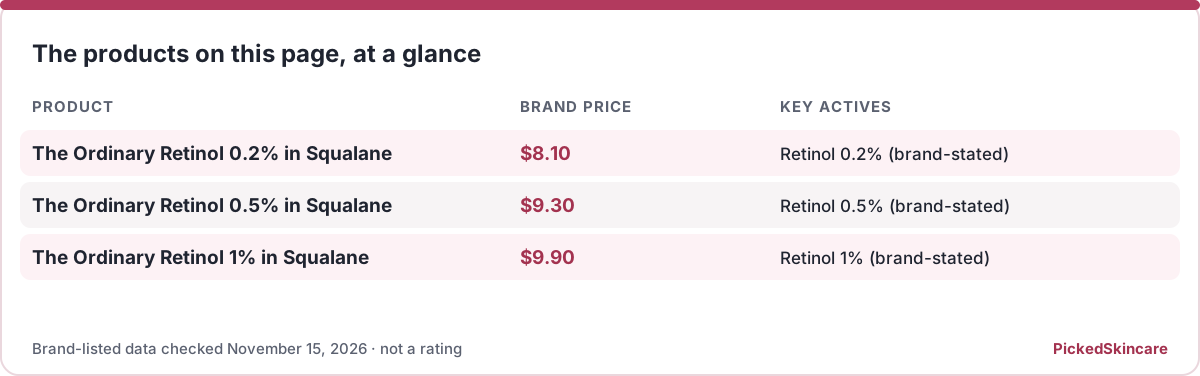
| Spending less | All three are inexpensive. The 0.2% is about $8.10, the 0.5% about $9.30, and the 1% about $9.90, each for 30 ml (checked November 15, 2026). |
This page is only about The Ordinary’s three retinol-in-squalane serums. It is not a first-retinoid shopping list across brands; for that, see best retinol for beginners. The question here is simpler: once you have chosen this formula family, which percentage do you actually use?
What’s in each bottle?
Copied from each brand’s own product page (or the sunscreen’s Drug Facts) on November 15, 2026. Brands reformulate, so the carton in your hand is the final word.
The Ordinary Retinol 0.2% in Squalane
- Key actives
- Retinol 0.2% (brand-stated)
- Base
- Water-free squalane and plant-oil base
- Brand price
- $8.10 · 30 ml
- Brand notes
- Brand says to start here before 0.5% and 1%, refrigerate after opening and use within three months; avoid when pregnant or breastfeeding.
Full ingredient list
Squalane, Caprylic/Capric Triglyceride, Simmondsia Chinensis (Jojoba) Seed Oil, Retinol, Solanum Lycopersicum (Tomato) Fruit Extract, Rosmarinus Officinalis (Rosemary) Leaf Extract, Hydroxymethoxyphenyl Decanone, BHT.
The Ordinary product page · Check price on Amazon (opens in a new tab)
The Ordinary Retinol 0.5% in Squalane
- Key actives
- Retinol 0.5% (brand-stated)
- Base
- Water-free squalane and plant-oil base
- Brand price
- $9.30 · 30 ml
Full ingredient list
Squalane, Caprylic/Capric Triglyceride, Simmondsia Chinensis (Jojoba) Seed Oil, Retinol, Solanum Lycopersicum (Tomato) Fruit Extract, Rosmarinus Officinalis (Rosemary) Leaf Extract, Hydroxymethoxyphenyl Decanone, BHT.
The Ordinary product page · Check price on Amazon (opens in a new tab)
The Ordinary Retinol 1% in Squalane
- Key actives
- Retinol 1% (brand-stated)
- Base
- Water-free squalane and plant-oil base
- Brand price
- $9.90 · 30 ml
- Brand notes
- Brand recommends working up from 0.2% and 0.5%; refrigerate after opening, use within three months; avoid when pregnant or breastfeeding.
Full ingredient list
Squalane, Caprylic/Capric Triglyceride, Simmondsia Chinensis (Jojoba) Seed Oil, Retinol, Solanum Lycopersicum (Tomato) Fruit Extract, Rosmarinus Officinalis (Rosemary) Leaf Extract, Hydroxymethoxyphenyl Decanone, BHT.
The Ordinary product page · Check price on Amazon (opens in a new tab)
What is the difference between 0.2%, 0.5% and 1%?
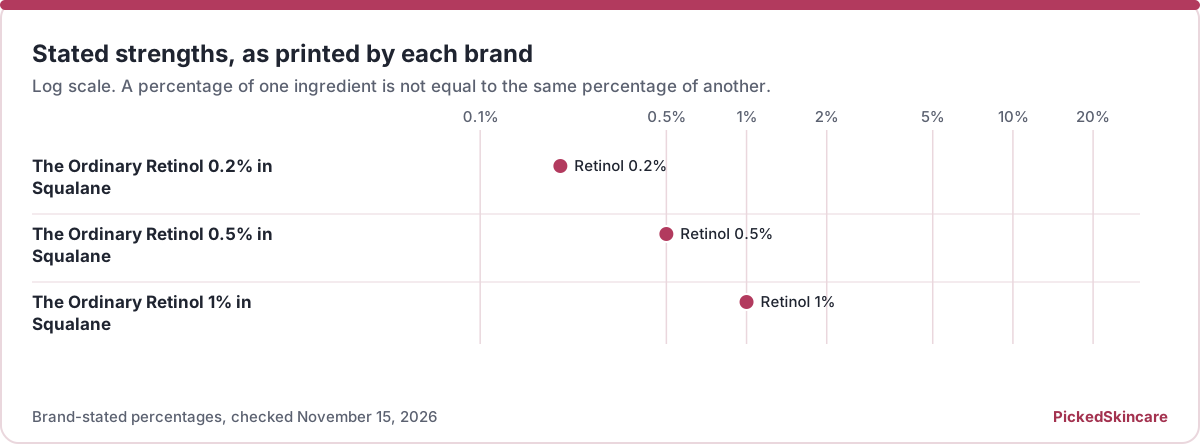
The ingredient lists are the same: squalane, caprylic/capric triglyceride, jojoba oil, retinol, tomato fruit extract, rosemary leaf extract, hydroxymethoxyphenyl decanone and BHT. The brand’s stated retinol strength is the only formula difference we could read.
| Serum | Brand’s label | Price for 30 ml |
|---|---|---|
| Retinol 0.2% in Squalane | Mild / entry-level, for general signs of aging | $8.10 |
| Retinol 0.5% in Squalane | Moderate / intermediate | $9.30 |
| Retinol 1% in Squalane | High-strength / expert-level, for fine lines and texture | $9.90 |
The Ordinary’s tip on all three pages is to start with 0.2% and slowly work up to 0.5% and then 1%. If you are prone to sensitivity, the same tip points you toward its Granactive Retinoid 2% Emulsion instead of climbing this retinol ladder.
How should you use these serums?
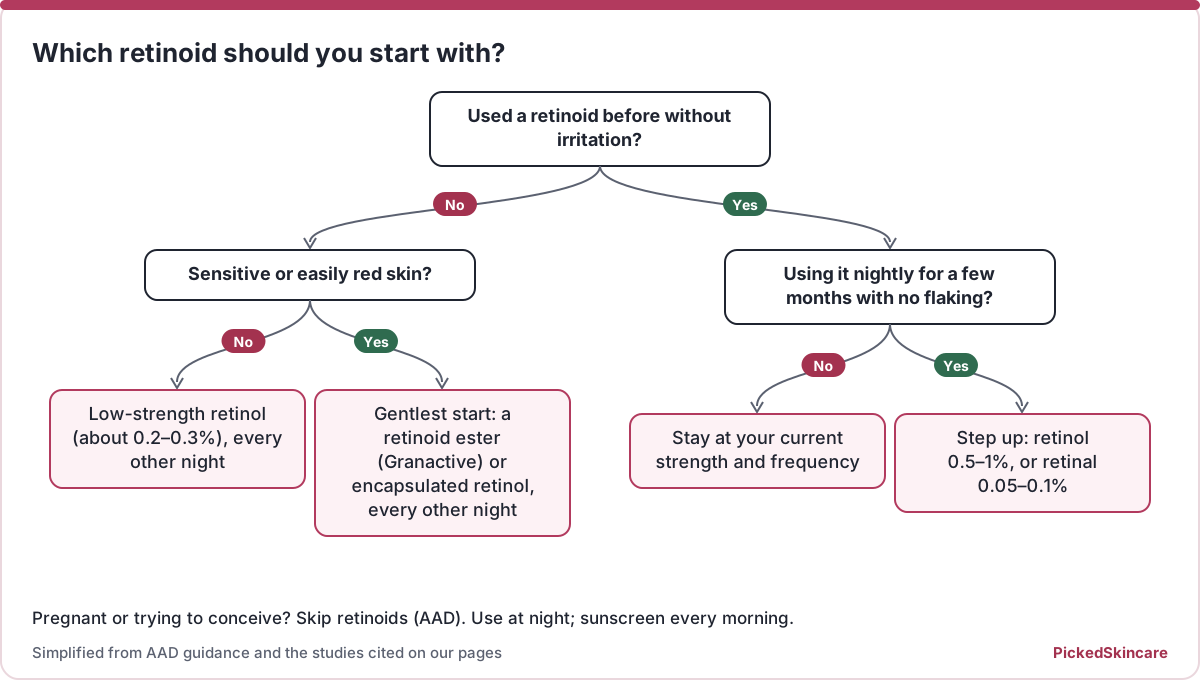
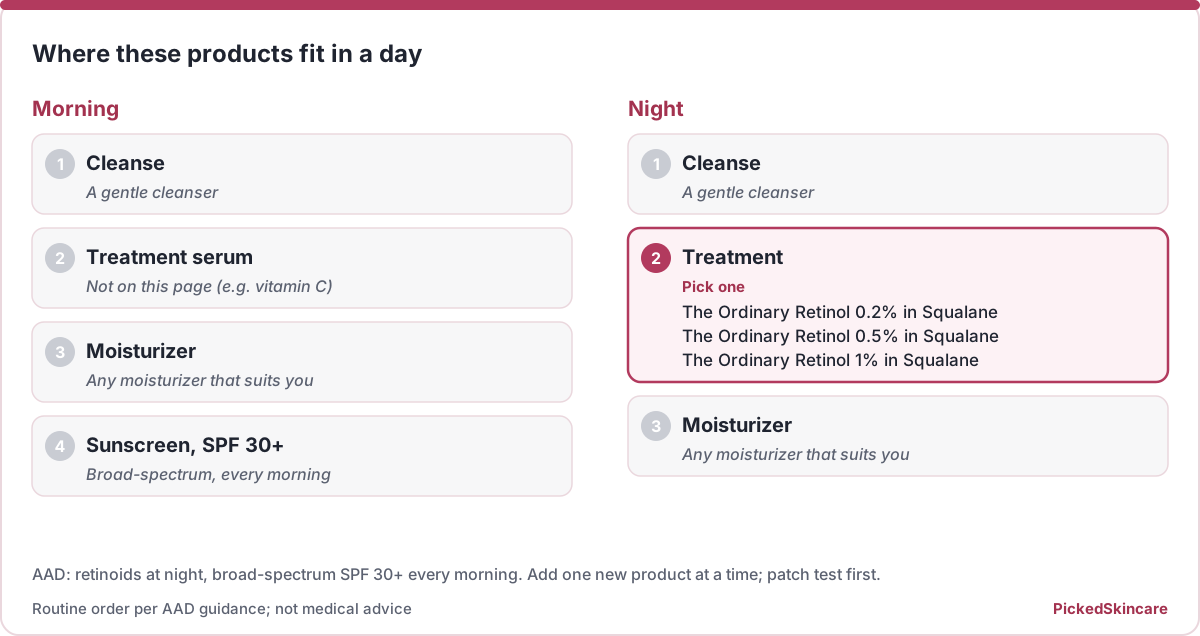
Directions are the same on each page: apply a few drops to the face in the evening, do not use with other retinoid products, and use sun protection during the day. The brand warns that retinol can cause irritation, redness and peeling. After opening, refrigerate the bottle and finish it within three months. The AAD’s[4][5] advice for a first retinoid matches the slow start: use the lowest strength you can find, every other night at first, at night only, with moisturizer and daily sunscreen. Its 20s skin-care guide suggests moisturizer first, then the retinoid 20 to 30 minutes later.
When should you move up a step?
Stay on 0.2% until your skin is comfortable on a nightly or near-nightly cadence without lingering redness or peeling. The 0.5% is the intermediate step, not a skip-ahead for first-time users. The 1% is the expert-level option in this family; there is no reason to start there, and the price difference is small enough that buying the strongest bottle “to get it over with” is a poor trade.
Who should skip it?
If you have never used a retinoid at all and want help choosing among formats (serum, cream, capsules, esters), use the beginners page first. This ladder is for people already looking at The Ordinary’s retinol-in-squalane bottles.
- Anyone pregnant, trying to conceive or breastfeeding: The AAD[4][5] says retinoids should not be used during pregnancy, and The Ordinary tells pregnant and breastfeeding users to avoid products with retinol. Consider instead: ask your doctor; niacinamide is a common non-retinoid option brands suggest.
- Rosacea-prone or very red, inflamed skin: AAD[4][5] dermatologists advise avoiding retinoids and asking about other care instead.
- First-time users starting at 0.5% or 1%: The Ordinary itself tells you to start at 0.2% in this family, or to consider a different retinoid technology if you are prone to sensitivity. Consider instead: Retinol 0.2% in Squalane, or the beginners guide if you want a different format.
- Anyone already using another retinoid: The Ordinary says not to use these serums with other retinoid products.
How can you spend less?
All three are inexpensive. The 0.2% is about $8.10, the 0.5% about $9.30, and the 1% about $9.90, each for 30 ml (checked November 15, 2026). Start with the 0.2%; buying the 1% first does not save meaningful money and raises the chance you will have to stop.
What should you know before you start?
- Patch test first. The American Academy of Dermatology suggests applying a new product to a quarter-sized area twice a day for 7 to 10 days and stopping if you react. AAD: how to test skin care products.
- Add one new product at a time, and give it time: the AAD says many anti-aging products take 6 weeks to 3 months to show results. AAD: get the most from anti-aging products.
- Retinoids: the AAD says to apply them at night, wear sunscreen daily, start with the lowest strength every other night, and that retinoids should not be used during pregnancy. AAD: retinoid or retinol?
What do people ask most?
Should I start with The Ordinary Retinol 0.2%?
Is 1% twice as effective as 0.5%?
Why do I have to refrigerate them?
Can I use this retinol with vitamin C?
Can I use more than one of these at once?
Where this comes from
We opened and read every source below for this page. Ingredient lists, strengths, directions and prices come from each brand’s own product page; health and usage guidance comes from the American Academy of Dermatology, the FDA, the National Eczema Association and peer-reviewed studies (via PubMed). Prices checked: November 2026; confirm on the seller’s site before you buy.
- The Ordinary (brand page): The Ordinary Retinol 0.2% in Squalane (theordinary.com)
- The Ordinary (brand page): The Ordinary Retinol 0.5% in Squalane (theordinary.com)
- The Ordinary (brand page): The Ordinary Retinol 1% in Squalane (theordinary.com)
- AAD: Retinoid or retinol? (aad.org)
- AAD: Dermatologist-recommended skin care for your 20s (aad.org)
Related
Using an acid with retinol: same night, or skip it
Do not put a leave-on acid and a retinol on the same night when you are starting either one. Use retinol on its nights and the acid on different nights, or use only one of them. The Ordinary tells you not to combine its salicylic acid with retinoids. Its glycolic toner stays out of the same routine as strong retinoids. Anyone pregnant should skip the retinol entirely.
guideAdapalene gel vs a cosmetic retinol: which label are you buying?
Buy an OTC adapalene 0.1% gel if you want the drug label. Buy The Ordinary Retinol 0.2% in Squalane if you want a cosmetic retinol with a stated 0.2%. They are not the same ingredient. Effaclar’s brand page did not load, so this page uses DailyMed and does not state an Effaclar price.
guideGlycolic vs lactic vs salicylic acid: which leave-on should you buy?
Choose glycolic 7% for a watery toner whose description says about pH 3.6. Choose lactic acid 5% if you want the milder AHA serum, or 10% if 5% has been comfortable. Choose a 2% salicylic acid leave-on if you want a BHA instead of an AHA. Do not start with all of them.
best ofThe best first retinol for your skin type
Your first retinoid should be low strength, used every other night, and match your skin type. Here are four starting points, from a budget stated-strength retinol to single-dose capsules, and who should skip each.
guideRetinol vs retinal: which one should you start with?
Short answer: start with a low-strength retinol if you have never used a retinoid; move to retinal once your skin handles retinol without flaking. Retinal sits one conversion step closer to retinoic acid, so a smaller percentage does more.
comparisonThe Ordinary Granactive Retinoid 2% Emulsion vs Retinol 0.2% in Squalane
These are the two products The Ordinary itself points beginners to. Granactive Retinoid 2% is a creamy emulsion built around a retinoid ester (hydroxypinacolone retinoate) plus some retinol; Retinol 0.2% is plain retinol in squalane and jojoba oil.
comparisonThe Ordinary Retinol 1% vs Paula’s Choice CLINICAL 1% Retinol
Both brands state 1% retinol. The Ordinary puts it in a short, water-free oil base; Paula’s Choice puts it in a lotion with peptides, a vitamin C derivative and soothing extracts. Neither is a starting strength.
guideCan you use niacinamide with vitamin C or retinol?
Short answer: niacinamide with retinol is widely accepted; even Paula’s Choice says they pair well. Niacinamide with vitamin C is where brands disagree, so the simple default is vitamin C in the morning and niacinamide or retinol at night.
best ofThe best moisturizer to use with retinol, by need
You do not need a special “retinol moisturizer.” You need a bland cream or lotion you will actually use at night, and sunscreen in the morning. Here are three official-formula options: a night lotion with niacinamide, a short-list cream, and a ceramide cream labeled for morning and evening — plus who should skip each.
comparisonPaula’s Choice 2% BHA Liquid vs The Ordinary Salicylic Acid 2% Solution
Both bottles state 2% salicylic acid. Pick The Ordinary if you want a 30 ml solution with a short list and a brand rule against other acids, retinoids, and peptides. Drug Facts: a thin layer one to three times daily, starting once daily. The brand’s FAQ says once daily in the PM, after cleansing and before moisturizer. Pick Paula’s Choice if you want a 4 fl oz leave-on you can use morning or night, and you will add sunscreen whenever you use it in the day.