Using an acid with retinol: same night, or skip it
Do not put a leave-on acid and a retinol on the same night when you are starting either one. Use retinol on its nights and the acid on different nights, or use only one of them. The Ordinary tells you not to combine its salicylic acid with retinoids. Its glycolic toner stays out of the same routine as strong retinoids. Anyone pregnant should skip the retinol entirely.
Checked against brand ingredient lists on and against dermatology sources (American Academy of Dermatology, FDA, peer-reviewed studies). How we research · Editorial policy · 8 sources
Disclosure: PickedSkincare is reader-supported. Some “Check price” links are Amazon affiliate links. If you buy through them, we earn a commission at no extra cost to you. As an Amazon Associate, PickedSkincare earns from qualifying purchases. Commission never decides a pick, and we tell you when the cheaper bottle is the better buy. How we make money.
How this page was made: we compared what each brand publishes (actives, strengths, full ingredient lists, directions and prices) and checked the claims against dermatology guidance and published studies, all linked at the bottom. On November 19, 2026 The Ordinary glycolic toner, salicylic acid 2% solution, and retinol 0.2% in squalane were read. Retinol 0.2% was $8.10 and out of stock. Paula’s Choice 2% BHA returned a page shell: the JSON-LD price was $37 and in stock, and the FAQ schema was read. That response did not include the ingredient list or a size, so this page does not reprint them. The AAD retinoid page, the AAD 20s page, and the AAD patch-test page were read the same day. A request for an older FDA alpha-hydroxy-acid URL returned HTTP 404 and is not cited. Brand pages checked November 19, 2026; prices checked November 19, 2026. We haven’t tested these products hands-on, we don’t score or rate them, and a commission never decides a pick. Our methodology.
Not medical advice. This page compares cosmetic products. If you have a skin condition, use prescription treatment, or are pregnant or breastfeeding, ask a dermatologist or your doctor before starting something new.
Short answer
Do not start a leave-on acid and a retinol on the same night. The Ordinary says not to use its glycolic toner with strong retinoids in the same routine, and not to use its salicylic acid with retinoids at all. Use retinol every other night at first, only at night, and wear sunscreen in the day. Skip retinoids in pregnancy.
Last updated Ingredient lists checked 2026-11-19Prices checked November 19, 2026
The numbers side by side
| In brief | |
|---|---|
| The rule of thumb | Do not put a leave-on acid and a retinol on the same night when you are starting either one. Use retinol on its nights and the acid on different nights, or use only one of them. |
| Who should skip it | If you are not using a retinoid, you do not need an “acid with retinol” plan. Use one leave-on you tolerate, or none. Most people do not need both families in the same month. |
| Spending less | You may not need both. The Ordinary Retinol 0.2% in Squalane is about $8.10 for 30 ml (checked November 19, 2026), and that size was out of stock the same day. |
The acid family choice is glycolic vs lactic vs salicylic. The beginner retinoid choice is the first retinol. This page is only the calendar: which of these bottles, which nights, and who should not build that calendar at all.
What’s in each bottle?
Copied from each brand’s own product page (or the sunscreen’s Drug Facts) on November 19, 2026. Brands reformulate, so the carton in your hand is the final word.
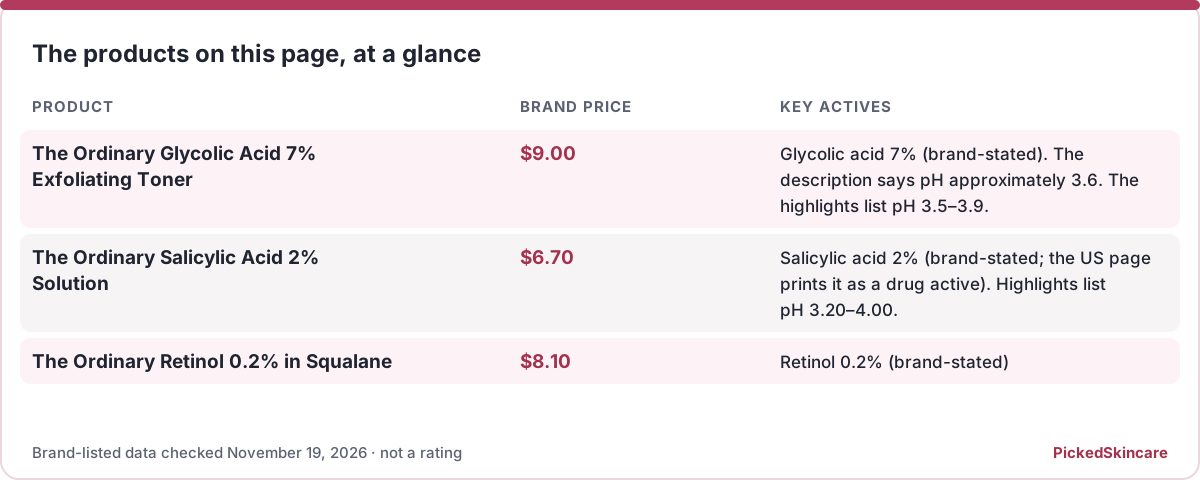
The Ordinary Glycolic Acid 7% Exfoliating Toner
- Key actives
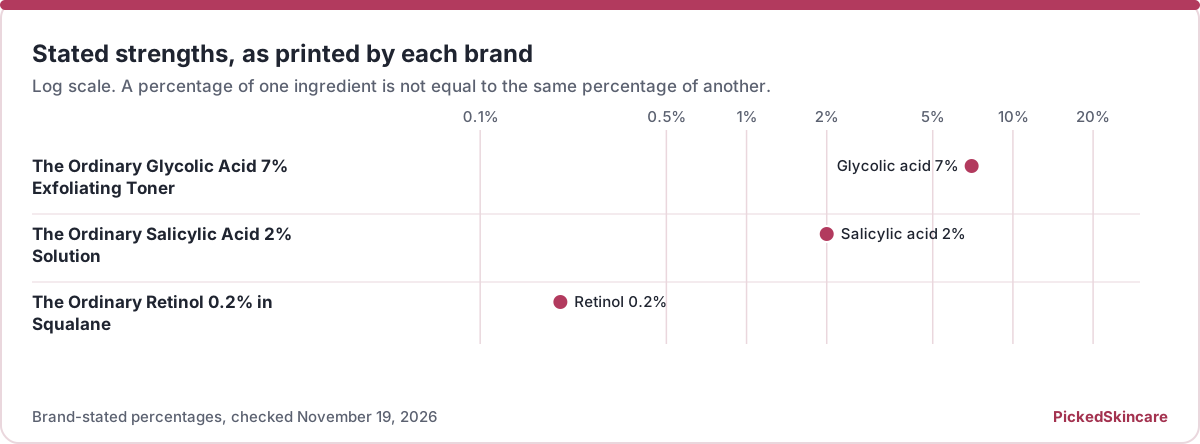
- Glycolic acid 7% (brand-stated). The description says pH approximately 3.6. The highlights list pH 3.5–3.9.
- Base
- Water-based toner with rose water, cornflower water, aloe water and glycerin. Highlights: alcohol-free, oil-free, silicone-free. Not water-free.
- Brand price
- $9.00 · 100 ml in stock. A 240 ml size is listed; its price was not on the page.
- Brand notes
- Brand: do not use on sensitive, peeling or compromised skin. Do not use with other direct acids or strong retinoids in the same routine. Sunburn alert: this AHA may increase sun sensitivity; use sunscreen, wear protective clothing and limit sun while using it and for a week afterwards. Apply once daily, ideally in the evening.
Full ingredient list
Aqua (Water), Glycolic Acid, Rosa Damascena Flower Water, Centaurea Cyanus Flower Water, Aloe Barbadensis Leaf Water, Propanediol, Glycerin, Triethanolamine, Aminomethyl Propanol, Panax Ginseng Root Extract, Tasmannia Lanceolata Fruit/Leaf Extract, Aspartic Acid, Alanine, Glycine, Serine, Valine, Isoleucine, Proline, Threonine, Histidine, Phenylalanine, Glutamic Acid, Arginine, PCA, Sodium PCA, Sodium Lactate, Fructose, Glucose, Sucrose, Urea, Hexyl Nicotinate, Dextrin, Citric Acid, Polysorbate 20, Gellan Gum, Trisodium Ethylenediamine Disuccinate, Sodium Chloride, Hexylene Glycol, Potassium Sorbate, Sodium Benzoate, 1,2-Hexanediol, Caprylyl Glycol.
The Ordinary product page · Check price on Amazon (opens in a new tab)
The Ordinary Salicylic Acid 2% Solution
- Key actives
- Salicylic acid 2% (brand-stated; the US page prints it as a drug active). Highlights list pH 3.20–4.00.
- Base
- Water-based solution. Brand highlights: alcohol-free, oil-free, silicone-free.
- Brand price
- $6.70 · 30 ml
- Brand notes
- Drug Facts: a thin layer one to three times daily, starting once daily, then gradually increase to two or three times daily if needed or as directed by a doctor. If dryness or peeling is bothersome, use once a day or every other day. The brand’s FAQ says once daily in the PM, after cleansing and before moisturizer. The brand also says it may not suit sensitive skin, may increase sun sensitivity, and not to combine it with other acids, retinoids or peptides. The old URL ending 100422 now resolves to a scalp serum, not this solution.
Full ingredient list
Active: Salicylic Acid 2%. Inactive: Water, Chlorphenesin, Citric Acid, Glycerin, Isoceteth-20, Pentylene Glycol, Phenoxyethanol, Saccharide Isomerate, Sodium Citrate, Sodium Hydroxide, Xanthan Gum.
The Ordinary product page · Check price on Amazon (opens in a new tab)
The Ordinary Retinol 0.2% in Squalane
- Key actives
- Retinol 0.2% (brand-stated)
- Base
- Water-free squalane and plant-oil base
- Brand price
- $8.10 · 30 ml
- Brand notes
- Brand says to start here before 0.5% and 1%, refrigerate after opening and use within three months; avoid when pregnant or breastfeeding.
Full ingredient list
Squalane, Caprylic/Capric Triglyceride, Simmondsia Chinensis (Jojoba) Seed Oil, Retinol, Solanum Lycopersicum (Tomato) Fruit Extract, Rosmarinus Officinalis (Rosemary) Leaf Extract, Hydroxymethoxyphenyl Decanone, BHT.
The Ordinary product page · Check price on Amazon (opens in a new tab)
Can you use an acid and a retinol the same night?
Not when you are starting. Put retinol 0.2% on its own nights. Put the glycolic toner or the salicylic solution on other nights. Do not use both acids, and do not put the salicylic solution on a retinoid night at all.
The Ordinary’s salicylic page says not to use that solution with other acids, retinoids, or peptides. Its glycolic toner says not to use it with other direct acids or strong retinoids in the same routine, and not to use it on sensitive, peeling, or compromised skin. Both warnings are brand instructions. The stricter one is the salicylic line: not with retinoids.
Paula’s Choice, on the FAQ schema read the same day, says a BHA can be paired with retinoids if you introduce combinations gradually. It also says you can use the 2% BHA morning or night, and that daytime use needs sunscreen of SPF 30 or higher. Those instructions conflict with The Ordinary’s salicylic ban. The conflict is a reason to keep the stricter spacing until your skin has been calm: different nights, one active family at a time. The ingredient list and the bottle size were not in that Paula’s Choice response, so they are not restated here. The bottle-by-bottle list is the 2% BHA comparison.
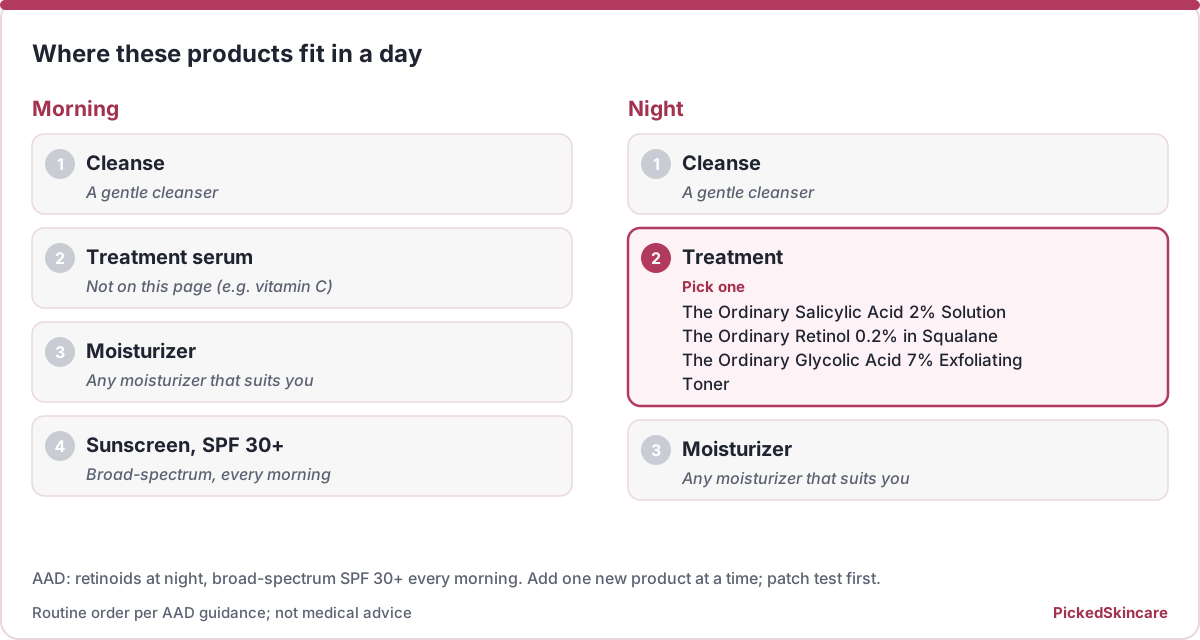
The AAD[5][6][7] says to start with the least intense retinoid you can find, every other night, only at night, because retinoids can make skin more sensitive to the sun, and to wear sunscreen during the day. The same retinoid page says retinoids should not be used during pregnancy.
If you use a retinoid, which of these acids is the later add?
Neither, until the retinol nights are comfortable. If you add one, pick a single acid on a night you skip retinol. The salicylic solution is the one The Ordinary tells you not to combine with retinoids.
| Product | Role next to a retinoid | The brand’s own limit |
|---|---|---|
| The Ordinary Retinol 0.2% in Squalane | The night retinoid, if you want a stated 0.2% | The brand says this is not a treatment for acne, to avoid it in pregnancy or breastfeeding, and to refrigerate it after opening and finish it within three months. |
| The Ordinary Glycolic Acid 7% toner | An AHA for a different night, if you want a glycolic at all | Not in the same routine as strong retinoids. Not for sensitive, peeling, or compromised skin. Sunscreen, including the week after. |
| The Ordinary Salicylic Acid 2% Solution | Not on a retinoid night. The brand’s own line says not to combine them. | Not with other acids, retinoids, or peptides. The page says it may not suit sensitive skin. |
The AAD’s[5][6][7] 20s page says to wash, wait 20 to 30 minutes, then apply the retinoid. Moisturizer right after washing is the extra step only if the retinoid is too drying, and you still wait 20 to 30 minutes before the retinoid. A moisturizer to sit with retinol is a separate pick. The acid does not go in that same window while you are starting.
What does a simple week look like?
Example, not a prescription: retinol every other night, nothing acidic on those nights, and at most one acid on a night you skip retinol. Moisturizer can follow. Sunscreen every morning.
A calm week can look like retinol on Monday, Wednesday, and Friday, and no acid those nights. If the skin is still calm after a few weeks, one non-retinol night can take the glycolic toner, not the salicylic solution, and not both. If you see peeling, stop the acid first. The Ordinary already says not to put the glycolic toner on peeling skin. The AAD’s[5][6][7] patch test for a new product is a quarter-sized spot, twice a day, for seven to 10 days. That page also says retinol and glycolic acid can irritate skin, especially sensitive skin.
Morning is cleanser if you use one, moisturizer, and sunscreen. Neither the acid nor the retinol replaces SPF. The AAD’s sunscreen page still wants broad spectrum and SPF 30 or higher.
Is there a study that says this schedule is the effective one?
No study of this schedule was fetched. The calendar is here so you do not stack two leave-ons that the brands and the AAD[5][6][7] already tell you to respect. It is not a result claim.
The Ordinary’s own lines are the limit: salicylic acid stays away from retinoids, and the glycolic toner stays out of a strong-retinoid routine. The AAD’s[5][6][7] lines are the other limit: night only, every other night at the start, sunscreen in the day, and no retinoid in pregnancy. That is the evidence this calendar uses.
Who should skip it?
If you are not using a retinoid, you do not need an “acid with retinol” plan. Use one leave-on you tolerate, or none. Most people do not need both families in the same month.
- Anyone pregnant or trying to conceive: The AAD[5][6][7] says retinoids should not be used during pregnancy. The Ordinary also says to avoid retinoid products while pregnant or breastfeeding. Skip the retinol and ask your doctor what else is appropriate.
- Skin that is peeling, stinging, or sunburned: The Ordinary says not to put the glycolic toner on sensitive, peeling, or compromised skin, and that the salicylic solution may not suit sensitive skin. A retinol night on that same skin is the wrong week. Consider instead: Moisturizer and sunscreen only, until it is calm.
- People who want the salicylic solution and the retinol the same night: The Ordinary says not to combine that solution with retinoids. This page does not offer a workaround.
- People who want both acids and the retinol every night: That is the stack this page is declining. One retinoid night or one acid night, not all three bottles in one evening.
- Anyone on a prescription retinoid or other prescribed leave-on: Adding a cosmetic acid or a second retinoid is a question for the prescriber, not a calendar from a product page.
How can you spend less?
You may not need both. The Ordinary Retinol 0.2% in Squalane is about $8.10 for 30 ml (checked November 19, 2026), and that size was out of stock the same day. The glycolic toner is about $9 for 100 ml (checked November 19, 2026). The salicylic solution is about $6.70 for 30 ml (checked November 19, 2026). Paula’s Choice 2% BHA showed $37 in the page data the same day, with no size in that response. Buy the retinol first if a retinoid is the point, and add an acid only later. Do not step up to 0.5% or 1% only because 0.2% is out of stock. That ladder is 0.2% vs 0.5% vs 1%.
What should you know before you start?
- Patch test first. The American Academy of Dermatology suggests applying a new product to a quarter-sized area twice a day for 7 to 10 days and stopping if you react. AAD: how to test skin care products.
- Add one new product at a time, and give it time: the AAD says many anti-aging products take 6 weeks to 3 months to show results. AAD: get the most from anti-aging products.
- Retinoids: the AAD says to apply them at night, wear sunscreen daily, start with the lowest strength every other night, and that retinoids should not be used during pregnancy. AAD: retinoid or retinol?
What do people ask most?
Should moisturizer go on before the retinol?
Can I use an acid in the morning and retinol at night?
Which Ordinary acid bans retinoids by name?
Does Paula’s Choice say the opposite?
What if the 0.2% retinol is out of stock?
Where this comes from
We opened and read every source below for this page. Ingredient lists, strengths, directions and prices come from each brand’s own product page; health and usage guidance comes from the American Academy of Dermatology, the FDA, the National Eczema Association and peer-reviewed studies (via PubMed). Prices checked: November 19, 2026; confirm on the seller’s site before you buy.
- The Ordinary (brand page): The Ordinary Glycolic Acid 7% Exfoliating Toner (theordinary.com)
- The Ordinary (brand page): The Ordinary Salicylic Acid 2% Solution (theordinary.com)
- The Ordinary (brand page): The Ordinary Retinol 0.2% in Squalane (theordinary.com)
- Paula’s Choice (brand page): Paula’s Choice SKIN PERFECTING 2% BHA Liquid Exfoliant (paulaschoice.com)
- AAD: Retinoid or retinol? (aad.org)
- AAD: Dermatologist-recommended skin care for your 20s (aad.org)
- AAD: How to test skin care products (aad.org)
- AAD: How to select a sunscreen (aad.org)
Related
Glycolic vs lactic vs salicylic acid: which leave-on should you buy?
Choose glycolic 7% for a watery toner whose description says about pH 3.6. Choose lactic acid 5% if you want the milder AHA serum, or 10% if 5% has been comfortable. Choose a 2% salicylic acid leave-on if you want a BHA instead of an AHA. Do not start with all of them.
comparisonPaula’s Choice 2% BHA Liquid vs The Ordinary Salicylic Acid 2% Solution
Both bottles state 2% salicylic acid. Pick The Ordinary if you want a 30 ml solution with a short list and a brand rule against other acids, retinoids, and peptides. Drug Facts: a thin layer one to three times daily, starting once daily. The brand’s FAQ says once daily in the PM, after cleansing and before moisturizer. Pick Paula’s Choice if you want a 4 fl oz leave-on you can use morning or night, and you will add sunscreen whenever you use it in the day.
comparisonThe Ordinary Glycolic Acid 7% toner vs Naturium Glycolic Acid Resurfacing Gel 10%
Pick The Ordinary’s 7% glycolic toner if you want the lower stated percentage, a watery texture, and the lower bottle price. Pick Naturium’s gel if you have already tolerated a glycolic leave-on and you want the higher stated percentage in a gel. Do not start on the 10% gel. The Ordinary says not to use its toner on sensitive, peeling, or compromised skin.
best ofThe best first retinol for your skin type
Your first retinoid should be low strength, used every other night, and match your skin type. Here are four starting points, from a budget stated-strength retinol to single-dose capsules, and who should skip each.
guideThe Ordinary Retinol 0.2% vs 0.5% vs 1%: which step to use
Start with The Ordinary Retinol 0.2% in Squalane. Move to 0.5%, then 1%, only after your skin is comfortable. All three use the same water-free squalane base; the brand’s own tip is to climb this ladder rather than begin at the top.
best ofThe best moisturizer to use with retinol, by need
You do not need a special “retinol moisturizer.” You need a bland cream or lotion you will actually use at night, and sunscreen in the morning. Here are three official-formula options: a night lotion with niacinamide, a short-list cream, and a ceramide cream labeled for morning and evening — plus who should skip each.