The best first retinol for your skin type
Your first retinoid should be low strength, used every other night, and match your skin type. Here are four starting points, from an $8.10 stated-strength retinol to single-dose capsules, and who should skip each.
Checked against brand ingredient lists on and against dermatology sources (American Academy of Dermatology, FDA, peer-reviewed studies). How we research · Editorial policy · 11 sources
Disclosure: PickedSkincare is reader-supported. “Check price” links may become affiliate links, and we may earn a commission if you buy through them, at no extra cost to you. Commission never decides a pick, and we tell you when the cheaper bottle is the better buy. How we make money.
How this page was made: we compared what each brand publishes (actives, strengths, full ingredient lists, directions and prices) and checked the claims against dermatology guidance and published studies, all linked at the bottom. We haven’t tested these products on our own skin, we don’t publish star ratings, and a commission never decides a pick. Our methodology.
Not medical advice. This page compares cosmetic products. If you have a skin condition, use prescription treatment, or are pregnant or breastfeeding, ask a dermatologist or your doctor before starting something new.
Short answer
Your first retinoid should be low strength, used every other night, and match your skin type. Here are four starting points, from an $8.10 stated-strength retinol to single-dose capsules, and who should skip each. Dry or normal skin, lowest cost: The Ordinary Retinol 0.2% in Squalane, $8.10. Sensitive or easily red skin: The Ordinary Granactive Retinoid 2% Emulsion, $12.10.
Last updated Ingredient lists checked 2026-11-11Prices checked November 2026
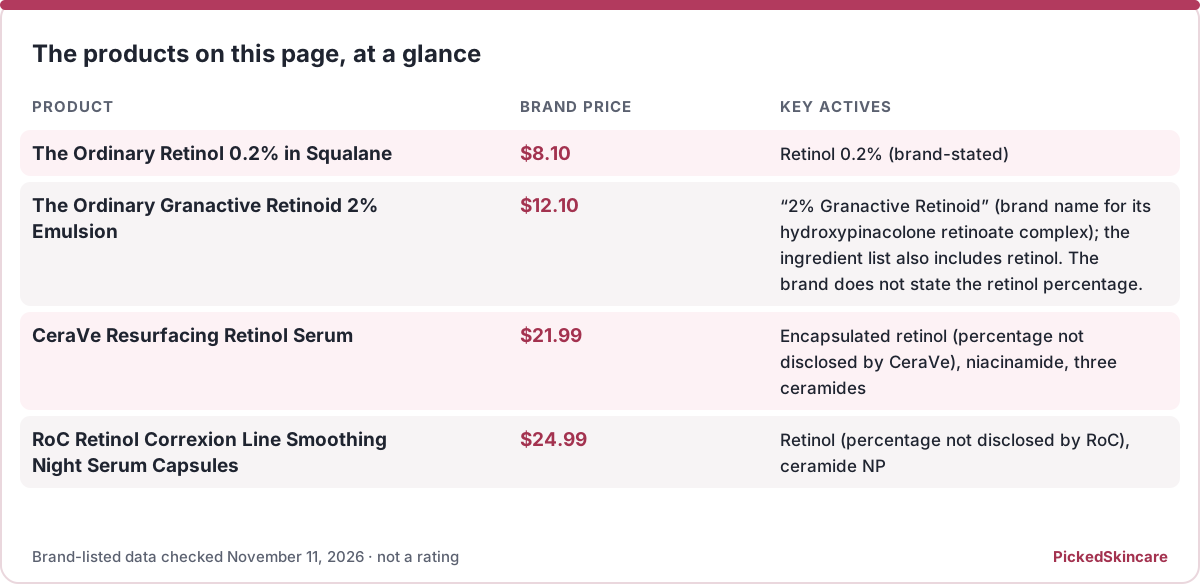
The numbers side by side
| Pick | Product | Best for | Price |
|---|---|---|---|
| Dry or normal skin, lowest cost | The Ordinary Retinol 0.2% in Squalane | dry or normal skin on a budget | $8.10 for 30 ml (brand site) |
| Sensitive or easily red skin | The Ordinary Granactive Retinoid 2% Emulsion | sensitive or easily irritated skin | $12.10 for 30 ml (brand site) |
| Oily or breakout-prone skin | CeraVe Resurfacing Retinol Serum | oily or breakout-prone skin | $21.99 listed on CeraVe’s site (sold through retailers) |
| Short ingredient list, single doses | RoC Retinol Correxion Line Smoothing Night Serum Capsules | dry or normal skin that likes simple formulas | $24.99 (brand site) |
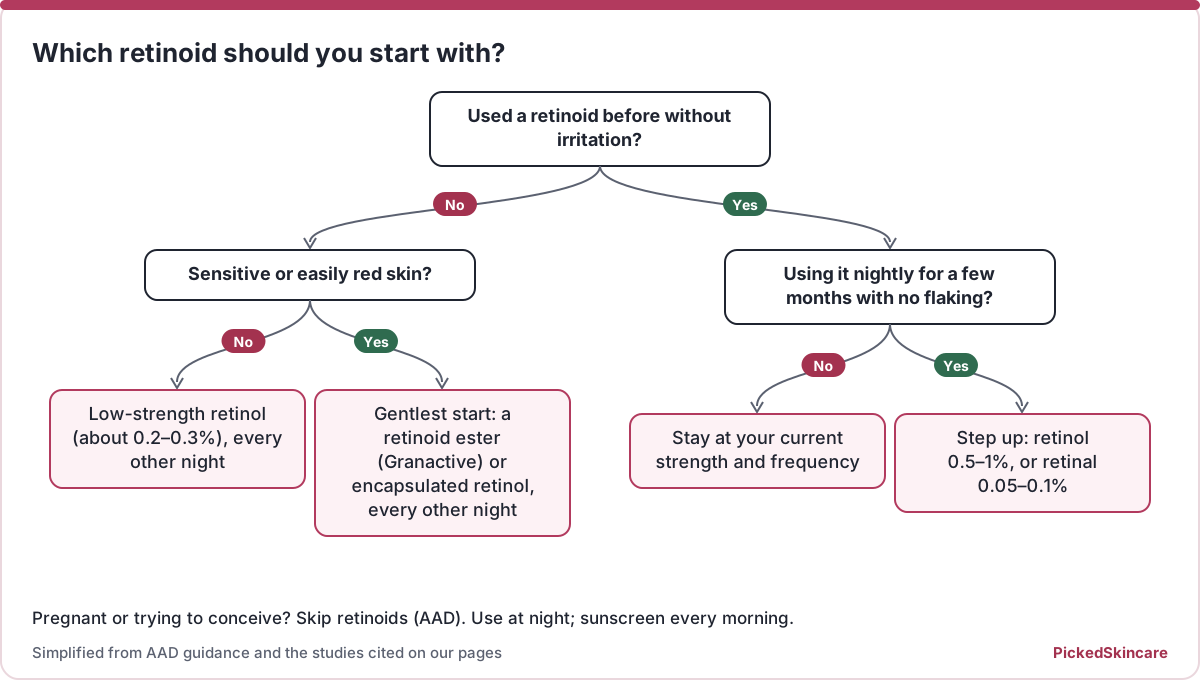
The AAD’s[1][2][3] advice for a first retinoid is simple: use the lowest-strength formula you can find, apply it every other night, use it at night only, and wear sunscreen every day. The hard part is that many labels don’t state a percentage. We picked four products that are either clearly low strength or built around a gentler retinoid, and matched each to a skin type using its ingredient list and the brand’s own directions. We haven’t tested them ourselves and we don’t give scores.
Which pick suits which skin?
How do the picks compare side by side?
| Product | Best for | Retinoid and stated strength | Base | Price (checked November 2026) |
|---|---|---|---|---|
| The Ordinary Retinol 0.2% in Squalane | Dry or normal skin on a budget | Retinol 0.2% | Water-free oils | $8.10 / 30 ml |
| The Ordinary Granactive Retinoid 2% Emulsion | Sensitive or easily irritated skin | Hydroxypinacolone retinoate (“2%”) + retinol (unstated) | Creamy emulsion | $12.10 / 30 ml |
| CeraVe Resurfacing Retinol Serum | Oily or breakout-prone skin | Encapsulated retinol, not disclosed | Water-based serum | Check current price |
| RoC Retinol Correxion Capsules | Dry or normal skin that likes simple formulas | Retinol, not disclosed | Silicone serum in capsules | $24.99 |
Why is each product on the list?
1. The Ordinary Retinol 0.2% in Squalane
Best for: dry or normal skin on a budgetThe only pick here with a stated retinol percentage at a true starting strength. The base is three oils and nothing else of note, which suits dry skin and makes reactions easier to trace. The Ordinary tells users to start here, refrigerate after opening and finish within three months, and warns retinol can cause irritation, redness and peeling at first.
Price (November 2026): $8.10 for 30 ml (brand site) Source
Pros
- Stated 0.2% strength
- Eight ingredients
- Clear path to 0.5% and 1%
Cons
- Oily finish
- Needs refrigeration after opening
2. The Ordinary Granactive Retinoid 2% Emulsion
Best for: sensitive or easily irritated skinThe Ordinary recommends this to people prone to sensitivity. Its main active is hydroxypinacolone retinoate, a retinoid ester the brand says gives comparable visible results to retinol with less likelihood of irritation. That claim comes from the brand; we didn’t find an independent trial of this product. Retinol is also in the list at an unstated level.
Price (November 2026): $12.10 for 30 ml (brand site) Source
Pros
- Brand positions it as the low-irritation option
- Cream texture
- Under $13
Cons
- Brand-only efficacy claim
- Retinol amount not stated
3. CeraVe Resurfacing Retinol Serum
Best for: oily or breakout-prone skinA light water-based serum CeraVe aims at the look of post-acne marks and pores. It adds niacinamide (fifth ingredient), three ceramides and dipotassium glycyrrhizate, is non-comedogenic per the brand, and is labeled PM only. The catch: CeraVe doesn’t state the retinol percentage, so you can’t be sure you are starting low.
Price (November 2026): $21.99 listed on CeraVe’s site (sold through retailers) Source
Pros
- Niacinamide and ceramides in the same step
- Free of added fragrance
- Light texture
Cons
- Retinol percentage not disclosed
- Contains a small amount of alcohol
4. RoC Retinol Correxion Line Smoothing Night Serum Capsules
Best for: dry or normal skin that likes simple formulasEight ingredients, water-free, sealed one dose per capsule. RoC’s own directions match the AAD’s[1][2][3]: start every other night, then build up, with sunscreen by day. Like CeraVe, RoC doesn’t disclose the retinol percentage.
Price (November 2026): $24.99 (brand site) Source
Pros
- Very short ingredient list
- Single-dose freshness
- Clear every-other-night start
Cons
- Percentage not disclosed
- More packaging per use
Also looked at
Paula’s Choice CLINICAL 1% Retinol and retinal serums are not starting products; both brands say so.
What’s in each bottle?
Copied from each brand’s own product page (or the sunscreen’s Drug Facts) on November 11, 2026. Brands reformulate, so the carton in your hand is the final word.
The Ordinary Retinol 0.2% in Squalane
- Key actives
- Retinol 0.2% (brand-stated)
- Base
- Water-free squalane and plant-oil base
- Brand price
- $8.10 · 30 ml
- Brand notes
- Brand says to start here before 0.5% and 1%, refrigerate after opening and use within three months; avoid when pregnant or breastfeeding.
Full ingredient list
Squalane, Caprylic/Capric Triglyceride, Simmondsia Chinensis (Jojoba) Seed Oil, Retinol, Solanum Lycopersicum (Tomato) Fruit Extract, Rosmarinus Officinalis (Rosemary) Leaf Extract, Hydroxymethoxyphenyl Decanone, BHT.
The Ordinary product page · Check price on Amazon (opens in a new tab)
The Ordinary Granactive Retinoid 2% Emulsion
- Key actives
- “2% Granactive Retinoid” (brand name for its hydroxypinacolone retinoate complex); the ingredient list also includes retinol. The brand does not state the retinol percentage.
- Base
- Water-based emulsion
- Brand price
- $12.10 · 30 ml
- Brand notes
- Brand says it is less likely to cause irritation than retinol; avoid when pregnant or breastfeeding.
Full ingredient list
Aqua (Water), Glycerin, Caprylic/Capric Triglyceride, Ethyl Linoleate, Propanediol, Dimethyl Isosorbide, Cetearyl Isononanoate, Bisabolol, Hydroxypinacolone Retinoate, Retinol, Tasmannia Lanceolata Fruit/Leaf Extract, Inulin Lauryl Carbamate, Glyceryl Stearate, Ceteareth-12, Ceteareth-20, Cetearyl Alcohol, Carrageenan, Xanthan Gum, Acacia Senegal Gum, Cetyl Palmitate, Sucrose Laurate, Polysorbate 20, Isoceteth-20, Rosmarinus Officinalis (Rosemary) Leaf Extract, Hydroxymethoxyphenyl Decanone, Behentrimonium Chloride, Trisodium Ethylenediamine Disuccinate, Disodium Edta, Dehydroacetic Acid, Benzoic Acid, Ethylhexylglycerin, Phenoxyethanol, Chlorphenesin.
The Ordinary product page · Check price on Amazon (opens in a new tab)
CeraVe Resurfacing Retinol Serum
- Key actives
- Encapsulated retinol (percentage not disclosed by CeraVe), niacinamide, three ceramides
- Base
- Lightweight water-based serum
- Brand price
- $21.99 · listed on CeraVe’s page; sold through retailers (size not shown)
- Brand notes
- Brand: developed with dermatologists, free of added fragrance; positioned for the look of post-acne marks and pores. CeraVe lists $21.99 but sells through retailers (“Find in Stores”).
Full ingredient list
Aqua/Water/Eau, Propanediol, Dimethicone, Cetearyl Ethylhexanoate, Niacinamide, Ammonium Polyacryloyldimethyl Taurate, Dipotassium Glycyrrhizate, Hydrogenated Lecithin, Potassium Phosphate, Ceramide NP, Ceramide AP, Ceramide EOP, Carbomer, Cetearyl Alcohol, Behentrimonium Methosulfate, Dimethiconol, Lecithin, Sodium Citrate, Retinol, Sodium Hyaluronate, Sodium Lauroyl Lactylate, Cholesterol, Phenoxyethanol, Alcohol, Isopropyl Myristate, Caprylyl Glycol, Citric Acid, Trisodium Ethylenediamine Disuccinate, Pentylene Glycol, Phytosphingosine, Xanthan Gum, Polysorbate 20, Ethylhexylglycerin.
CeraVe product page · Check price on Amazon (opens in a new tab)
RoC Retinol Correxion Line Smoothing Night Serum Capsules
- Key actives
- Retinol (percentage not disclosed by RoC), ceramide NP
- Base
- Water-free silicone serum in single-use twist capsules
- Brand price
- $24.99
- Brand notes
- Brand: airtight capsules for retinol freshness; tagged fragrance-free; use at night.
Full ingredient list
Cyclopentasiloxane, Ethylhexyl Cocoate, Dimethiconol, Glycine Soja (Soybean) Oil, Retinol, Dimethylmethoxy Chromanol, Ceramide NP, Phenoxyethanol.
RoC product page · Check price on Amazon (opens in a new tab)
How should a beginner start, step by step?
- Patch test: the AAD[1][2][3] suggests a quarter-sized area twice a day for 7 to 10 days.
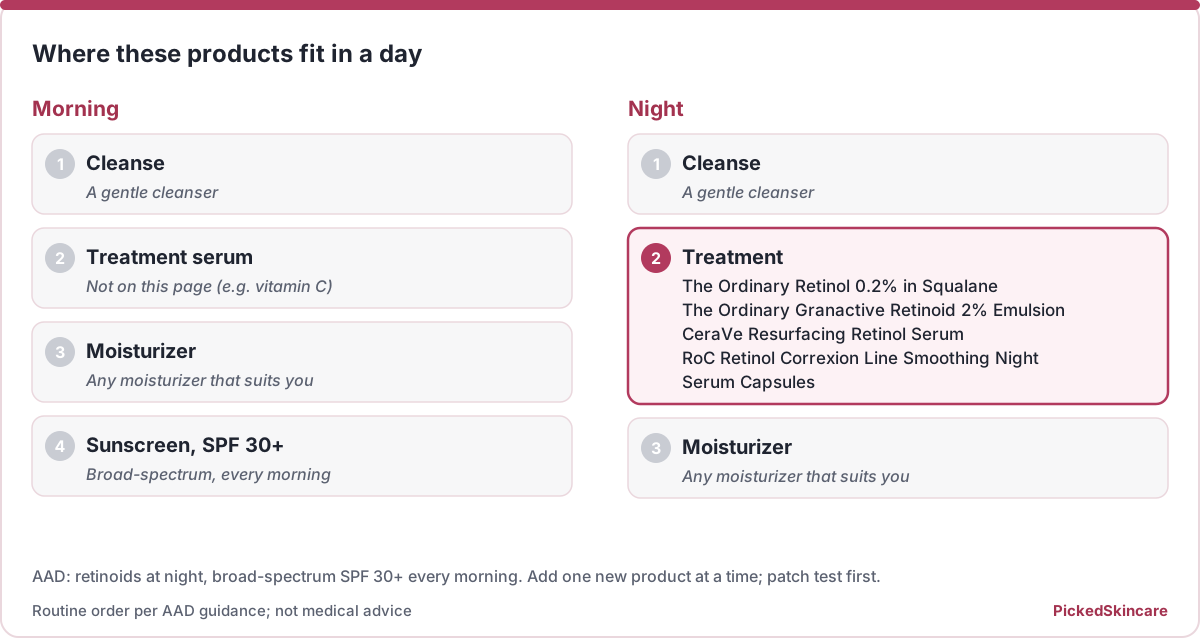
- Night only, every other night at first (the AAD’s advice for a first retinoid).
- If it stings or flakes, put moisturizer on first and wait. The AAD’s skin-care-in-your-20s guide suggests moisturizer, then the retinoid 20 to 30 minutes later.
- Sunscreen every morning, SPF 30 or higher.
- Give it time: the AAD says 6 weeks to 3 months for anti-aging products.
What can a beginner expect in the first months?
The best independent retinol data we found is Kafi[6] et al. (2007): 0.4% retinol, up to three times a week, improved fine wrinkling over 24 weeks compared with the base lotion in 36 older adults. The Mukherjee[7] review (2006) describes retinol as considerably less irritating than prescription retinoids. Expect slow, modest change; the AAD[1][2][3] reminds readers that anti-aging products deliver modest results.
Who should skip it?
If your main goal is preventing future sun damage, sunscreen comes first. The AAD[1][2][3] calls sunscreen and moisturizer the two most effective anti-aging products you can buy.
- Pregnant, trying to conceive or breastfeeding: The AAD[1][2][3] says retinoids should not be used during pregnancy. Consider instead: ask your doctor; consider niacinamide.
- Rosacea-prone, very red or eczema-prone skin: AAD[1][2][3] dermatologists say people with skin allergies, dryness or a lot of redness are probably not good candidates.
- Anyone on prescription acne or retinoid creams: Don’t stack retinoids; ask your dermatologist.
How can you spend less?
The Ordinary Retinol 0.2% in Squalane at $8.10 is the cheapest stated-strength option we found. Pair it with a moisturizer you already own rather than buying a “retinol system”.
What should you know before you start?
- Patch test first. The American Academy of Dermatology suggests applying a new product to a quarter-sized area twice a day for 7 to 10 days and stopping if you react. AAD: how to test skin care products.
- Add one new product at a time, and give it time: the AAD says many anti-aging products take 6 weeks to 3 months to show results. AAD: get the most from anti-aging products.
- Retinoids: the AAD says to apply them at night, wear sunscreen daily, start with the lowest strength every other night, and that retinoids should not be used during pregnancy. AAD: retinoid or retinol?
What do people ask most?
What percentage of retinol should a beginner use?
How often should I use retinol at first?
Is purging or peeling normal?
Can I use retinol with vitamin C?
Do I need a separate eye retinol?
Where this comes from
We opened and read every source below for this page. Ingredient lists, strengths, directions and prices come from each brand’s own product page; health and usage guidance comes from the American Academy of Dermatology, the FDA, the National Eczema Association and peer-reviewed studies (via PubMed). Prices checked: November 2026; confirm on the seller’s site before you buy.
- AAD: Retinoid or retinol? (aad.org)
- AAD: How to test skin care products (aad.org)
- AAD: How to maximize results from anti-aging skin care products (aad.org)
- AAD: How to select anti-aging skin care products (aad.org)
- AAD: Dermatologist-recommended skin care for your 20s (aad.org)
- Kafi et al. 2007, Archives of Dermatology: Improvement of naturally aged skin with vitamin A (retinol) (pubmed.ncbi.nlm.nih.gov)
- Mukherjee et al. 2006, Clinical Interventions in Aging: Retinoids in the treatment of skin aging (pubmed.ncbi.nlm.nih.gov)
- The Ordinary (brand page): The Ordinary Retinol 0.2% in Squalane (theordinary.com)
- The Ordinary (brand page): The Ordinary Granactive Retinoid 2% Emulsion (theordinary.com)
- CeraVe (brand page): CeraVe Resurfacing Retinol Serum (cerave.com)
- RoC (brand page): RoC Retinol Correxion Line Smoothing Night Serum Capsules (rocskincare.com)
Related
Retinol vs retinal: which one should you start with?
Short answer: start with a low-strength retinol if you have never used a retinoid; move to retinal once your skin handles retinol without flaking. Retinal sits one conversion step closer to retinoic acid, so a smaller percentage does more.
comparisonThe Ordinary Granactive Retinoid 2% Emulsion vs Retinol 0.2% in Squalane
These are the two products The Ordinary itself points beginners to. Granactive Retinoid 2% is a creamy emulsion built around a retinoid ester (hydroxypinacolone retinoate) plus some retinol; Retinol 0.2% is plain retinol in squalane and jojoba oil.
comparisonCeraVe Resurfacing Retinol Serum vs RoC Retinol Correxion Capsules
Neither brand states how much retinol is inside. CeraVe surrounds encapsulated retinol with niacinamide, three ceramides and licorice-derived dipotassium glycyrrhizate; RoC seals retinol in an eight-ingredient silicone serum, one capsule per night.
comparisonThe Ordinary Retinol 1% vs Paula’s Choice CLINICAL 1% Retinol
Both brands state 1% retinol. The Ordinary puts it in a short, water-free oil base for $9.90; Paula’s Choice puts it in a lotion with peptides, a vitamin C derivative and soothing extracts for $65 list. Neither is a starting strength.
comparisonThe Ordinary Retinal 0.2% vs Naturium Retinaldehyde Cream Serum 0.10%
Both are for people who already tolerate retinol. The Ordinary’s is twice the stated strength at 0.2% and costs $14.90 for 15 ml; Naturium’s 0.10% is a “sustained-release” cream-serum at $32 and the brand sells a 0.05% step below it.
guideCan you use niacinamide with vitamin C or retinol?
Short answer: niacinamide with retinol is widely accepted; even Paula’s Choice says they pair well. Niacinamide with vitamin C is where brands disagree, so the simple default is vitamin C in the morning and niacinamide or retinol at night.
comparisonCeraVe PM Facial Moisturizing Lotion vs La Roche-Posay Toleriane Double Repair
These two read alike on the shelf: glycerin, niacinamide, ceramide, fragrance-free. Underneath, CeraVe has three ceramides, cholesterol and hyaluronic acid in a light lotion labeled for night; La Roche-Posay has one ceramide and squalane in a lightweight cream for day or night at $24.99 for 100 ml.
comparisonThe Ordinary Ascorbyl Glucoside Solution 12% vs Vitamin C Suspension 23%
Same brand, opposite approaches. Ascorbyl Glucoside 12% is a water-based derivative the brand calls lower in irritation potential but less potent; Vitamin C Suspension 23% is pure L-ascorbic acid in a water-free base that the brand says will tingle.
comparisonCeraVe Moisturizing Cream vs CeraVe Daily Moisturizing Lotion
CeraVe says the main difference between these two is texture. The ingredient lists show why: the cream has petrolatum near the top and more fatty alcohols; the lotion has no petrolatum and is labeled oil-free. Both carry ceramides NP, AP and EOP, cholesterol and hyaluronic acid.