The Ordinary Retinol 1% vs Paula’s Choice CLINICAL 1% Retinol
Both brands state 1% retinol. The Ordinary puts it in a short, water-free oil base for $9.90; Paula’s Choice puts it in a lotion with peptides, a vitamin C derivative and soothing extracts for $65 list. Neither is a starting strength.
Checked against brand ingredient lists on and against dermatology sources (American Academy of Dermatology, FDA, peer-reviewed studies). How we research · Editorial policy · 7 sources
Disclosure: PickedSkincare is reader-supported. “Check price” links may become affiliate links, and we may earn a commission if you buy through them, at no extra cost to you. Commission never decides a pick, and we tell you when the cheaper bottle is the better buy. How we make money.
How this page was made: we compared what each brand publishes (actives, strengths, full ingredient lists, directions and prices) and checked the claims against dermatology guidance and published studies, all linked at the bottom. We haven’t tested these products on our own skin, we don’t publish star ratings, and a commission never decides a pick. Our methodology.
Not medical advice. This page compares cosmetic products. If you have a skin condition, use prescription treatment, or are pregnant or breastfeeding, ask a dermatologist or your doctor before starting something new.
Short answer
pick The Ordinary Retinol 1% ($9.90, 30 ml) if you have dry or normal skin, already tolerate retinol and want the fewest extra ingredients. Pick Paula’s Choice CLINICAL 1% ($65 list) if you prefer a lotion texture and want peptides and soothing extracts in the same step. New to retinol? Start lower with either brand.
Last updated Ingredient lists checked 2026-11-11Prices checked November 2026
Check The Ordinary Retinol 1% in price (opens in a new tab)Check Paula’s Choice CLINICAL 1% Retinol price (opens in a new tab)
The numbers side by side
| The Ordinary Retinol 1% in Squalane | Paula’s Choice CLINICAL 1% Retinol Treatment | |
|---|---|---|
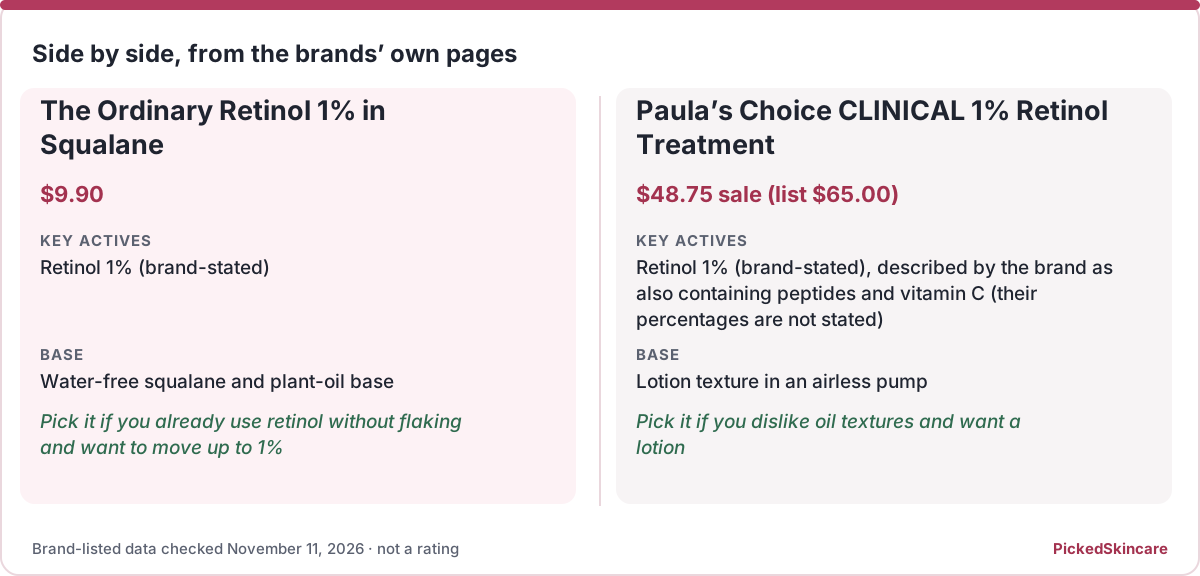
| Price (brand site) | $9.90 for 30 ml | $65.00 list; $48.75 on sale when checked |
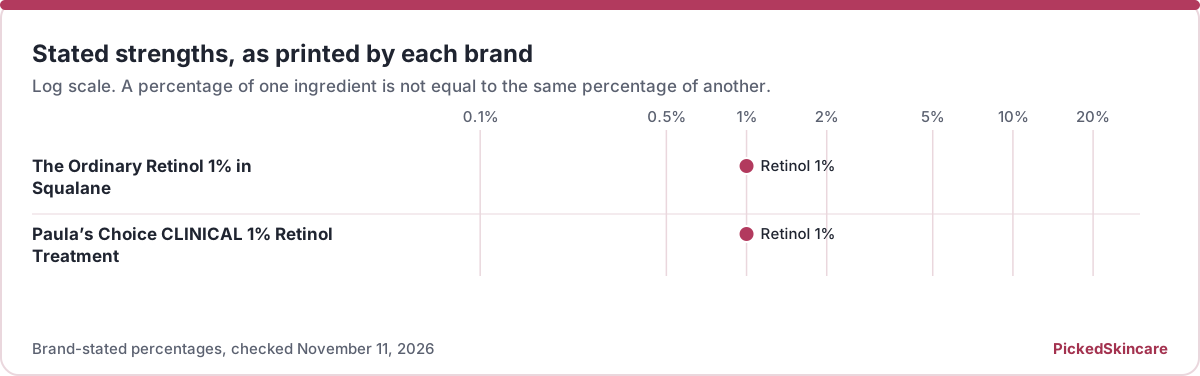
| Retinol | 1% (stated) | 1% (stated) |
| Base | Water-free: squalane, caprylic/capric triglyceride, jojoba oil | Lotion in an airless pump |
| Ingredient list length | 8 ingredients | 53 ingredients, including peptides and a vitamin C derivative (tetrahexyldecyl ascorbate) |
| Brand’s first-timer advice | Start at its 0.2%, then 0.5%, before 1% | Use at a reduced rate for the first two weeks |
“1% retinol” is the same number on both labels, so the decision comes down to what surrounds it: the base, the extras, the packaging and the price. We read both brand pages and the dermatology guidance on starting retinoids. We haven’t used either product ourselves.
How do they differ, line by line?
| The Ordinary Retinol 1% in Squalane | Paula’s Choice CLINICAL 1% Retinol | |
|---|---|---|
| Price (brand site) | $9.90 for 30 ml | $65.00 list; $48.75 on sale when checked |
| Retinol | 1% (stated) | 1% (stated) |
| Base | Water-free: squalane, caprylic/capric triglyceride, jojoba oil | Lotion in an airless pump |
| Ingredient list length | 8 ingredients | 53 ingredients, including peptides and a vitamin C derivative (tetrahexyldecyl ascorbate) |
| Brand’s first-timer advice | Start at its 0.2%, then 0.5%, before 1% | Use at a reduced rate for the first two weeks |
| Brand’s skin-type note | Not stated; oil base | Lotion texture “ideal” for normal to dry skin |
| Storage note | Refrigerate after opening; use within 3 months | Airless pump (prime before first use) |
| Pregnancy / breastfeeding | Brand says avoid | Brand says avoid |
What does each do well, and where does it fall short?
The Ordinary Retinol 1% in Squalane: pros
- About a seventh of the list price of the Paula’s Choice bottle
- Very short ingredient list: easier to spot something you react to
- Water-free oil base suits dry skin
- Same brand sells 0.2% and 0.5% steps for working up
The Ordinary Retinol 1% in Squalane: cons
- Oily finish some oily-skinned users won’t want
- Brand asks you to refrigerate it and finish it within 3 months of opening
- No soothing extras in the formula
Paula’s Choice CLINICAL 1% Retinol Treatment: pros
- Lotion texture the brand recommends for normal to dry skin
- Adds peptides and a vitamin C derivative (percentages not stated)
- Airless pump limits air exposure
Paula’s Choice CLINICAL 1% Retinol Treatment: cons
- $65 list price
- Long ingredient list: harder to pin down a reaction
- Full ingredient list not readable in the page source on our check date; read the carton
Which one fits your skin?
If retinol is the reason you are buying, the active is the same 1% in both. The Ordinary is the better value and the simpler formula; Paula’s Choice charges for a lotion base and supporting ingredients. Both brands steer beginners to lower strengths first, and the AAD[4][7] agrees: start with the lowest strength you can find, every other night.
Pick The Ordinary Retinol 1% in Squalane if…
- you already use retinol without flaking and want to move up to 1%
- you have dry or normal skin and like oils
- you want the shortest ingredient list for $9.90
Pick Paula’s Choice CLINICAL 1% Retinol Treatment if…
- you dislike oil textures and want a lotion
- you want peptides and soothing extracts in one step
- the price difference doesn’t matter to you
What’s in each bottle?
Copied from each brand’s own product page (or the sunscreen’s Drug Facts) on November 11, 2026. Brands reformulate, so the carton in your hand is the final word.
The Ordinary Retinol 1% in Squalane
- Key actives
- Retinol 1% (brand-stated)
- Base
- Water-free squalane and plant-oil base
- Brand price
- $9.90 · 30 ml
- Brand notes
- Brand recommends working up from 0.2% and 0.5%; refrigerate after opening, use within three months; avoid when pregnant or breastfeeding.
Full ingredient list
Squalane, Caprylic/Capric Triglyceride, Simmondsia Chinensis (Jojoba) Seed Oil, Retinol, Solanum Lycopersicum (Tomato) Fruit Extract, Rosmarinus Officinalis (Rosemary) Leaf Extract, Hydroxymethoxyphenyl Decanone, BHT.
The Ordinary product page · Check price on Amazon (opens in a new tab)
Paula’s Choice CLINICAL 1% Retinol Treatment
- Key actives
- Retinol 1% (brand-stated), described by the brand as also containing peptides and vitamin C (their percentages are not stated)
- Base
- Lotion texture in an airless pump
- Brand price
- $48.75 sale price when checked (list $65.00)
- Brand notes
- Brand FAQ: use it at a reduced rate for the first two weeks because skin responds to retinol with a delay; avoid when pregnant or breastfeeding; the lotion texture is “ideal if you have normal to dry skin”, and the brand points sensitive skin to its 0.3% Retinol + 2% Bakuchiol formula instead.
Full ingredient list
Water, Dimethicone, Glycerin, Butylene Glycol, Isononyl Isononanoate, Castor Isostearate Succinate, Glyceryl Stearate, C12-15 Alkyl Benzoate, Dimethicone Crosspolymer, PEG-33, Polysorbate 20, Behenyl Alcohol, PEG-100 Stearate, Pentaerythrityl Tetraisostearate, Polymethylsilsesquioxane, Tetrahexyldecyl Ascorbate, Retinol, Ceramide NG, Palmitoyl Tetrapeptide-7, Palmitoyl Hexapeptide-12, Sodium Hyaluronate, Dipotassium Glycyrrhizate, Glycyrrhiza Glabra (Licorice) Root Extract, Avena Sativa (Oat) Kernel Extract, Arctium Lappa, Salix Alba Extract, Glycine Soja Sterols, Lecithin, Allantoin, Tocopheryl Acetate, Hydrolyzed Soy Protein, Sorbitan Laurate, Acetyl Dipeptide-1 Cetyl Ester, Disodium EDTA, Hydroxyethylcellulose, Palmitoyl Tripeptide-1, Sodium Hydroxide, Tribehenin, Caprylyl Glycol, Ethylhexylglycerin, Pentylene Glycol, PEG-75 Shea Butter Glycerides, PPG-12/SMDI Copolymer, PEG-10 Phytosterol, PEG-8 Dimethicone, PEG-14, Magnesium Aluminum Silicate, Arachidyl Glucoside, Arachidyl Alcohol, Sclerotium Gum, Carbomer, Phenoxyethanol, Benzoic Acid.
Paula’s Choice product page · Check price on Amazon (opens in a new tab)
Why does the base matter more than the number?
A 2022 review in Advances in Therapy lists instability, low penetration and irritation as the core problems with retinoid formulas, which is why brands differ so much in how they package and surround the same active. The Ordinary’s answer is a water-free base plus a refrigeration and three-month use-by instruction. Paula’s Choice uses an airless pump and a lotion base. Neither brand publishes a head-to-head study, and we found none.
Which one suits your skin type?
- Dry: either; Paula’s Choice names normal-to-dry skin for this lotion, and The Ordinary’s base is all oils.
- Oily or breakout-prone: Paula’s Choice points oily skin to a different product (its 1% Retinol Booster), not this lotion. The Ordinary’s oil base may feel heavy.
- Sensitive: neither at 1%. Paula’s Choice suggests its 0.3% Retinol + 2% Bakuchiol for sensitive skin; The Ordinary suggests its Granactive Retinoid or 0.2% retinol.
Who should skip it?
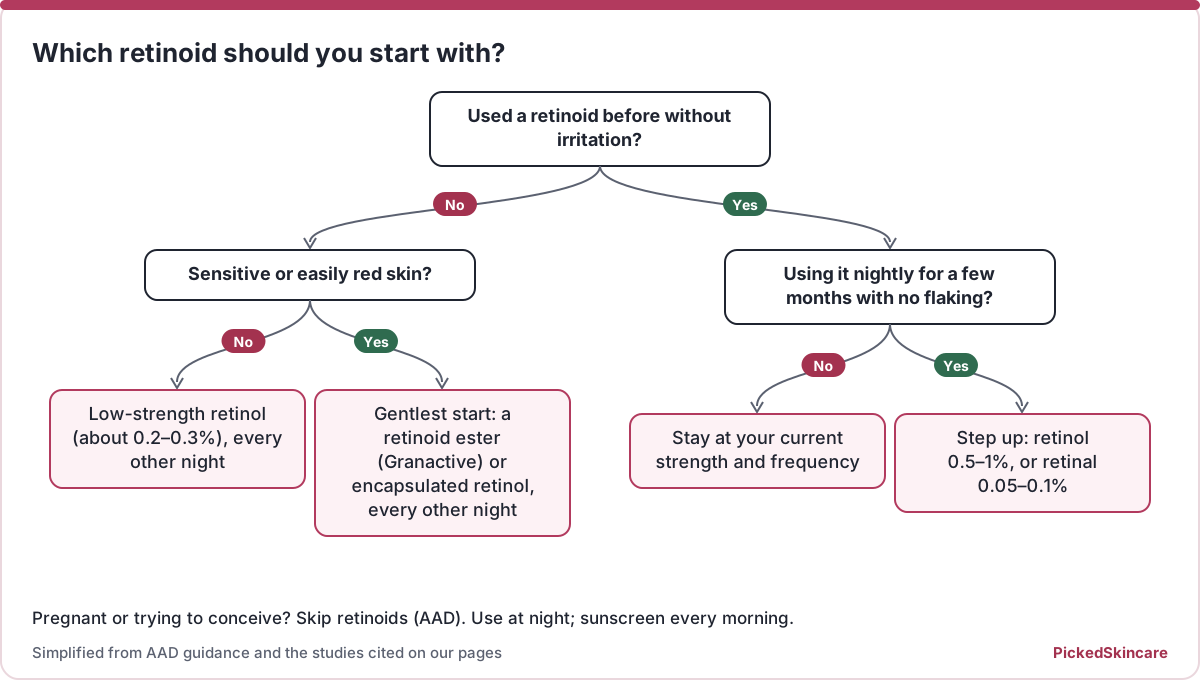
- Anyone new to retinoids: Both brands steer first-timers lower, and the AAD[4][7] advises starting with the lowest-strength formula every other night. Consider instead: a beginner-strength retinol.
- Pregnant or breastfeeding: Both brands say to avoid retinol; the AAD[4][7] says retinoids should not be used during pregnancy.
- Very red or rosacea-prone skin: The AAD[4][7] advises people with a lot of redness or inflammation to avoid retinoids and see a dermatologist.
How can you spend less?
The Ordinary is the budget pick at $9.90, and its 0.2% ($8.10) and 0.5% ($9.30) steps let you build tolerance for under $30 total.
What should you know before you start?
- Patch test first. The American Academy of Dermatology suggests applying a new product to a quarter-sized area twice a day for 7 to 10 days and stopping if you react. AAD: how to test skin care products.
- Add one new product at a time, and give it time: the AAD says many anti-aging products take 6 weeks to 3 months to show results. AAD: get the most from anti-aging products.
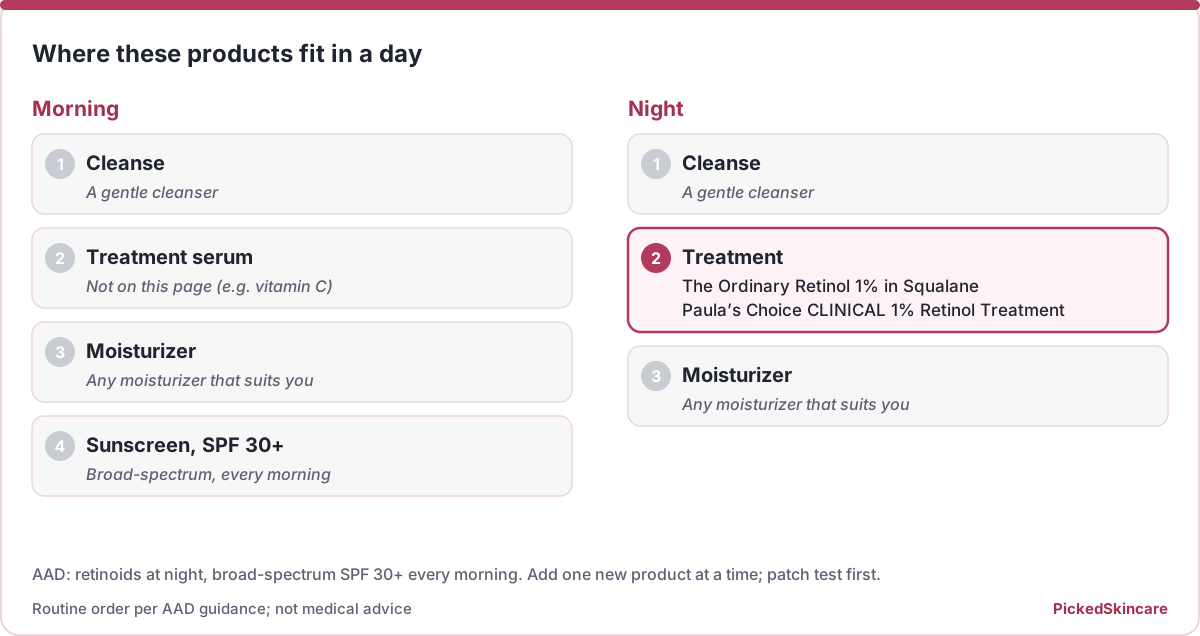
- Retinoids: the AAD says to apply them at night, wear sunscreen daily, start with the lowest strength every other night, and that retinoids should not be used during pregnancy. AAD: retinoid or retinol?
What do people ask most?
Are both really 1% retinol?
Why is Paula’s Choice so much more expensive?
Can I use either with niacinamide?
Where this comes from
We opened and read every source below for this page. Ingredient lists, strengths, directions and prices come from each brand’s own product page; health and usage guidance comes from the American Academy of Dermatology, the FDA, the National Eczema Association and peer-reviewed studies (via PubMed). Prices checked: November 2026; confirm on the seller’s site before you buy.
- The Ordinary (brand page): The Ordinary Retinol 1% in Squalane (theordinary.com)
- The Ordinary (brand page): The Ordinary Retinol 0.2% in Squalane (theordinary.com)
- Paula’s Choice (brand page): Paula’s Choice CLINICAL 1% Retinol Treatment (paulaschoice.com)
- AAD: Retinoid or retinol? (aad.org)
- Milosheska & Roškar 2022, Advances in Therapy: Use of retinoids in topical antiaging treatments (pubmed.ncbi.nlm.nih.gov)
- Kafi et al. 2007, Archives of Dermatology: Improvement of naturally aged skin with vitamin A (retinol) (pubmed.ncbi.nlm.nih.gov)
- AAD: How to test skin care products (aad.org)
Related
The best first retinol for your skin type
Your first retinoid should be low strength, used every other night, and match your skin type. Here are four starting points, from an $8.10 stated-strength retinol to single-dose capsules, and who should skip each.
guideRetinol vs retinal: which one should you start with?
Short answer: start with a low-strength retinol if you have never used a retinoid; move to retinal once your skin handles retinol without flaking. Retinal sits one conversion step closer to retinoic acid, so a smaller percentage does more.
comparisonCeraVe Resurfacing Retinol Serum vs RoC Retinol Correxion Capsules
Neither brand states how much retinol is inside. CeraVe surrounds encapsulated retinol with niacinamide, three ceramides and licorice-derived dipotassium glycyrrhizate; RoC seals retinol in an eight-ingredient silicone serum, one capsule per night.
comparisonThe Ordinary Granactive Retinoid 2% Emulsion vs Retinol 0.2% in Squalane
These are the two products The Ordinary itself points beginners to. Granactive Retinoid 2% is a creamy emulsion built around a retinoid ester (hydroxypinacolone retinoate) plus some retinol; Retinol 0.2% is plain retinol in squalane and jojoba oil.
guideCan you use niacinamide with vitamin C or retinol?
Short answer: niacinamide with retinol is widely accepted; even Paula’s Choice says they pair well. Niacinamide with vitamin C is where brands disagree, so the simple default is vitamin C in the morning and niacinamide or retinol at night.
comparisonThe Ordinary Retinal 0.2% vs Naturium Retinaldehyde Cream Serum 0.10%
Both are for people who already tolerate retinol. The Ordinary’s is twice the stated strength at 0.2% and costs $14.90 for 15 ml; Naturium’s 0.10% is a “sustained-release” cream-serum at $32 and the brand sells a 0.05% step below it.