The Ordinary Retinal 0.2% vs Naturium Retinaldehyde Cream Serum 0.10%
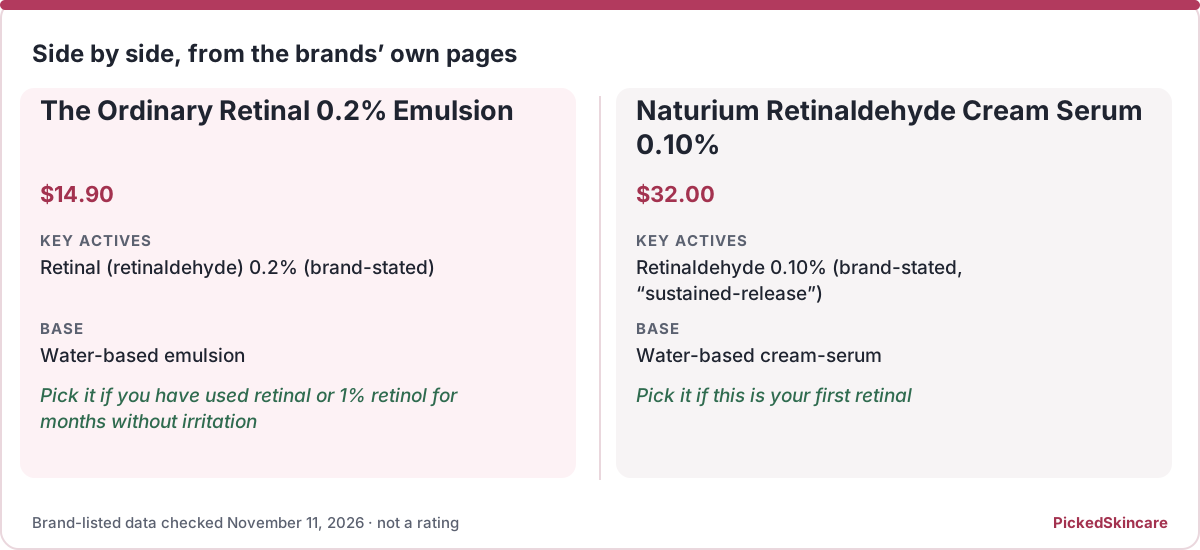
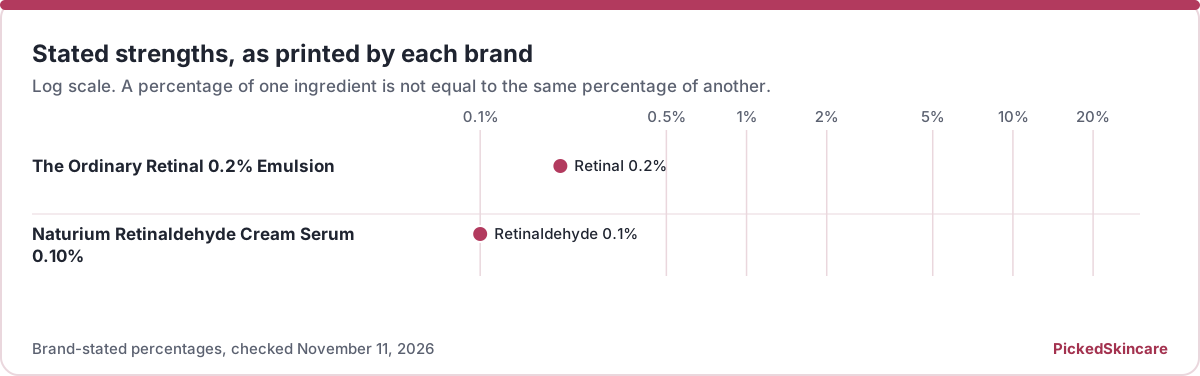
Both are for people who already tolerate retinol. The Ordinary’s is twice the stated strength at 0.2% and costs $14.90 for 15 ml; Naturium’s 0.10% is a “sustained-release” cream-serum at $32 and the brand sells a 0.05% step below it.
Checked against brand ingredient lists on and against dermatology sources (American Academy of Dermatology, FDA, peer-reviewed studies). How we research · Editorial policy · 7 sources
Disclosure: PickedSkincare is reader-supported. “Check price” links may become affiliate links, and we may earn a commission if you buy through them, at no extra cost to you. Commission never decides a pick, and we tell you when the cheaper bottle is the better buy. How we make money.
How this page was made: we compared what each brand publishes (actives, strengths, full ingredient lists, directions and prices) and checked the claims against dermatology guidance and published studies, all linked at the bottom. We haven’t tested these products on our own skin, we don’t publish star ratings, and a commission never decides a pick. Our methodology.
Not medical advice. This page compares cosmetic products. If you have a skin condition, use prescription treatment, or are pregnant or breastfeeding, ask a dermatologist or your doctor before starting something new.
Short answer
pick Naturium Retinaldehyde 0.10% ($32) if this is your first retinal and you want the gentler step, ideally after its 0.05% version. Pick The Ordinary Retinal 0.2% ($14.90, 15 ml) only if you have used retinal or 1% retinol comfortably for months and want the higher stated strength.
Last updated Ingredient lists checked 2026-11-11Prices checked November 2026
Check The Ordinary Retinal 0.2% Emulsion price (opens in a new tab)Check Naturium Retinaldehyde Cream Serum 0.10% price (opens in a new tab)
The numbers side by side
| The Ordinary Retinal 0.2% Emulsion | Naturium Retinaldehyde Cream Serum 0.10% | |
|---|---|---|
| Price (brand site) | $14.90 for 15 ml | $32.00 |
| Retinal (retinaldehyde) | 0.2% (stated) | 0.10% (stated), “sustained-release” |
| Lower step from the same brand | Points beginners to Granactive Retinoid 2% or Retinol 0.2% | Retinaldehyde 0.05%; Retinol Complex for beginners |
| Brand’s user level | “Recommended for experienced users of retinoids” | For “more experienced” retinol users, after the 0.05% |
| Base | Water-based emulsion with hydroxyapatite | Water-based cream-serum |
Retinal (retinaldehyde) is one conversion step closer to the active form of vitamin A than retinol, so the percentages are small. Both brands state theirs, which lets you compare directly. We read the brand pages and the retinaldehyde research; we haven’t tried either serum.
How do they differ, line by line?
| The Ordinary Retinal 0.2% Emulsion | Naturium Retinaldehyde Cream Serum 0.10% | |
|---|---|---|
| Price (brand site) | $14.90 for 15 ml | $32.00 |
| Retinal (retinaldehyde) | 0.2% (stated) | 0.10% (stated), “sustained-release” |
| Lower step from the same brand | Points beginners to Granactive Retinoid 2% or Retinol 0.2% | Retinaldehyde 0.05%; Retinol Complex for beginners |
| Brand’s user level | “Recommended for experienced users of retinoids” | For “more experienced” retinol users, after the 0.05% |
| Base | Water-based emulsion with hydroxyapatite | Water-based cream-serum |
| Notable extras | Hydroxyapatite, ergothioneine, bisabolol, ginger root extract | Yeast extracts, pomegranate seed extract, tocopherol |
| Brand directions | PM use only; sunscreen strongly advised | PM; reduce frequency if redness; sunscreen by day; patch test |
| Color | Bright yellow; can tint skin and light fabrics | Not noted |
What does each do well, and where does it fall short?
The Ordinary Retinal 0.2% Emulsion: pros
- Higher stated strength for experienced users
- Lower price per bottle
- Clear warning about color transfer
The Ordinary Retinal 0.2% Emulsion: cons
- Only 15 ml
- Brand reserves it for experienced retinoid users
- Can tint pillowcases if not fully absorbed
Naturium Retinaldehyde Cream Serum 0.10%: pros
- Half the stated strength, with a 0.05% step below it
- Brand lists it as fragrance free
- Cream-serum texture
Naturium Retinaldehyde Cream Serum 0.10%: cons
- $32 per bottle
- Long ingredient list with several botanical extracts
- Size not stated on the page we checked
Which one fits your skin?
Naturium is the sensible first retinal; The Ordinary is the stronger, cheaper bottle for people who have already been there. Saurat[3] et al. (1994) found 0.05% and 0.1% retinaldehyde well tolerated on the face, which lines up with Naturium’s 0.05% to 0.10% ladder. We found no published study of 0.2% retinal in a product like The Ordinary’s.
Pick The Ordinary Retinal 0.2% Emulsion if…
- you have used retinal or 1% retinol for months without irritation
- you want the higher stated strength
- you are fine with a 15 ml bottle and yellow tint
Pick Naturium Retinaldehyde Cream Serum 0.10% if…
- this is your first retinal
- your skin is on the sensitive side but tolerates retinol
- you prefer a cream-serum texture
What’s in each bottle?
Copied from each brand’s own product page (or the sunscreen’s Drug Facts) on November 11, 2026. Brands reformulate, so the carton in your hand is the final word.
The Ordinary Retinal 0.2% Emulsion
- Key actives
- Retinal (retinaldehyde) 0.2% (brand-stated)
- Base
- Water-based emulsion
- Brand price
- $14.90 · 15 ml
- Brand notes
- Brand calls it a “very high strength” retinoid, recommended for experienced retinoid users; newcomers are pointed to Granactive Retinoid 2% Emulsion or Retinol 0.2%. The yellow color can tint skin and light fabrics.
Full ingredient list
Aqua (Water), Coco-Caprylate/Caprate, Propanediol, Pentylene Glycol, Hydroxyapatite, Retinal, Cetylhydroxyproline Palmitamide, 4-t-Butylcyclohexanol, Hydroxyphenyl Propamidobenzoic Acid, Ergothioneine, Biosaccharide Gum-1, Bisabolol, Brassica Campestris Sterols, Zingiber Officinale Root Extract, Butylene Glycol, Isohexadecane, Hexyldecanol, Maltodextrin, Caesalpinia Spinosa Gum, Polyacrylate Crosspolymer-6, Hydroxyethyl Acrylate/Sodium Acryloyldimethyl Taurate Copolymer, Stearic Acid, Isoceteth-20, Polysorbate 60, Ascorbyl Palmitate, Tocopherol, Lactic Acid, Sodium Lactate, Sodium Hydroxide, Ethylhexylglycerin, Phenoxyethanol, Chlorphenesin.
The Ordinary product page · Check price on Amazon (opens in a new tab)
Naturium Retinaldehyde Cream Serum 0.10%
- Key actives
- Retinaldehyde 0.10% (brand-stated, “sustained-release”)
- Base
- Water-based cream-serum
- Brand price
- $32.00
Full ingredient list
Aqua (Water), Glycerin, Propanediol, Triheptanoin, C13-15 Alkane, Coco-Caprylate/Caprate, Carbomer, Faex (Yeast) Extract, Apricot Kernel Oil Polyglyceryl-6 Esters, Soy Amino Acids, Punica Granatum Seed Extract, Cetyl Diglyceryl Tris (Trimethylsiloxy) Silylethyl Dimethicone, Hydrolyzed Yeast Extract, Olivine Extract, Dilinoleic Acid/Butanediol Copolymer, Cellulose, Phenoxyethanol, Sorbitan Oleate, Sodium Metabisulfite, Retinal, Guanosine, Uracil, Polyacrylate Crosspolymer-6, C9-12 Alkane, Caprylyl Glycol, Polyglyceryl-10 Dipalmitate, Dipropylene Glycol, Sodium Hydroxide, Glyceryl Polyacrylate, Tocopherol, PVM/MA Copolymer, Adenosine Phosphate, Castor Oil/IPDI Copolymer, Potassium Sorbate, Hexadecene, Sodium Benzoate, T-Butyl Alcohol.
Naturium product page · Check price on Amazon (opens in a new tab)
What does the retinaldehyde research show?
- Saurat[3] et al. (1994): 0.05%, 0.1% and 0.5% retinaldehyde produced dose-dependent changes in the outer skin over 1 to 3 months; 0.05% and 0.1% were well tolerated on the face, while a 1% preparation was tolerated by up to 70% of people.
- Duell et al. (1997): under occlusion, 0.01% retinaldehyde triggered the same retinoid-response enzyme that needed 0.025% retinol.
- Mukherjee[5] et al. (2006): retinaldehyde and retinol are considerably less irritating than prescription tretinoin and tazarotene.
Which one suits your skin type?
- Experienced, not sensitive: The Ordinary 0.2%.
- Experienced but reactive: Naturium 0.05%, then 0.10%.
- New to vitamin A: neither yet. See retinol for beginners.
Who should skip it?
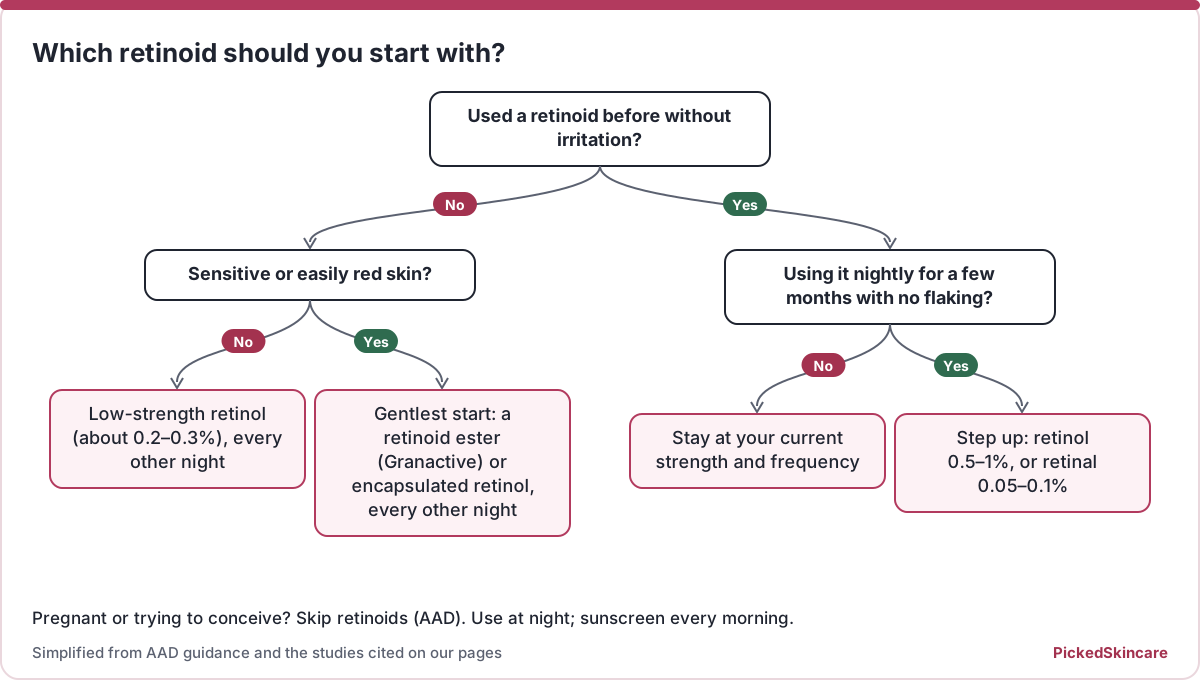
- Retinoid beginners: Both brands point beginners to gentler products first, and the AAD[6][7] advises starting with the lowest strength.
- Pregnant or breastfeeding: The AAD[6][7] says retinoids should not be used during pregnancy; The Ordinary lists pregnancy and breastfeeding under its cautions.
- Very red or rosacea-prone skin: The AAD[6][7] advises avoiding retinoids if you have a lot of redness or inflammation.
How can you spend less?
The Ordinary is cheaper per bottle at $14.90, but it is the stronger product. If budget is the priority and you are still building tolerance, The Ordinary Retinol 0.5% in Squalane ($9.30) is the step before any retinal.
What should you know before you start?
- Patch test first. The American Academy of Dermatology suggests applying a new product to a quarter-sized area twice a day for 7 to 10 days and stopping if you react. AAD: how to test skin care products.
- Add one new product at a time, and give it time: the AAD says many anti-aging products take 6 weeks to 3 months to show results. AAD: get the most from anti-aging products.
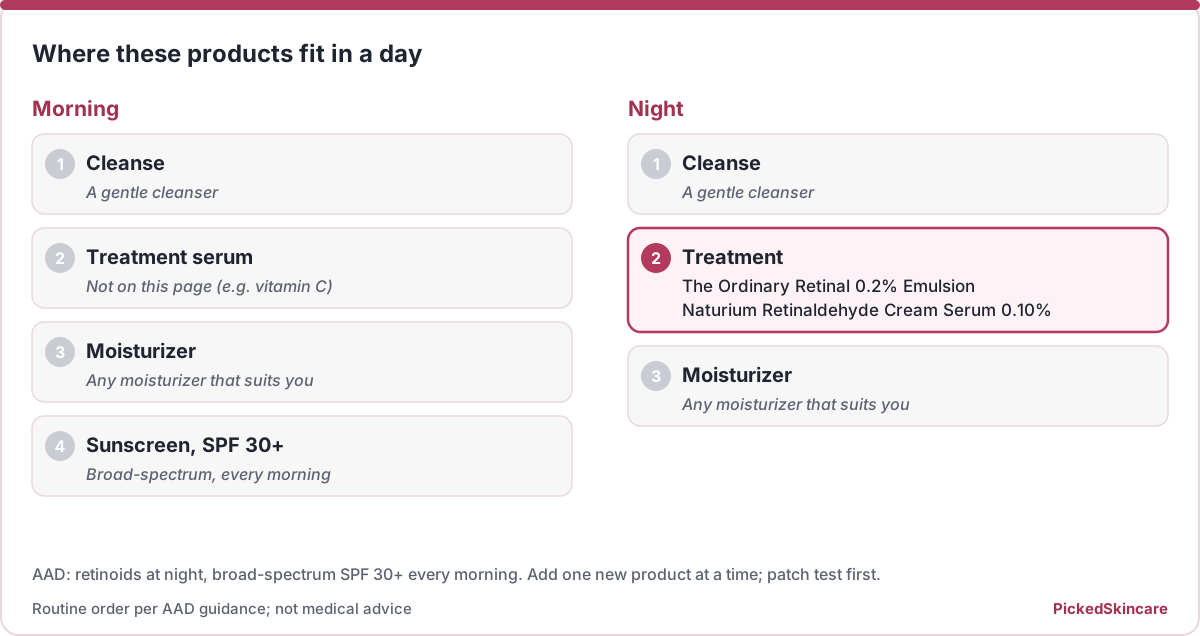
- Retinoids: the AAD says to apply them at night, wear sunscreen daily, start with the lowest strength every other night, and that retinoids should not be used during pregnancy. AAD: retinoid or retinol?
What do people ask most?
Is 0.2% retinal twice as strong as 0.1% retinal?
Why does The Ordinary Retinal stain fabric?
Can I go from retinol straight to 0.2% retinal?
Where this comes from
We opened and read every source below for this page. Ingredient lists, strengths, directions and prices come from each brand’s own product page; health and usage guidance comes from the American Academy of Dermatology, the FDA, the National Eczema Association and peer-reviewed studies (via PubMed). Prices checked: November 2026; confirm on the seller’s site before you buy.
- The Ordinary (brand page): The Ordinary Retinal 0.2% Emulsion (theordinary.com)
- Naturium (brand page): Naturium Retinaldehyde Cream Serum 0.10% (naturium.com)
- Saurat et al. 1994, Journal of Investigative Dermatology: Topical retinaldehyde on human skin (pubmed.ncbi.nlm.nih.gov)
- Duell et al. 1997, Journal of Investigative Dermatology: Unoccluded retinol penetrates human skin (pubmed.ncbi.nlm.nih.gov)
- Mukherjee et al. 2006, Clinical Interventions in Aging: Retinoids in the treatment of skin aging (pubmed.ncbi.nlm.nih.gov)
- AAD: Retinoid or retinol? (aad.org)
- AAD: How to test skin care products (aad.org)
Related
Retinol vs retinal: which one should you start with?
Short answer: start with a low-strength retinol if you have never used a retinoid; move to retinal once your skin handles retinol without flaking. Retinal sits one conversion step closer to retinoic acid, so a smaller percentage does more.
best ofThe best first retinol for your skin type
Your first retinoid should be low strength, used every other night, and match your skin type. Here are four starting points, from an $8.10 stated-strength retinol to single-dose capsules, and who should skip each.
comparisonThe Ordinary Granactive Retinoid 2% Emulsion vs Retinol 0.2% in Squalane
These are the two products The Ordinary itself points beginners to. Granactive Retinoid 2% is a creamy emulsion built around a retinoid ester (hydroxypinacolone retinoate) plus some retinol; Retinol 0.2% is plain retinol in squalane and jojoba oil.
comparisonThe Ordinary Retinol 1% vs Paula’s Choice CLINICAL 1% Retinol
Both brands state 1% retinol. The Ordinary puts it in a short, water-free oil base for $9.90; Paula’s Choice puts it in a lotion with peptides, a vitamin C derivative and soothing extracts for $65 list. Neither is a starting strength.
comparisonCeraVe Resurfacing Retinol Serum vs RoC Retinol Correxion Capsules
Neither brand states how much retinol is inside. CeraVe surrounds encapsulated retinol with niacinamide, three ceramides and licorice-derived dipotassium glycyrrhizate; RoC seals retinol in an eight-ingredient silicone serum, one capsule per night.