CeraVe PM Facial Moisturizing Lotion vs La Roche-Posay Toleriane Double Repair
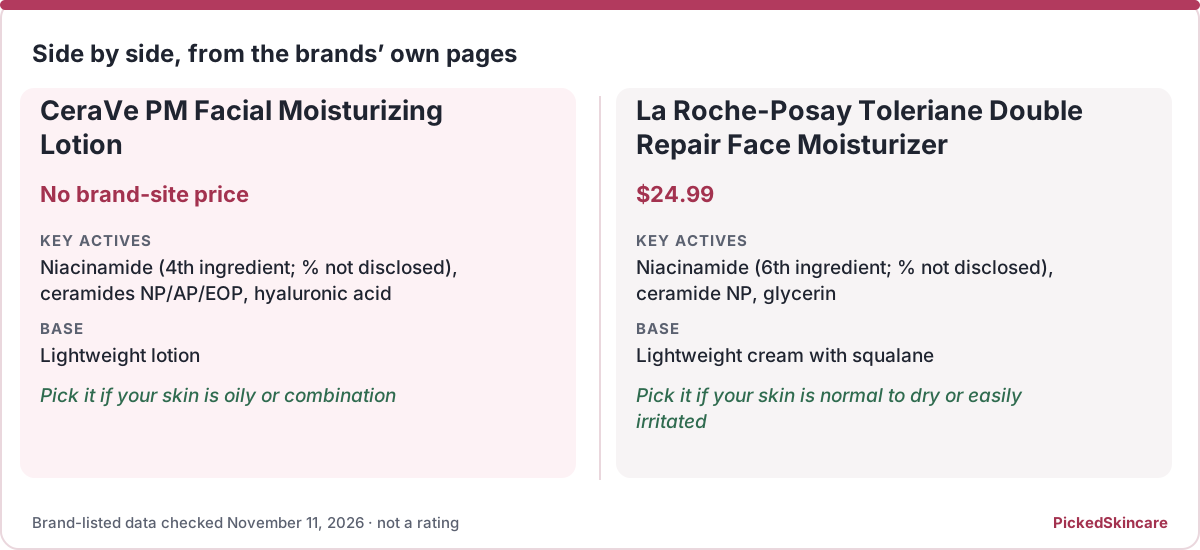
These two read alike on the shelf: glycerin, niacinamide, ceramide, fragrance-free. Underneath, CeraVe has three ceramides, cholesterol and hyaluronic acid in a light lotion labeled for night; La Roche-Posay has one ceramide and squalane in a lightweight cream for day or night at $24.99 for 100 ml.
Checked against brand ingredient lists on and against dermatology sources (American Academy of Dermatology, FDA, peer-reviewed studies). How we research · Editorial policy · 8 sources
Disclosure: PickedSkincare is reader-supported. “Check price” links may become affiliate links, and we may earn a commission if you buy through them, at no extra cost to you. Commission never decides a pick, and we tell you when the cheaper bottle is the better buy. How we make money.
How this page was made: we compared what each brand publishes (actives, strengths, full ingredient lists, directions and prices) and checked the claims against dermatology guidance and published studies, all linked at the bottom. We haven’t tested these products on our own skin, we don’t publish star ratings, and a commission never decides a pick. Our methodology.
Not medical advice. This page compares cosmetic products. If you have a skin condition, use prescription treatment, or are pregnant or breastfeeding, ask a dermatologist or your doctor before starting something new.
Short answer
pick CeraVe PM if your skin is oily or combination and you want a light night lotion with three ceramides and hyaluronic acid. Pick La Roche-Posay Toleriane Double Repair ($24.99, 100 ml) if your skin is normal to dry or sensitive and you want one moisturizer for morning and night, with squalane for extra slip.
Last updated Ingredient lists checked 2026-11-11Prices checked November 2026
Check CeraVe PM Facial Moisturizing Lotion price (opens in a new tab)Check La Roche-Posay Toleriane Double Repair price (opens in a new tab)
The numbers side by side
| CeraVe PM Facial Moisturizing Lotion | La Roche-Posay Toleriane Double Repair Face Moisturizer | |
|---|---|---|
| Price (brand site) | Not sold direct; check a retailer | $24.99 for 100 ml ($0.25/ml) |
| Niacinamide | 4th ingredient; % not stated | 6th ingredient; % not stated |
| Ceramides | Three: NP, AP, EOP (plus cholesterol, phytosphingosine) | One: NP |
| Other notable | Hyaluronic acid (sodium hyaluronate), caprylic/capric triglyceride | Squalane, dimethicone, corn starch |
| Ingredient count | 24 | 18 |
Both are fragrance-free facial moisturizers built around the same idea: humectant (glycerin), barrier lipids (ceramides) and niacinamide. Neither brand states its niacinamide percentage. We lined up both full ingredient lists from the brand pages. We haven’t tested them on our own skin.
How do they differ, line by line?
| CeraVe PM Facial Moisturizing Lotion | La Roche-Posay Toleriane Double Repair | |
|---|---|---|
| Price (brand site) | Not sold direct; check a retailer | $24.99 for 100 ml ($0.25/ml) |
| Niacinamide | 4th ingredient; % not stated | 6th ingredient; % not stated |
| Ceramides | Three: NP, AP, EOP (plus cholesterol, phytosphingosine) | One: NP |
| Other notable | Hyaluronic acid (sodium hyaluronate), caprylic/capric triglyceride | Squalane, dimethicone, corn starch |
| Ingredient count | 24 | 18 |
| When to use (brand) | PM only | Day or night |
| Fragrance | Free of added fragrance | Fragrance-free (no fragrance in list) |
| Brand skin-type note | Lightweight, oil-free, non-comedogenic | Normal/combination and dry; suitable for sensitive skin; non-comedogenic |
What does each do well, and where does it fall short?
CeraVe PM Facial Moisturizing Lotion: pros
- Three ceramides plus cholesterol, the fuller barrier-lipid set
- Oil-free, lightweight lotion
- Hyaluronic acid included
CeraVe PM Facial Moisturizing Lotion: cons
- Labeled PM only (no SPF; CeraVe sells an AM version)
- No price on the brand site
La Roche-Posay Toleriane Double Repair Face Moisturizer: pros
- Shorter list (18 ingredients)
- Squalane adds emollience for drier skin
- Brand positions it for sensitive skin, day or night
La Roche-Posay Toleriane Double Repair Face Moisturizer: cons
- One ceramide
- Description mentions thermal water that isn’t in the listed ingredients
- No SPF; add sunscreen by day
Which one fits your skin?
Both are sound, simple moisturizers, and the choice is about feel and timing. CeraVe PM has the more complete barrier-lipid lineup in a lighter lotion; La Roche-Posay is the squalane cream for day and night with a shorter list. Moisturizer helps the skin barrier regardless of brand: a 2023 review in Skin Pharmacology and Physiology reports that moisturizers have been shown to improve water loss through the skin.
Pick CeraVe PM Facial Moisturizing Lotion if…
- your skin is oily or combination
- you want a light night lotion, maybe over a retinoid
- you want three ceramides plus hyaluronic acid
Pick La Roche-Posay Toleriane Double Repair Face Moisturizer if…
- your skin is normal to dry or easily irritated
- you want one moisturizer for day and night
- you prefer a shorter ingredient list
What’s in each bottle?
Copied from each brand’s own product page (or the sunscreen’s Drug Facts) on November 11, 2026. Brands reformulate, so the carton in your hand is the final word.
CeraVe PM Facial Moisturizing Lotion
- Key actives
- Niacinamide (4th ingredient; % not disclosed), ceramides NP/AP/EOP, hyaluronic acid
- Base
- Lightweight lotion
- Brand price
- Not sold on the brand site; check a retailer
- Brand notes
- Brand: free of added fragrance. CeraVe does not sell direct on its site.
Full ingredient list
Aqua / Water / Eau, Glycerin, Caprylic/Capric Triglyceride, Niacinamide, Cetearyl Alcohol, Potassium Phosphate, Ceramide NP, Ceramide AP, Ceramide EOP, Carbomer, Dimethicone, Ceteareth-20, Behentrimonium Methosulfate, Sodium Lauroyl Lactylate, Sodium Hyaluronate, Cholesterol, Phenoxyethanol, Disodium EDTA, Dipotassium Phosphate, Caprylyl Glycol, Phytosphingosine, Xanthan Gum, Polyglyceryl-3 Diisostearate, Ethylhexylglycerin.
CeraVe product page · Check price on Amazon (opens in a new tab)
La Roche-Posay Toleriane Double Repair Face Moisturizer
- Key actives
- Niacinamide (6th ingredient; % not disclosed), ceramide NP, glycerin
- Base
- Lightweight cream with squalane
- Brand price
- $24.99 · 100 ml ($0.25/ml)
- Brand notes
- Brand: suitable for sensitive skin, non-comedogenic, drying-alcohol-free; recommended for normal/combination and dry skin. (The ingredient list does not include La Roche-Posay thermal water, although the description mentions it.)
Full ingredient list
Aqua / Water / Eau, Glycerin, Squalane, Dimethicone, Zea Mays Starch / Corn Starch, Niacinamide, Ammonium Polyacryloyldimethyl Taurate, Myristyl Myristate, Stearic Acid, Ceramide NP, Potassium Cetyl Phosphate, Glyceryl Stearate SE, Sodium Hydroxide, Myristic Acid, Palmitic Acid, Capryloyl Glycine, Caprylyl Glycol, Xanthan Gum.
La Roche-Posay product page · Check price on Amazon (opens in a new tab)
Which ingredients actually matter here?
- Glycerin (2nd in both): a humectant; the AAD[3][8] lists glycerin among the moisturizer ingredients to look for if your skin is dry.
- Ceramides: lipids your skin barrier is built from. Tanno[4] et al. (2000) also found niacinamide increased the skin’s own ceramide production.
- Niacinamide: listed high in both, but neither brand gives a percentage, so we can’t match it to the 2% to 5% used in studies.
- Squalane and dimethicone (La Roche-Posay): emollients that smooth; the AAD also lists dimethicone for dry skin.
Which one suits your skin type?
- Oily / acne-prone: CeraVe PM (oil-free, non-comedogenic).
- Dry: La Roche-Posay, or step up to a cream; the AAD[3][8] says creams and ointments are more effective than lotions for dry skin.
- Sensitive: both are fragrance-free; patch test either. The FDA[6][7] notes that “hypoallergenic” has no legal definition, so rely on the ingredient list.
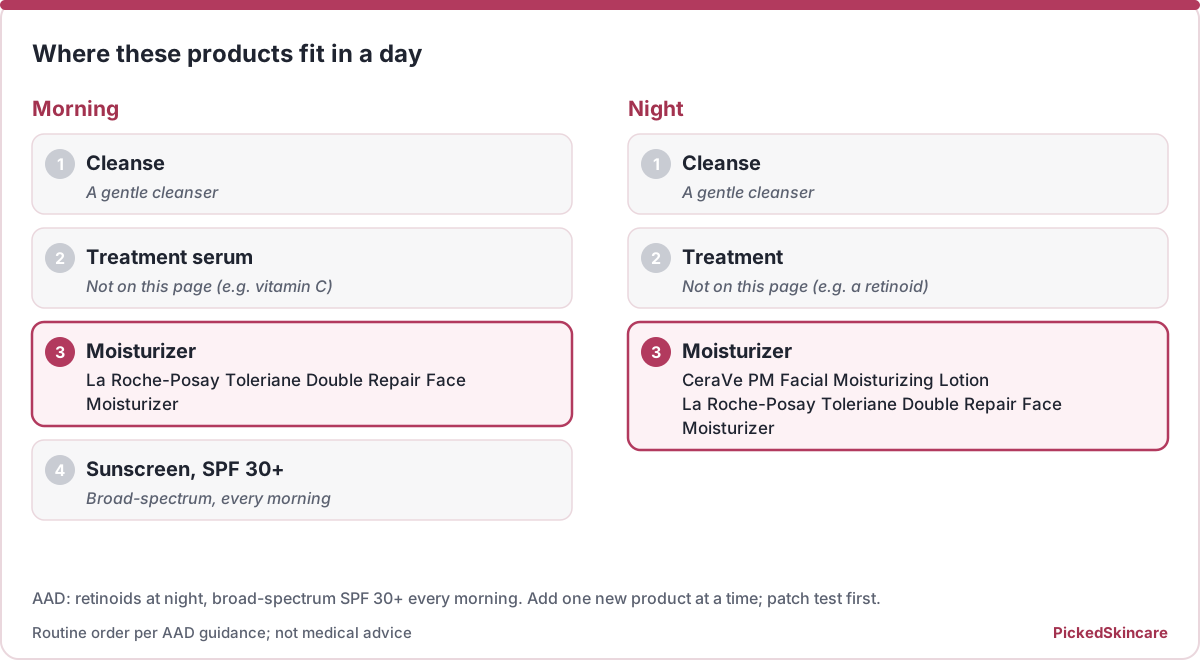
- Using a retinoid: either works as the buffer moisturizer the AAD describes.
Who should skip it?
- Very dry or eczema-prone skin looking for one product: The AAD[3][8] says creams and ointments add more moisture than lotions. Consider instead: a thicker cream.
- Anyone using either as daytime sun protection: Neither has SPF. The AAD[3][8] recommends broad-spectrum SPF 30+ daily. Consider instead: CeraVe AM SPF 30 or a separate sunscreen.
How can you spend less?
La Roche-Posay lists $24.99 for 100 ml on its own site. CeraVe doesn’t sell direct; retailer prices vary, so compare per ml at checkout.
What should you know before you start?
- Patch test first. The American Academy of Dermatology suggests applying a new product to a quarter-sized area twice a day for 7 to 10 days and stopping if you react. AAD: how to test skin care products.
- Add one new product at a time, and give it time: the AAD says many anti-aging products take 6 weeks to 3 months to show results. AAD: get the most from anti-aging products.
What do people ask most?
Can I use CeraVe PM in the morning?
Which has more niacinamide?
Are they non-comedogenic?
Where this comes from
We opened and read every source below for this page. Ingredient lists, strengths, directions and prices come from each brand’s own product page; health and usage guidance comes from the American Academy of Dermatology, the FDA, the National Eczema Association and peer-reviewed studies (via PubMed). Prices checked: November 2026; confirm on the seller’s site before you buy.
- CeraVe (brand page): CeraVe PM Facial Moisturizing Lotion (cerave.com)
- La Roche-Posay (brand page): La Roche-Posay Toleriane Double Repair Face Moisturizer (laroche-posay.us)
- AAD: Dermatologists’ top tips for relieving dry skin (aad.org)
- Tanno et al. 2000, British Journal of Dermatology: Nicotinamide increases ceramide biosynthesis (pubmed.ncbi.nlm.nih.gov)
- Rajkumar et al. 2023, Skin Pharmacology and Physiology: The skin barrier and moisturization (pubmed.ncbi.nlm.nih.gov)
- FDA: “Hypoallergenic” cosmetics (fda.gov)
- FDA: Fragrances in cosmetics (fda.gov)
- AAD: How to select anti-aging skin care products (aad.org)
Related
CeraVe AM vs PM Facial Moisturizing Lotion: what’s actually different?
The real difference is sunscreen. AM is a broad-spectrum SPF 30 with zinc oxide 8%, homosalate 10%, octinoxate 5% and octocrylene 2%; PM has no SPF and is labeled night only. Both list niacinamide near the top, three ceramides and hyaluronic acid.
comparisonVanicream Moisturizing Cream vs CeraVe Moisturizing Cream
Both are fragrance-free, non-comedogenic, carry National Eczema Association recognition and go on face and body. The real split: Vanicream keeps its list to 10 ingredients and has no ceramides; CeraVe adds three ceramides, cholesterol and hyaluronic acid across 24.
comparisonCeraVe Moisturizing Cream vs CeraVe Daily Moisturizing Lotion
CeraVe says the main difference between these two is texture. The ingredient lists show why: the cream has petrolatum near the top and more fatty alcohols; the lotion has no petrolatum and is labeled oil-free. Both carry ceramides NP, AP and EOP, cholesterol and hyaluronic acid.
guideWhat niacinamide percentage do you actually need?
Short answer: the clinical studies we found used 2% niacinamide for oiliness and 5% for spots, blotchiness and fine lines. Serums at 10% to 12% are popular, but we found no trial showing they beat 5%, and higher strengths are more likely to sting reactive skin.
best ofThe best first retinol for your skin type
Your first retinoid should be low strength, used every other night, and match your skin type. Here are four starting points, from an $8.10 stated-strength retinol to single-dose capsules, and who should skip each.
comparisonThe Ordinary Niacinamide 10% + Zinc 1% vs Naturium Niacinamide 12% + Zinc 2%
Both are high-strength niacinamide serums with zinc PCA, used morning and night. The Ordinary’s is 10% for $6; Naturium’s is 12% with hyaluronic acid for $17. Published trials used far less niacinamide than either: 2% to 5%.
comparisonThe Ordinary Granactive Retinoid 2% Emulsion vs Retinol 0.2% in Squalane
These are the two products The Ordinary itself points beginners to. Granactive Retinoid 2% is a creamy emulsion built around a retinoid ester (hydroxypinacolone retinoate) plus some retinol; Retinol 0.2% is plain retinol in squalane and jojoba oil.