Tinted mineral sunscreen for deeper skin: three US Drug Facts labels
A tint is how you cut a mineral white cast, and it is also what the AAD points to for visible light. CeraVe and the DailyMed label for Anthelios each name a Deep shade. EltaMD UV AOX Elements is one tint, not a shade range.
Checked against brand ingredient lists on and against dermatology sources (American Academy of Dermatology, FDA, peer-reviewed studies). How we research · Editorial policy · 9 sources
Disclosure: PickedSkincare is reader-supported. Some “Check price” links are Amazon affiliate links. If you buy through them, we earn a commission at no extra cost to you. As an Amazon Associate, PickedSkincare earns from qualifying purchases. Commission never decides a pick, and we tell you when the cheaper bottle is the better buy. How we make money.
How this page was made: we compared what each brand publishes (actives, strengths, full ingredient lists, directions and prices) and checked the claims against dermatology guidance and published studies, all linked at the bottom. On November 19, 2026 the CeraVe Sheer Tint Deep page was opened again. The product-details price is $15.99, in the same block as Find in Stores, and the buy-online object names 1.7 oz at that price. It is not a CeraVe checkout button. On November 18, 2026 CeraVe Sheer Tint Deep, Medium and Light were read on cerave.com, and Deep was checked against DailyMed setid a1cab79d-0151-49ee-86dc-c2739842e62e. Actives match at titanium dioxide 5.5% and zinc oxide 10%. The inactive lists do not match, so salicylic acid is not stated as an ingredient. EltaMD UV AOX Elements was read on the brand page, the Shopify product file, and DailyMed setid 2c74209d-9b88-4c32-ad42-cd6de16c1fef. Actives match. The brand page says 40 minutes. DailyMed says reapply after 80 minutes of swimming or sweating. Both clocks are stated. A direct request for the La Roche-Posay tinted URL returned HTTP 403 and was not read. Deep-shade facts are from DailyMed setid 8bdd63f7-2f67-4280-9484-d6c8e80ad9b9 only: SPF 40, titanium dioxide 17%, zinc oxide 8%, 50 mL. No brand price and no other-shade formula are stated. A Lyons 2021 record did not load, so that review is not cited. No Korean sunscreen. Brand pages checked November 18, 2026; prices checked November 18, 2026. We haven’t tested these products hands-on, we don’t score or rate them, and a commission never decides a pick. Our methodology.
Not medical advice. This page compares cosmetic products. If you have a skin condition, use prescription treatment, or are pregnant or breastfeeding, ask a dermatologist or your doctor before starting something new.
Short answer
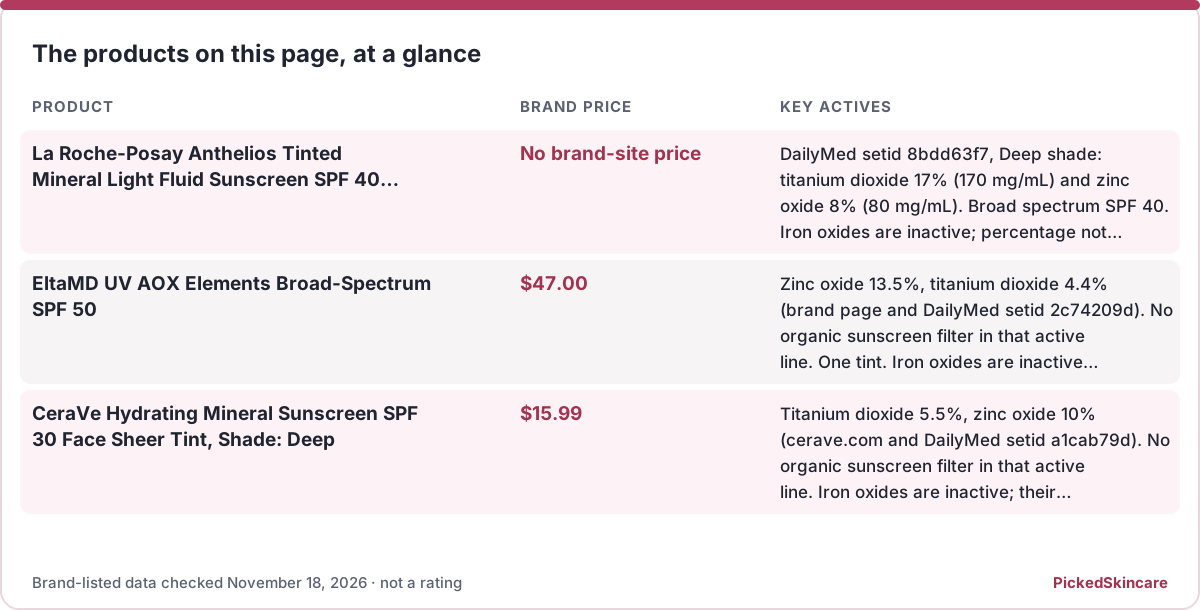
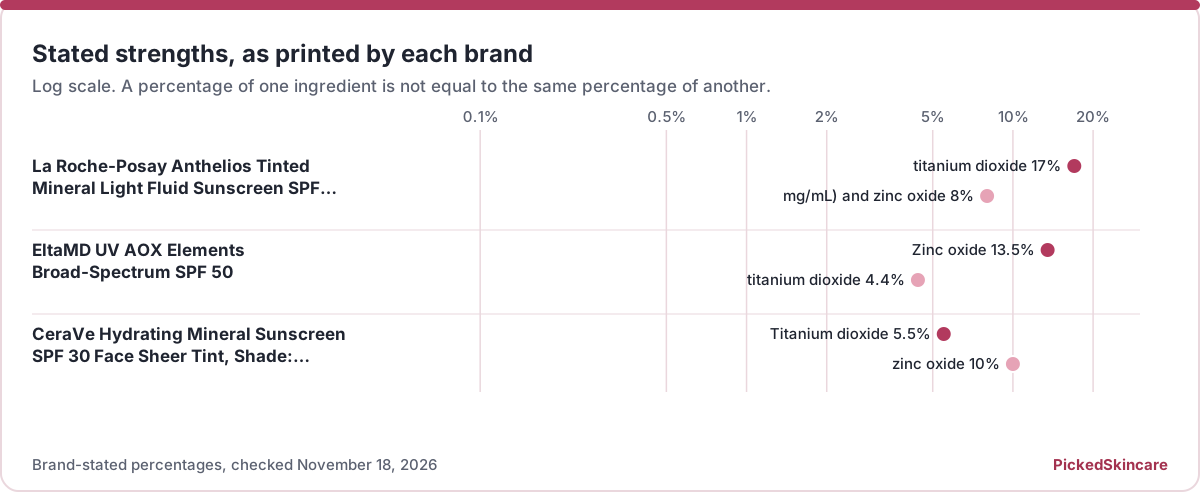
For a named Deep shade, CeraVe Sheer Tint Deep is SPF 30 with titanium dioxide 5.5% and zinc oxide 10%. Anthelios Deep, from DailyMed only, is SPF 40 with titanium dioxide 17% and zinc oxide 8%. EltaMD UV AOX Elements is one tint at SPF 50. All three list only mineral filters plus iron oxides.
Last updated Ingredient lists checked 2026-11-18Prices checked November 18, 2026
The numbers side by side
| Pick | Product | Best for | Price |
|---|---|---|---|
| Deep shade on DailyMed, SPF 40 | La Roche-Posay Anthelios Tinted Mineral Light Fluid Sunscreen SPF 40, Deep | the Deep shade on DailyMed, with titanium dioxide 17% and zinc oxide 8% | No brand price. The brand page returned HTTP 403 on November 18, 2026. |
| One tint, higher zinc, SPF 50 | EltaMD UV AOX Elements Broad-Spectrum SPF 50 | SPF 50 and a high zinc percentage, if one tint is enough on your skin | $47 for 1.7 oz (checked November 18, 2026) |
| Deep shade, drugstore SPF 30 | CeraVe Hydrating Mineral Sunscreen SPF 30 Face Sheer Tint, Shade: Deep | a named Deep shade at SPF 30, when you are not swimming | $15.99 next to Find in Stores (checked November 19, 2026) |
Untinted mineral sunscreens are a different job. That list is mineral-only face sunscreens, and none of those three is an iron-oxide tint. This page only keeps products whose US active line is zinc oxide, titanium dioxide, or both, and whose inactive list includes iron oxides. A hybrid with octinoxate or avobenzone is not on it, even if the front says “tinted.”
Which pick suits which skin?
How do the picks compare side by side?
| Product | Best for | Price | Mineral actives | Tint | Price (checked November 18, 2026) |
|---|---|---|---|---|---|
| Anthelios Tinted Mineral, Deep | The Deep shade on DailyMed, with titanium dioxide 17% and zinc oxide 8% | Brand page returned 403. No price stated. | DailyMed Deep: titanium dioxide 17%, zinc oxide 8%. SPF 40 | Iron oxides on the Deep inactive list. Other shades were not re-read. | DailyMed Deep: use a water-resistant sunscreen if you swim or sweat |
| EltaMD UV AOX Elements SPF 50 | SPF 50 and a high zinc percentage, if one tint is enough on your skin | $47 for 1.7 oz (checked November 18, 2026) | Zinc oxide 13.5%, titanium dioxide 4.4% | One tint | Brand page: 40 minutes. DailyMed: reapply after 80 minutes |
| CeraVe Sheer Tint, Deep | A named Deep shade at SPF 30, when you are not swimming | $15.99 next to Find in Stores | Titanium dioxide 5.5%, zinc oxide 10% | Deep shade; Light and Medium exist, same actives | DailyMed: use a water-resistant sunscreen if you swim or sweat |
Why is each product on the list?
1. La Roche-Posay Anthelios Tinted Mineral Light Fluid Sunscreen SPF 40, Deep
Best for: the Deep shade on DailyMed, with titanium dioxide 17% and zinc oxide 8%DailyMed’s[2][6][7] Deep shade is labeled Anthelios Tinted Mineral Light Fluid Sunscreen Broad Spectrum SPF 40. The actives are titanium dioxide 17% and zinc oxide 8%, in a 50 mL bottle. Iron oxides are first on the inactive list. Directions say to use a water-resistant sunscreen if you swim or sweat, so this is not the swim bottle. The brand page did not load. This page does not repeat a price, a shade count, or another shade’s active line from an earlier read.
Price (November 18, 2026): No brand price. The brand page returned HTTP 403 on November 18, 2026. Source
Pros
- A Deep shade with a Drug Facts label on DailyMed
- SPF 40, titanium dioxide 17% and zinc oxide 8%
- Iron oxides are on the inactive list, which is the tint
Cons
- Deep is not the swim bottle
- The brand page did not load, so other shades are not compared
- No brand price is stated
2. EltaMD UV AOX Elements Broad-Spectrum SPF 50
Best for: SPF 50 and a high zinc percentage, if one tint is enough on your skinEltaMD UV AOX Elements lists zinc oxide 13.5% and titanium dioxide 4.4% on the brand page and on DailyMed[2][6][7]. The brand page says water resistant for 40 minutes and to reapply after 40 minutes of swimming or sweating. DailyMed says to reapply after 80 minutes of swimming or sweating, immediately after towel drying, and at least every 2 hours. The inactive list used here is the DailyMed list, which includes canola oil and sodium citrate. The brand page’s inactive list does not include those two. There is one tint. That is a single color, not a Deep shade you can choose.
Price (November 18, 2026): $47 for 1.7 oz (checked November 18, 2026) Source
Pros
- SPF 50 with only mineral actives
- The highest zinc percentage of these three
- A brand price and a 1.7 oz size
Cons
- One tint, so deeper skin may still look ashy or orange
- The brand inactive list is not the DailyMed list
- The brand page says 40 minutes in the water; DailyMed says 80
3. CeraVe Hydrating Mineral Sunscreen SPF 30 Face Sheer Tint, Shade: Deep
Best for: a named Deep shade at SPF 30, when you are not swimmingCeraVe’s Deep page and DailyMed[2][6][7] setid a1cab79d both list titanium dioxide 5.5% and zinc oxide 10%, and no organic sunscreen active. Iron oxides are on both inactive lists, and the percentage of those pigments is not disclosed. Light and Medium listed the same active percentages the same day. Both lists include capryloyl salicylic acid. Salicylic acid is on the brand page and not on that DailyMed label, so it is not stated as an ingredient. DailyMed says to use a water-resistant sunscreen if you swim or sweat. The product object names a 1.7 oz variant beside the price next to Find in Stores. That is not a CeraVe checkout button.
Price (November 18, 2026): $15.99 next to Find in Stores (checked November 19, 2026) Source
Pros
- A shade named Deep, plus Light and Medium with the same actives
- Only mineral filters in the active line
- Ceramides and niacinamide on both the brand list and DailyMed
Cons
- SPF 30, not 50
- DailyMed does not give it a 40- or 80-minute water line
- cerave.com and DailyMed disagree on whether plain salicylic acid is in the inactives
Also looked at
CeraVe’s untinted Hydrating Mineral SPF 50 is on the mineral-only page. It does not have this iron-oxide tint. EltaMD UV Clear is a hybrid of zinc oxide and octinoxate, including its tinted version, so it is not a mineral-only pick here. Korean sunscreens without a US Drug Facts label were left off on purpose.
What’s in each bottle?
Copied from each brand’s own product page (or the sunscreen’s Drug Facts) on November 18, 2026. Brands reformulate, so the carton in your hand is the final word.
La Roche-Posay Anthelios Tinted Mineral Light Fluid Sunscreen SPF 40, Deep
- Key actives
- DailyMed setid 8bdd63f7, Deep shade: titanium dioxide 17% (170 mg/mL) and zinc oxide 8% (80 mg/mL). Broad spectrum SPF 40. Iron oxides are inactive; percentage not disclosed.
- Base
- Fluid. DailyMed says to use a water-resistant sunscreen if swimming or sweating. This is not the swim bottle.
- Brand price
- Not sold on the brand site; check a retailer
- Brand notes
- The brand URL was not read on November 18, 2026. Other shade formulas are not restated from memory.
Full ingredient list
Inactive, Deep shade, from that DailyMed label: Iron Oxides, Isohexadecane, Dimethicone, Triethylhexanoin, C15-19 Alkane, Silica, C12-15 Alkyl Benzoate, Caprylyl Methicone, Butyloctyl Salicylate, Aluminum Stearate, Dicaprylyl Carbonate, Dicaprylyl Ether, Talc, Dimethicone/PEG-10/15 Crosspolymer, Alumina, Polyhydroxystearic Acid, Water, PEG-9 Polydimethylsiloxyethyl Dimethicone, Pentylene Glycol, Acrylates/Dimethicone Copolymer, Aluminum Hydroxide, Stearic Acid, Phenoxyethanol, Magnesium Sulfate, Caprylyl Glycol, Disodium Stearoyl Glutamate, Triethoxycaprylylsilane, Disteardimonium Hectorite, Diethylhexyl Syringylidenemalonate, Tocopherol, Propylene Carbonate, Cassia Alata Leaf Extract, Maltodextrin, Dipropylene Glycol, Sodium Citrate, Caprylic/Capric Triglyceride.
La Roche-Posay product page · Check price on Amazon (opens in a new tab)
EltaMD UV AOX Elements Broad-Spectrum SPF 50
- Key actives
- Zinc oxide 13.5%, titanium dioxide 4.4% (brand page and DailyMed setid 2c74209d). No organic sunscreen filter in that active line. One tint. Iron oxides are inactive; their percentage is not disclosed.
- Base
- Moisturizing lotion with dimethicone, sodium hyaluronate, tocopherol and ginger root extract.
- Brand price
- $47.00 · 1.7 oz
- Brand notes
- DailyMed: reapply after 80 minutes of swimming or sweating, immediately after towel drying, and at least every 2 hours. The brand page says water resistant for 40 minutes and to reapply after 40 minutes. The brand inactive list does not include canola oil or sodium citrate. Both clocks are stated; neither is dropped.
Full ingredient list
Inactive, from DailyMed setid 2c74209d: Water, Dimethicone, Butyloctyl Salicylate, Octyldodecyl Neopentanoate, Lauryl PEG-9 Polydimethylsiloxyethyl Dimethicone, Cetyl Dimethicone, Dimethicone/PEG-10/15 Crosspolymer, Polyhydroxystearic Acid, Alumina, Phenoxyethanol, Iron Oxides, Triethoxycaprylylsilane, Sodium Chloride, Hydrogen Dimethicone, Sodium Hyaluronate, Potassium Sorbate, Tocopheryl Acetate, Tocopherol, Bisabolol, Carnosine, Dipropylene Glycol, Ascorbyl Palmitate, Sodium Citrate, Canola Oil, Zingiber Officinale (Ginger) Root Extract. DailyMed spells sodium citrate as “soidum citrate”; the standard spelling is used here.
EltaMD product page · Check price on Amazon (opens in a new tab)
CeraVe Hydrating Mineral Sunscreen SPF 30 Face Sheer Tint, Shade: Deep
- Key actives
- Titanium dioxide 5.5%, zinc oxide 10% (cerave.com and DailyMed setid a1cab79d). No organic sunscreen filter in that active line. Iron oxides are inactive; their percentage is not disclosed. Light and Medium listed the same active percentages the same day.
- Base
- Lotion with niacinamide and ceramides NP, AP and EOP on both lists. DailyMed says to use a water-resistant sunscreen if swimming or sweating.
- Brand price
- $15.99 · Page data names a 1.7 oz variant. $15.99 is shown next to Find in Stores, not on a CeraVe checkout button.
- Brand notes
- DailyMed directions: use a water-resistant sunscreen if swimming or sweating, and ask a doctor for children under 6 months. Actives match, so those percentages stay. On November 19, 2026 the page showed $15.99 next to Find in Stores. The buy-online object names 1.7 oz.
Full ingredient list
Not one settled list. Both cerave.com and DailyMed setid a1cab79d include iron oxides and capryloyl salicylic acid. Salicylic acid, ethylene/acrylic acid copolymer, triethanolamine, silica, disodium EDTA and ethylhexylglycerin are on cerave.com and not on that DailyMed label. Glycine soja oil, triethyl citrate and trisodium ethylenediamine disuccinate are on DailyMed and not on the cerave.com list read November 18, 2026. Salicylic acid is not stated as an ingredient. The carton wins.
CeraVe product page · Check price on Amazon (opens in a new tab)
Why does deeper skin change the mineral sunscreen decision?
Mineral filters can leave a white cast. The AAD[8][9] says a tinted sunscreen contains iron oxide, helps with visible light, and is especially useful for darker skin tones.
The AAD’s[8][9] label guide says physical, or mineral, sunscreen is the one whose actives are titanium dioxide, zinc oxide, or both, and that dermatologists recommend that type for sensitive skin. The same page says tinted sunscreen can protect against visible light, that this matters more as skin is darker because UV and visible light can leave dark spots, and that iron oxide is what research ties to that visible-light protection. A tint can also avoid the white residue some sunscreens leave. The page also says visible light contributes to melasma. That is the AAD’s reason to wear a tinted sunscreen, shade and clothing. It is not a claim that any bottle here is a treatment for a pigment condition. If you have melasma or marks that are not just a cosmetic worry, ask a dermatologist.
Which of these three is actually a deeper shade?
CeraVe sells a shade named Deep, and DailyMed[2][6][7] has an Anthelios label named Deep. EltaMD UV AOX Elements is one tint. Try the Deep shade on your jaw in daylight before you buy a second bottle.
- You want a named Deep shade at SPF 30: CeraVe Sheer Tint Deep, not for a long swim. Light and Medium use the same active percentages.
- You want the DailyMed[2][6][7] Deep label, SPF 40, with 17% titanium dioxide and 8% zinc oxide: Anthelios Tinted Mineral in Deep. Still not the water bottle. Other shades were not re-read, because the brand page returned 403.
- You want SPF 50 and can see the single tint on your skin first: EltaMD UV AOX Elements. If the tint looks pale or gray, it is the wrong bottle even though the filters are mineral.
- You only need an untinted mineral lotion: that is the other mineral page, not this one.
What does the AAD not decide for you?
It explains why a tint exists. It does not rank these three bottles, and it does not tell you which shade matches your face.
Iron-oxide percentages are not on any of these labels, so this page does not state how much tint is in Deep versus EltaMD’s single shade. The AAD[8][9] still wants broad spectrum and SPF 30 or higher, and water resistance when the day includes sweat or water. CeraVe is SPF 30. DailyMed[2][6][7] tells you to use a water-resistant sunscreen if you swim or sweat. Anthelios Deep is SPF 40 on DailyMed, with the same swim instruction. EltaMD is SPF 50. Its brand page says 40 minutes. DailyMed says 80 minutes.
Who should skip it?
If your current mineral sunscreen already disappears on your skin and you will wear it, you do not need a new tint. The AAD’s[8][9] point is the sunscreen you use, at SPF 30 or higher and broad spectrum.
- A long swim or heavy sweat on CeraVe or Anthelios Deep: DailyMed[2][6][7] for both says to use a water-resistant sunscreen if you swim or sweat. EltaMD’s two labels disagree: 40 minutes on the brand page, 80 minutes on DailyMed. Consider instead: EltaMD only if you will follow the clock you are willing to trust, or another water-resistant sunscreen.
- Anyone avoiding salicylic acid or salicylates: CeraVe’s brand page and DailyMed[2][6][7] disagree on plain salicylic acid, so this page does not say that name is in the bottle. Both CeraVe lists include capryloyl salicylic acid. Anthelios Deep’s DailyMed inactive list and EltaMD’s DailyMed inactive list both include butyloctyl salicylate. If you are sensitive to salicylates, ask a doctor before any of these three. Consider instead: Ask a doctor. These three are not a salicylate-free set.
- Deeper skin buying EltaMD’s one tint without looking at it in daylight: One beige tint can still leave a cast. CeraVe names a Deep shade. Anthelios Deep is a named shade on DailyMed[2][6][7].
- Children under 6 months: The EltaMD DailyMed[2][6][7] label says to ask a physician. The CeraVe page says to consult a doctor. Sunscreen labels are not a baby-care guide.
- A pigment condition you are trying to manage on your own: Tinted mineral sunscreen is a cosmetic filter choice. Melasma and similar conditions need a dermatologist, not a shade name.
How can you spend less?
EltaMD UV AOX Elements is about $47 for 1.7 oz (checked November 18, 2026). CeraVe Sheer Tint Deep is about $15.99 (checked November 19, 2026), shown next to Find in Stores. Anthelios Deep’s brand page returned HTTP 403, so no price is stated. DailyMed’s[2][6][7] Deep package is 50 mL. A tint that looks wrong on your face is not a bargain.
What should you know before you start?
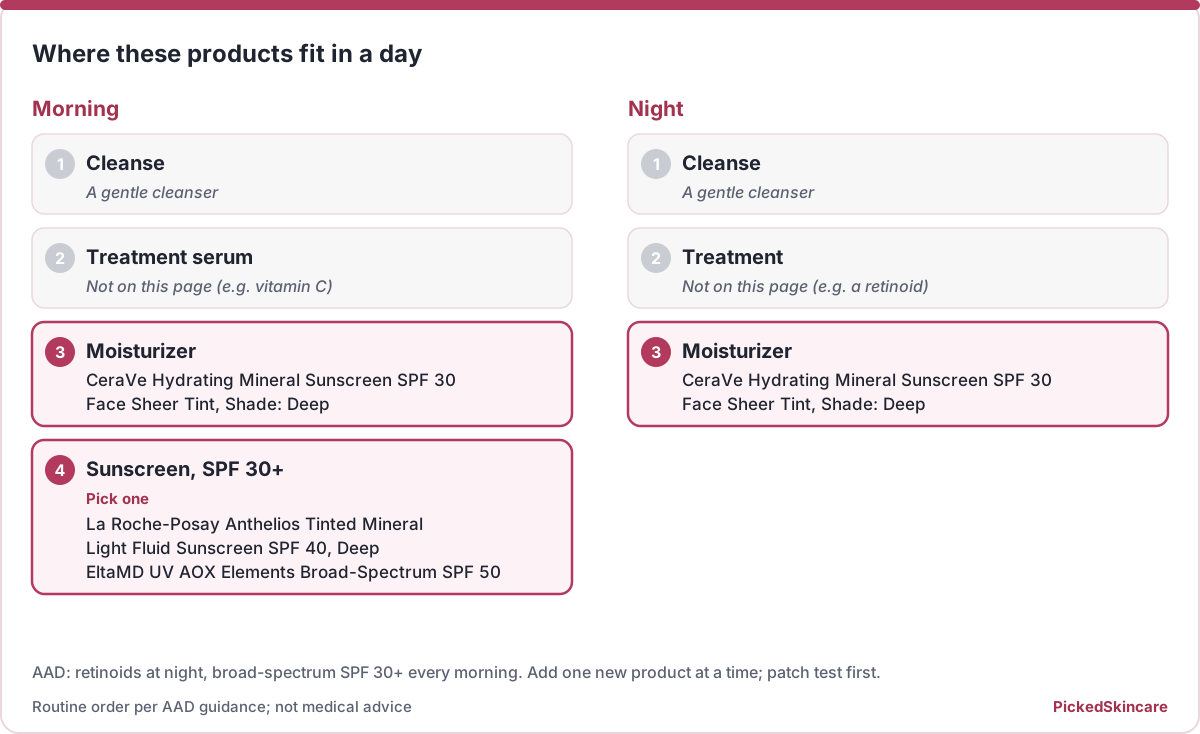
- Patch test first. The American Academy of Dermatology suggests applying a new product to a quarter-sized area twice a day for 7 to 10 days and stopping if you react. AAD: how to test skin care products.
- Add one new product at a time, and give it time: the AAD says many anti-aging products take 6 weeks to 3 months to show results. AAD: get the most from anti-aging products.
What do people ask most?
Is a tinted mineral sunscreen the same as makeup with SPF?
Do the CeraVe Light and Medium shades use different filters?
Is every Anthelios Mineral Tinted shade the same formula?
How long does EltaMD UV AOX Elements say to wait before you reapply in the water?
Where this comes from
We opened and read every source below for this page. Ingredient lists, strengths, directions and prices come from each brand’s own product page; health and usage guidance comes from the American Academy of Dermatology, the FDA, the National Eczema Association and peer-reviewed studies (via PubMed). Prices checked: November 18, 2026; confirm on the seller’s site before you buy.
- CeraVe (brand page): CeraVe Hydrating Mineral Sunscreen SPF 30 Face Sheer Tint, Shade: Deep (cerave.com)
- DailyMed: CeraVe Hydrating Mineral Sheer Tint SPF 30 Deep Drug Facts (dailymed.nlm.nih.gov)
- CeraVe (brand page): Hydrating Mineral Sheer Tint, Medium (cerave.com)
- CeraVe (brand page): Hydrating Mineral Sheer Tint, Light (cerave.com)
- EltaMD (brand page): EltaMD UV AOX Elements Broad-Spectrum SPF 50 (eltamd.com)
- DailyMed: Anthelios tinted mineral SPF 40, Deep shade, Drug Facts (dailymed.nlm.nih.gov)
- DailyMed: EltaMD UV AOX Elements SPF 50 tinted Drug Facts (dailymed.nlm.nih.gov)
- AAD: How to decode a sunscreen label (aad.org)
- AAD: How to select a sunscreen (aad.org)
Related
The best mineral face sunscreen, by what you need
If you want a mineral-only face sunscreen, read the Drug Facts actives first. Zinc oxide and titanium dioxide, and nothing else in that box, is the mineral test. These three pass it. A hybrid such as EltaMD UV Clear does not.
guideLip balm with SPF: 22% zinc oxide, or Aquaphor’s SPF 30 filters
A lip balm with SPF is a sunscreen you can put on your mouth, and the label is the whole claim. EltaMD’s stick is 22% zinc oxide at SPF 36. Aquaphor’s tube is SPF 30 with petrolatum plus five organic filters, including octinoxate and oxybenzone. If your lips are already chapped, the AAD’s avoid list points at the Aquaphor filters and toward the zinc stick.
guideMineral vs chemical sunscreen for sensitive skin: which should you use?
Short answer: if your skin reacts easily, start with a mineral sunscreen (zinc oxide and/or titanium dioxide only), which the AAD says dermatologists recommend for sensitive skin. Any sunscreen that is broad spectrum, SPF 30+ and used generously protects you; the best one is the one you’ll wear every day.
comparisonLa Roche-Posay Anthelios Ultra Light Fluid SPF 60 vs EltaMD UV Clear SPF 46
Anthelios uses four chemical filters (avobenzone, homosalate, octisalate, octocrylene), and is water resistant for 80 minutes. UV Clear pairs zinc oxide 9% with octinoxate 7.5%, adds 5% niacinamide, and isn’t water resistant. EltaMD describes UV Clear as an “oil-free formula designed for sensitive, rosacea, and acne-prone skin.”
comparisonEltaMD UV Clear SPF 46 vs EltaMD UV Daily SPF 40
Both use zinc oxide 9% and octinoxate 7.5%. The difference is the base: UV Clear is oil-free with 5% niacinamide (EltaMD describes it as an “oil-free formula designed for sensitive, rosacea, and acne-prone skin”); UV Daily adds petrolatum and hyaluronic acid and is aimed at dehydrated and mature skin.
guideNiacinamide vs vitamin C for dark spots: which should you try first?
Short answer: start with daily sunscreen (tinted, if you have a darker skin tone), then add one product. Niacinamide is the gentler first try with clearer clinical data on spots; L-ascorbic acid vitamin C is the stronger antioxidant but can sting.