EltaMD UV Clear SPF 46 vs EltaMD UV Daily SPF 40
Both use zinc oxide 9% and octinoxate 7.5%. The difference is the base: UV Clear is oil-free with 5% niacinamide and is aimed at sensitive, rosacea- and acne-prone skin; UV Daily adds petrolatum and hyaluronic acid and is aimed at dehydrated and mature skin.
Checked against brand ingredient lists on and against dermatology sources (American Academy of Dermatology, FDA, peer-reviewed studies). How we research · Editorial policy · 5 sources
Disclosure: PickedSkincare is reader-supported. “Check price” links may become affiliate links, and we may earn a commission if you buy through them, at no extra cost to you. Commission never decides a pick, and we tell you when the cheaper bottle is the better buy. How we make money.
How this page was made: we compared what each brand publishes (actives, strengths, full ingredient lists, directions and prices) and checked the claims against dermatology guidance and published studies, all linked at the bottom. We haven’t tested these products on our own skin, we don’t publish star ratings, and a commission never decides a pick. Our methodology.
Not medical advice. This page compares cosmetic products. If you have a skin condition, use prescription treatment, or are pregnant or breastfeeding, ask a dermatologist or your doctor before starting something new.
Short answer
pick UV Clear ($46, 1.7 oz) if your skin is oily, acne-prone or rosacea-prone. Pick UV Daily ($42, 1.7 oz) if your skin is dry or dehydrated and you want your sunscreen to double as moisturizer. Neither is water resistant.
Last updated Ingredient lists checked 2026-11-11Prices checked November 2026
Check EltaMD UV Clear Broad-Spectrum SPF price (opens in a new tab)Check EltaMD UV Daily Broad-Spectrum SPF price (opens in a new tab)
The numbers side by side
| EltaMD UV Clear Broad-Spectrum SPF 46 | EltaMD UV Daily Broad-Spectrum SPF 40 | |
|---|---|---|
| Price (brand site) | $46.00 for 1.7 oz | $42.00 for 1.7 oz |
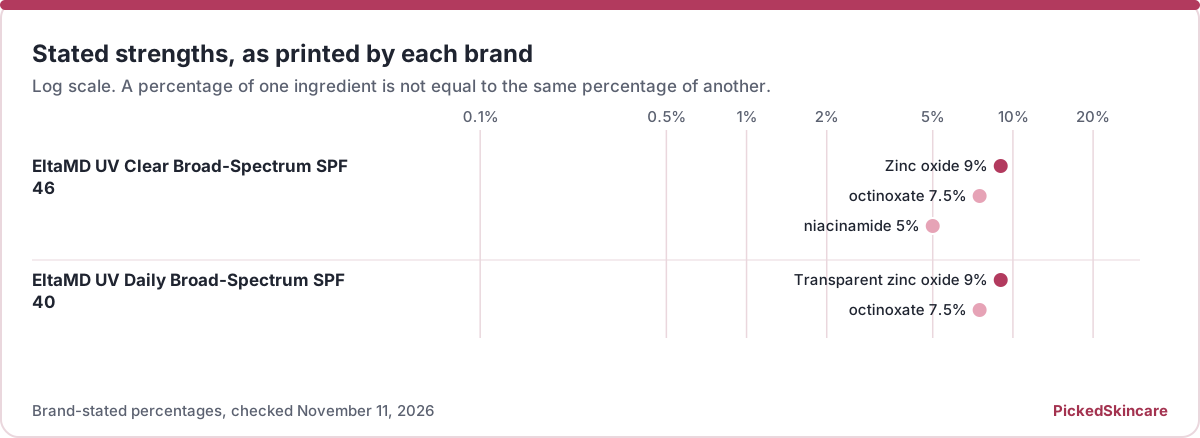
| Filters | Zinc oxide 9%, octinoxate 7.5% | Zinc oxide 9%, octinoxate 7.5% |
| Base highlights | Niacinamide 5%, hyaluronic acid, lactic acid; oil-free | Petrolatum (2nd inactive), isopropyl palmitate, dimethicone, hyaluronic acid |
| Brand “good for” | Sensitive, rosacea- and acne-prone skin | Dehydrated and mature skin; normal, dry, combination |
| Skin tone (untinted, per brand) | Fair to medium | Fair or light |
EltaMD sells these side by side and they share the same sunscreen actives, so the decision is the base. We read both Drug Facts panels and full inactive-ingredient lists on EltaMD’s site. We haven’t tested them.
How do they differ, line by line?
| EltaMD UV Clear SPF 46 | EltaMD UV Daily SPF 40 | |
|---|---|---|
| Price (brand site) | $46.00 for 1.7 oz | $42.00 for 1.7 oz |
| Filters | Zinc oxide 9%, octinoxate 7.5% | Zinc oxide 9%, octinoxate 7.5% |
| Base highlights | Niacinamide 5%, hyaluronic acid, lactic acid; oil-free | Petrolatum (2nd inactive), isopropyl palmitate, dimethicone, hyaluronic acid |
| Brand “good for” | Sensitive, rosacea- and acne-prone skin | Dehydrated and mature skin; normal, dry, combination |
| Skin tone (untinted, per brand) | Fair to medium | Fair or light |
| Water resistant | No | No |
| Fragrance | Fragrance-free | Fragrance-free |
What does each do well, and where does it fall short?
EltaMD UV Clear Broad-Spectrum SPF 46: pros
- Oil-free; brand targets acne- and rosacea-prone skin
- 5% niacinamide
- Tinted version available
EltaMD UV Clear Broad-Spectrum SPF 46: cons
- May feel too light on dry skin
- Not water resistant
EltaMD UV Daily Broad-Spectrum SPF 40: pros
- Moisturizing base with petrolatum and hyaluronic acid
- $4 cheaper
- Can replace a separate day moisturizer for dry skin
EltaMD UV Daily Broad-Spectrum SPF 40: cons
- Petrolatum base may feel heavy on oily skin
- Brand says it works best on fair or light skin tones
- Not water resistant
Which one fits your skin?
Same protection, different feel. Oily or breakout-prone skin should start with UV Clear; dry skin with UV Daily. If you have deeper skin, look at UV Clear Tinted, since EltaMD says the untinted UV Daily works best on fair or light skin tones.
Pick EltaMD UV Clear Broad-Spectrum SPF 46 if…
- your skin is oily, acne- or rosacea-prone
- you want niacinamide in your sunscreen
- you want a tinted option
Pick EltaMD UV Daily Broad-Spectrum SPF 40 if…
- your skin is dry or dehydrated
- you want to skip a separate moisturizer
- your skin tone is fair or light
What’s in each bottle?
Copied from each brand’s own product page (or the sunscreen’s Drug Facts) on November 11, 2026. Brands reformulate, so the carton in your hand is the final word.
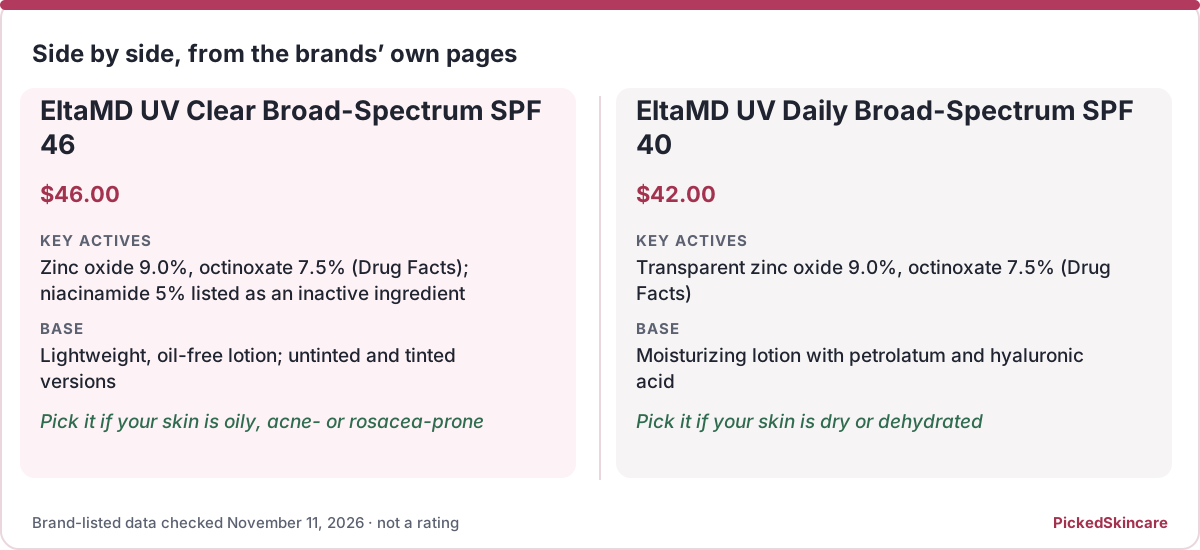
EltaMD UV Clear Broad-Spectrum SPF 46
- Key actives
- Zinc oxide 9.0%, octinoxate 7.5% (Drug Facts); niacinamide 5% listed as an inactive ingredient
- Base
- Lightweight, oil-free lotion; untinted and tinted versions
- Brand price
- $46.00 · 1.7 oz ($78.00 for 3.7 oz)
- Brand notes
- Brand: fragrance-free, oil-free, paraben-free, non-comedogenic; “good for” acne-prone skin and rosacea. Directions tell you to use a water-resistant sunscreen if swimming or sweating (it is not labeled water resistant).
Full ingredient list
Inactive: Water, Cyclopentasiloxane, Niacinamide, Octyldodecyl Neopentanoate, Hydroxyethyl Acrylate/Sodium Acryloyldimethyl Taurate Copolymer, Butylene Glycol, Phenoxyethanol, Polyisobutene, Triethoxycaprylylsilane, Tocopheryl Acetate, PEG-7 Trimethylolpropane Coconut Ether, Oleth-3 Phosphate, Iodopropynyl Butylcarbamate, Lactic Acid, Sodium Hyaluronate, Phosphoric Acid.
EltaMD product page · Check price on Amazon (opens in a new tab)
EltaMD UV Daily Broad-Spectrum SPF 40
- Key actives
- Transparent zinc oxide 9.0%, octinoxate 7.5% (Drug Facts)
- Base
- Moisturizing lotion with petrolatum and hyaluronic acid
- Brand price
- $42.00 · 1.7 oz
- Brand notes
- Brand: “good for” dehydrated and mature skin; non-comedogenic. Directions tell you to use a water-resistant sunscreen if swimming or sweating.
Full ingredient list
Inactive: Water, Petrolatum, Isopropyl Palmitate, Dimethicone, Cetearyl Alcohol, Oleth-3 Phosphate, Phenoxyethanol, Hydroxyethyl Acrylate/Sodium Acryloyldimethyl Taurate Copolymer, Polyisobutene, Cetearyl Glucoside, Polyether-1, Butylene Glycol, PEG-7 Trimethylolpropane Coconut Ether, Sodium Hyaluronate, Iodopropynyl Butylcarbamate, Tocopheryl Acetate, Triethoxycaprylylsilane.
EltaMD product page · Check price on Amazon (opens in a new tab)
Are EltaMD UV Clear and UV Daily mineral sunscreens?
No. Both are hybrids: zinc oxide 9% (a mineral filter) plus octinoxate 7.5% (a chemical filter). The AAD[3][4][5] defines a physical, or mineral, sunscreen as one whose actives are only zinc oxide and/or titanium dioxide. If you need a mineral-only formula, check the Drug Facts of other options.
Which one suits your skin type?
Oily or acne-prone: UV Clear, which is oil-free. Rosacea-prone or sensitive: UV Clear, which EltaMD designs for those skin types; patch test first. Dry or dehydrated: UV Daily, with petrolatum and hyaluronic acid. Combination: UV Clear in summer, UV Daily in winter.
For swimming or sweating, EltaMD itself says to switch to a water-resistant sunscreen.
Who should skip it?
- Either one for the beach or workouts: Neither is water resistant, and EltaMD says to use a water-resistant one when swimming or sweating. Consider instead: Anthelios (80 min).
- UV Daily on oily or acne-prone skin: Its base is built around petrolatum and isopropyl palmitate for dry skin.
- Anyone who needs a mineral-only sunscreen: Both contain octinoxate.
How can you spend less?
UV Daily is $42 and UV Clear $46 for 1.7 oz on EltaMD’s site. UV Clear also comes in 3.7 oz for $78, which works out cheaper per ounce for daily users.
What should you know before you start?
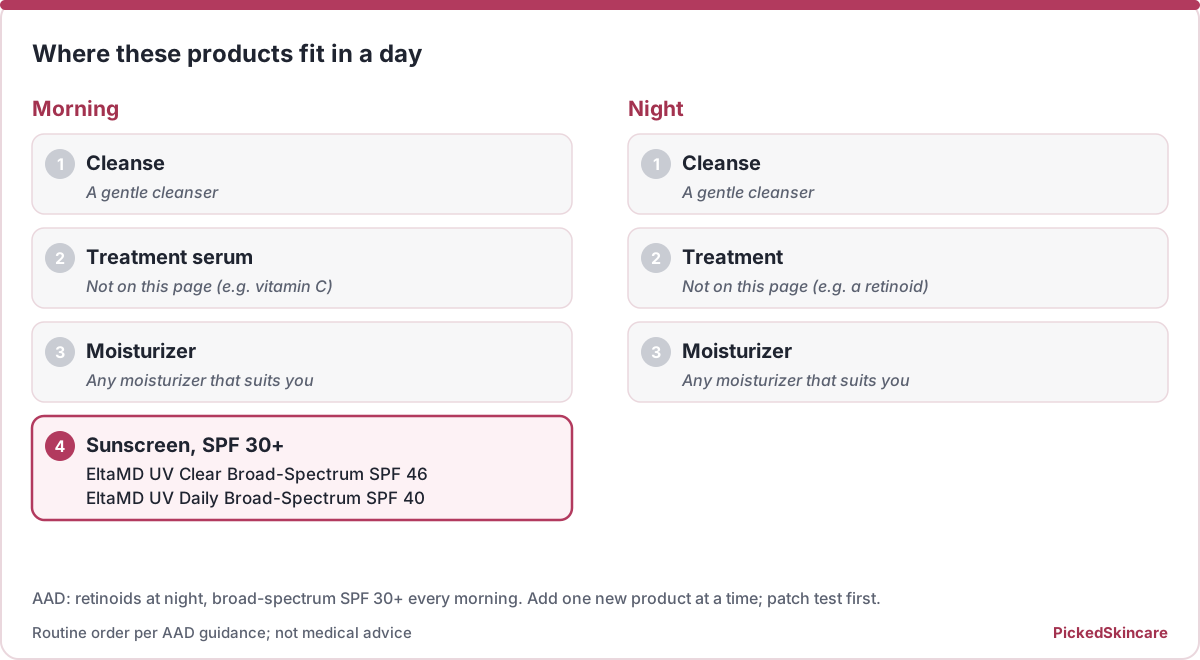
- Patch test first. The American Academy of Dermatology suggests applying a new product to a quarter-sized area twice a day for 7 to 10 days and stopping if you react. AAD: how to test skin care products.
- Add one new product at a time, and give it time: the AAD says many anti-aging products take 6 weeks to 3 months to show results. AAD: get the most from anti-aging products.
What do people ask most?
What is the difference between EltaMD UV Clear and UV Daily?
Can I use UV Daily as my moisturizer?
Do they leave a white cast?
Where this comes from
We opened and read every source below for this page. Ingredient lists, strengths, directions and prices come from each brand’s own product page; health and usage guidance comes from the American Academy of Dermatology, the FDA, the National Eczema Association and peer-reviewed studies (via PubMed). Prices checked: November 2026; confirm on the seller’s site before you buy.
- EltaMD (brand page): EltaMD UV Clear Broad-Spectrum SPF 46 (eltamd.com)
- EltaMD (brand page): EltaMD UV Daily Broad-Spectrum SPF 40 (eltamd.com)
- AAD: How to decode a sunscreen label (aad.org)
- AAD: Sunscreen FAQs (aad.org)
- AAD: How to select a sunscreen (aad.org)
Related
La Roche-Posay Anthelios Ultra Light Fluid SPF 60 vs EltaMD UV Clear SPF 46
Anthelios uses four chemical filters (avobenzone, homosalate, octisalate, octocrylene), is water resistant for 80 minutes and costs $35.99. UV Clear pairs zinc oxide 9% with octinoxate 7.5%, adds 5% niacinamide, is aimed at sensitive, rosacea- and acne-prone skin, isn’t water resistant and costs $46 for 1.7 oz.
guideMineral vs chemical sunscreen for sensitive skin: which should you use?
Short answer: if your skin reacts easily, start with a mineral sunscreen (zinc oxide and/or titanium dioxide only), which the AAD says dermatologists recommend for sensitive skin. Any sunscreen that is broad spectrum, SPF 30+ and used generously protects you; the best one is the one you’ll wear every day.
comparisonCeraVe AM vs PM Facial Moisturizing Lotion: what’s actually different?
The real difference is sunscreen. AM is a broad-spectrum SPF 30 with zinc oxide 8%, homosalate 10%, octinoxate 5% and octocrylene 2%; PM has no SPF and is labeled night only. Both list niacinamide near the top, three ceramides and hyaluronic acid.
guideWhat niacinamide percentage do you actually need?
Short answer: the clinical studies we found used 2% niacinamide for oiliness and 5% for spots, blotchiness and fine lines. Serums at 10% to 12% are popular, but we found no trial showing they beat 5%, and higher strengths are more likely to sting reactive skin.