Niacinamide vs vitamin C for dark spots: which should you try first?
Short answer: start with daily sunscreen (tinted, if you have a darker skin tone), then add one product. Niacinamide is the gentler first try with clearer clinical data on spots; L-ascorbic acid vitamin C is the stronger antioxidant but can sting.
Checked against brand ingredient lists on and against dermatology sources (American Academy of Dermatology, FDA, peer-reviewed studies). How we research · Editorial policy · 11 sources
Disclosure: PickedSkincare is reader-supported. “Check price” links may become affiliate links, and we may earn a commission if you buy through them, at no extra cost to you. Commission never decides a pick, and we tell you when the cheaper bottle is the better buy. How we make money.
How this page was made: we compared what each brand publishes (actives, strengths, full ingredient lists, directions and prices) and checked the claims against dermatology guidance and published studies, all linked at the bottom. We haven’t tested these products on our own skin, we don’t publish star ratings, and a commission never decides a pick. Our methodology.
Not medical advice. This page compares cosmetic products. If you have a skin condition, use prescription treatment, or are pregnant or breastfeeding, ask a dermatologist or your doctor before starting something new.
Short answer
start with daily sunscreen (tinted, if you have a darker skin tone), then add one product. Niacinamide is the gentler first try with clearer clinical data on spots; L-ascorbic acid vitamin C is the stronger antioxidant but can sting.
Last updated Ingredient lists checked 2026-11-11Prices checked November 2026
The numbers side by side
| In brief | |
|---|---|
| The rule of thumb | start with daily sunscreen (tinted, if you have a darker skin tone), then add one product. Niacinamide is the gentler first try with clearer clinical data on spots; L-ascorbic acid vitamin C is the stronger antioxidant but can sting. |
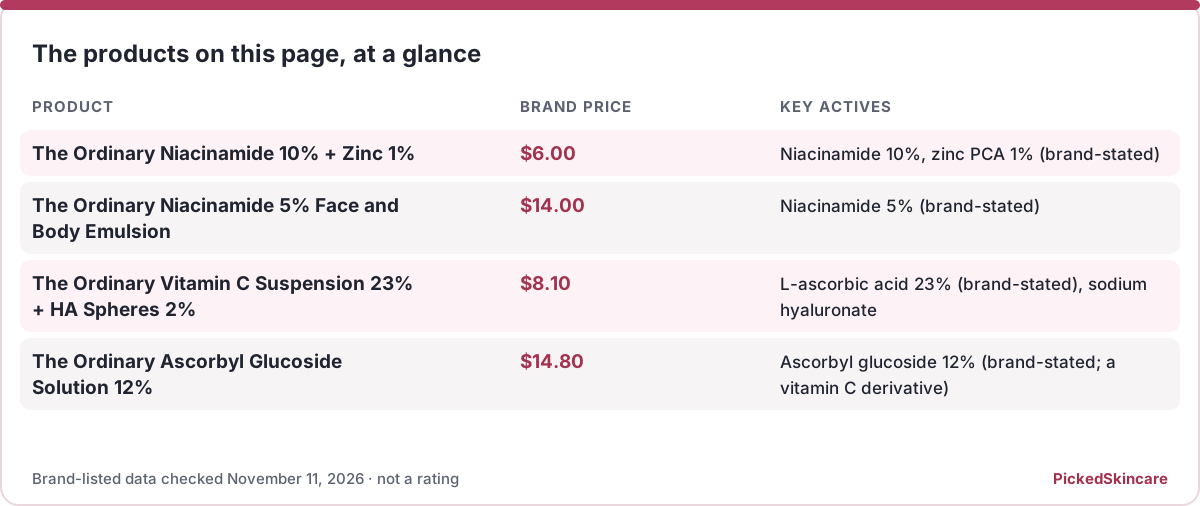
| Spending less | The Ordinary Niacinamide 10% + Zinc 1% costs $6, and its Vitamin C Suspension 23% costs $8.10. If you only buy one thing, buy a sunscreen you’ll wear daily. |
Both ingredients are on the AAD’s[1][2][7] list of over-the-counter options for fading dark spots, alongside azelaic acid, glycolic acid, kojic acid and retinoids. The AAD is equally clear that sunscreen comes first and that fading takes months. We compared the evidence for each and the products that state their strength. We haven’t tested them ourselves.
What’s in each bottle?
Copied from each brand’s own product page (or the sunscreen’s Drug Facts) on November 11, 2026. Brands reformulate, so the carton in your hand is the final word.
The Ordinary Niacinamide 10% + Zinc 1%
- Key actives
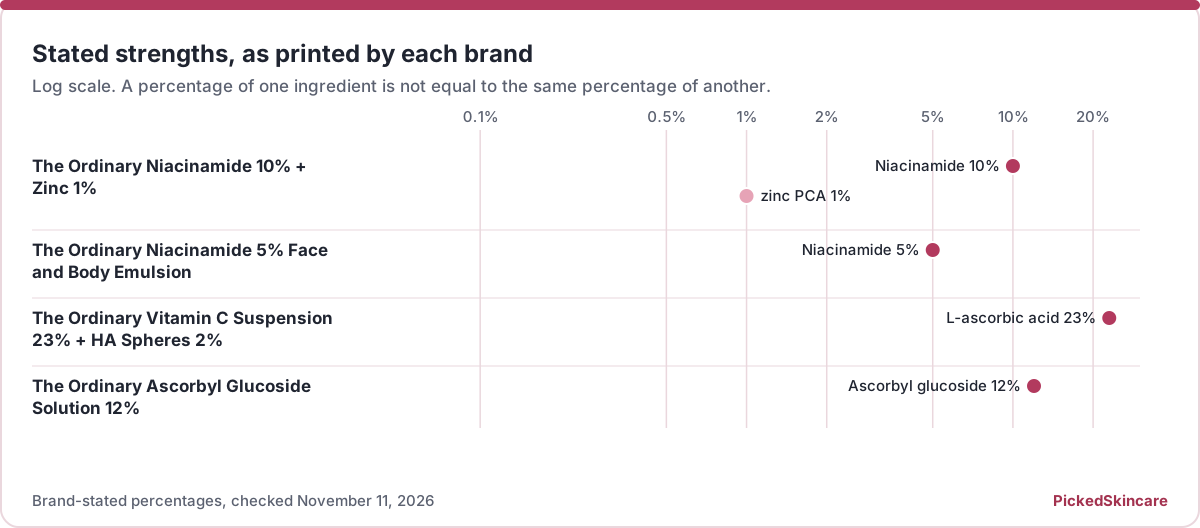
- Niacinamide 10%, zinc PCA 1% (brand-stated)
- Base
- Water-based serum
- Brand price
- $6.00 · 30 ml (60 ml also sold)
- Brand notes
- Brand compatibility tool says not to use it in the same routine as its direct or indirect vitamin C products; patch test advised.
Full ingredient list
Aqua (Water), Niacinamide, Pentylene Glycol, Zinc PCA, Dimethyl Isosorbide, Tamarindus Indica Seed Gum, Xanthan Gum, Isoceteth-20, Ethoxydiglycol, Phenoxyethanol, Chlorphenesin.
The Ordinary product page · Check price on Amazon (opens in a new tab)
The Ordinary Niacinamide 5% Face and Body Emulsion
- Key actives
- Niacinamide 5% (brand-stated)
- Base
- Water-based emulsion for face and body
- Brand price
- $14.00
Full ingredient list
Aqua (Water), Ethyl Macadamiate, Niacinamide, Propanediol, Glycerin, Sphingomonas Ferment Extract, Pentylene Glycol, Ethylhexyl Olivate, Polyglyceryl-4 Oleate, Sodium Acrylates Copolymer, Isoceteth-20, Sodium Citrate, Citric Acid, Malic Acid, Trisodium Ethylenediamine Disuccinate, Tocopherol, Ethylhexylglycerin, Phenoxyethanol, Chlorphenesin.
The Ordinary product page · Check price on Amazon (opens in a new tab)
The Ordinary Vitamin C Suspension 23% + HA Spheres 2%
- Key actives
- L-ascorbic acid 23% (brand-stated), sodium hyaluronate
- Base
- Water-free silicone/ester suspension (slightly gritty)
- Brand price
- $8.10 · 30 ml
- Brand notes
- Brand: tingling can be expected; can be diluted into a cream; patch test advised; not to be used in the same routine as its niacinamide, retinoids, peptides or direct acids.
Full ingredient list
Ascorbic Acid, Squalane, Isodecyl Neopentanoate, Isononyl Isononanoate, Coconut Alkanes, Ethylene/Propylene/Styrene Copolymer, Ethylhexyl Palmitate, Silica Dimethyl Silylate, Sodium Hyaluronate, Glucomannan, Coco-Caprylate/Caprate, Butylene/Ethylene/Styrene Copolymer, Acrylates/Ethylhexyl Acrylate Crosspolymer, Trihydroxystearin, BHT.
The Ordinary product page · Check price on Amazon (opens in a new tab)
The Ordinary Ascorbyl Glucoside Solution 12%
- Key actives
- Ascorbyl glucoside 12% (brand-stated; a vitamin C derivative)
- Base
- Water-based solution
- Brand price
- $14.80 · 30 ml
Full ingredient list
Aqua (Water), Ascorbyl Glucoside, Propanediol, Aminomethyl Propanol, Triethanolamine, Isoceteth-20, Xanthan Gum, Dimethyl Isosorbide, Ethoxydiglycol, Trisodium Ethylenediamine Disuccinate, 1,2-Hexanediol, Caprylyl Glycol.
The Ordinary product page · Check price on Amazon (opens in a new tab)
Why does sunscreen come first, whichever you pick?
The AAD’s[1][2][7] dark-spots guide says effective care “begins with sunscreen”, used daily on all exposed skin, and recommends a tinted sunscreen with iron oxide because visible light can worsen dark spots, especially on darker skin tones. Without it, neither serum has much chance. A spot a few shades darker than your skin usually fades within 6 to 12 months once the cause stops, the AAD says.
What does the evidence say?
| Niacinamide | Vitamin C (L-ascorbic acid) | |
|---|---|---|
| Clinical data on spots | 5% reduced visible hyperpigmentation after 4 weeks (Hakozaki[3] 2002, 18 people); 5% reduced spots over 12 weeks (Bissett[4] 2005, 50 women) | A 2017 review (Al-Niaimi[5] & Chiang) says it decreases melanin formation but that clinical studies on topical formulas remain limited |
| How it works (per studies) | Slows pigment transfer to skin cells (35–68% in a lab model) | Antioxidant; reduces melanin formation |
| Formula sensitivity | Stable in water-based serums | Needs pH below 3.5 to enter skin; derivatives tested didn’t raise skin vitamin C (Pinnell[6] 2001) |
| Typical feel | Usually comfortable at 5% | Tingling expected with The Ordinary’s 23%, per the brand |
Which one suits your skin type?
- Sensitive or darker skin tone: niacinamide first. The AAD[1][2][7] warns that a product that irritates darker skin can itself cause dark spots, and suggests products labeled for sensitive skin and fragrance-free.
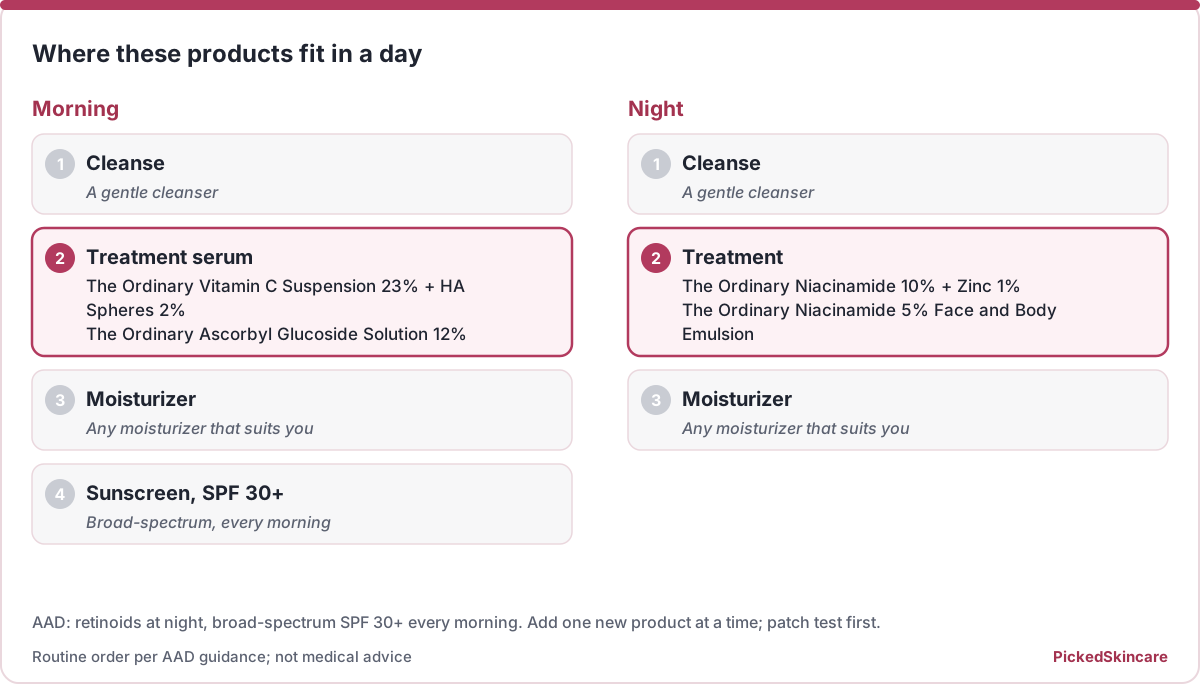
- Oily skin that tolerates acids: L-ascorbic acid vitamin C in the morning under sunscreen.
- Dry skin: niacinamide in an emulsion, or a gentler vitamin C derivative such as ascorbyl glucoside, accepting weaker evidence.
Who should skip it?
- Anyone skipping sunscreen: The AAD[1][2][7] says sunscreen can prevent new dark spots and help clear existing ones; serums alone are unlikely to keep up.
- Melasma, or spots that change, bleed or grow: Those need a dermatologist, not a serum.
- Using both at high strength on day one: Irritation on darker skin can create new dark marks (AAD[1][2][7]). Add one at a time.
How can you spend less?
The Ordinary Niacinamide 10% + Zinc 1% costs $6, and its Vitamin C Suspension 23% costs $8.10. If you only buy one thing, buy a sunscreen you’ll wear daily.
What should you know before you start?
- Patch test first. The American Academy of Dermatology suggests applying a new product to a quarter-sized area twice a day for 7 to 10 days and stopping if you react. AAD: how to test skin care products.
- Add one new product at a time, and give it time: the AAD says many anti-aging products take 6 weeks to 3 months to show results. AAD: get the most from anti-aging products.
What do people ask most?
Which is better for dark spots, niacinamide or vitamin C?
Can I use both?
How long until dark spots fade?
What else does the AAD list for dark spots?
Where this comes from
We opened and read every source below for this page. Ingredient lists, strengths, directions and prices come from each brand’s own product page; health and usage guidance comes from the American Academy of Dermatology, the FDA, the National Eczema Association and peer-reviewed studies (via PubMed). Prices checked: November 2026; confirm on the seller’s site before you buy.
- AAD: How to fade dark spots in darker skin tones (aad.org)
- AAD: Sunscreen FAQs (aad.org)
- Hakozaki et al. 2002, British Journal of Dermatology: Niacinamide and cutaneous pigmentation (pubmed.ncbi.nlm.nih.gov)
- Bissett et al. 2005, Dermatologic Surgery: Niacinamide improves aging facial skin appearance (pubmed.ncbi.nlm.nih.gov)
- Al-Niaimi & Chiang 2017, Journal of Clinical and Aesthetic Dermatology: Topical vitamin C and the skin (pubmed.ncbi.nlm.nih.gov)
- Pinnell et al. 2001, Dermatologic Surgery: Topical L-ascorbic acid percutaneous absorption (pubmed.ncbi.nlm.nih.gov)
- AAD: How to test skin care products (aad.org)
- The Ordinary (brand page): The Ordinary Niacinamide 10% + Zinc 1% (theordinary.com)
- The Ordinary (brand page): The Ordinary Niacinamide 5% Face and Body Emulsion (theordinary.com)
- The Ordinary (brand page): The Ordinary Vitamin C Suspension 23% + HA Spheres 2% (theordinary.com)
- The Ordinary (brand page): The Ordinary Ascorbyl Glucoside Solution 12% (theordinary.com)
Related
What niacinamide percentage do you actually need?
Short answer: the clinical studies we found used 2% niacinamide for oiliness and 5% for spots, blotchiness and fine lines. Serums at 10% to 12% are popular, but we found no trial showing they beat 5%, and higher strengths are more likely to sting reactive skin.
guideVitamin C forms explained: L-ascorbic acid vs the derivatives
Short answer: L-ascorbic acid is the form with the most research, but it only gets into skin from a very acidic formula and it oxidizes easily. Derivatives such as ascorbyl glucoside are steadier and gentler, with weaker evidence. Sensitive skin should usually start with a derivative.
guideCan you use niacinamide with vitamin C or retinol?
Short answer: niacinamide with retinol is widely accepted; even Paula’s Choice says they pair well. Niacinamide with vitamin C is where brands disagree, so the simple default is vitamin C in the morning and niacinamide or retinol at night.
guideMineral vs chemical sunscreen for sensitive skin: which should you use?
Short answer: if your skin reacts easily, start with a mineral sunscreen (zinc oxide and/or titanium dioxide only), which the AAD says dermatologists recommend for sensitive skin. Any sunscreen that is broad spectrum, SPF 30+ and used generously protects you; the best one is the one you’ll wear every day.
comparisonThe Ordinary Niacinamide 10% + Zinc 1% vs Naturium Niacinamide 12% + Zinc 2%
Both are high-strength niacinamide serums with zinc PCA, used morning and night. The Ordinary’s is 10% for $6; Naturium’s is 12% with hyaluronic acid for $17. Published trials used far less niacinamide than either: 2% to 5%.
comparisonLa Roche-Posay Anthelios Ultra Light Fluid SPF 60 vs EltaMD UV Clear SPF 46
Anthelios uses four chemical filters (avobenzone, homosalate, octisalate, octocrylene), is water resistant for 80 minutes and costs $35.99. UV Clear pairs zinc oxide 9% with octinoxate 7.5%, adds 5% niacinamide, is aimed at sensitive, rosacea- and acne-prone skin, isn’t water resistant and costs $46 for 1.7 oz.
comparisonThe Ordinary Ascorbyl Glucoside Solution 12% vs Vitamin C Suspension 23%
Same brand, opposite approaches. Ascorbyl Glucoside 12% is a water-based derivative the brand calls lower in irritation potential but less potent; Vitamin C Suspension 23% is pure L-ascorbic acid in a water-free base that the brand says will tingle.
comparisonThe Ordinary Vitamin C Suspension 23% vs SkinCeuticals C E Ferulic
Both are pure L-ascorbic acid. The Ordinary suspends 23% in a water-free base for $8.10 and warns it tingles; SkinCeuticals pairs 15% with vitamin E and ferulic acid, the combination tested in a 2005 peer-reviewed study, at a much higher price.