Vanicream Moisturizing Cream vs CeraVe Moisturizing Cream
Both are fragrance-free, non-comedogenic, carry National Eczema Association recognition and go on face and body. The real split: Vanicream keeps its list to 10 ingredients and has no ceramides; CeraVe adds three ceramides, cholesterol and hyaluronic acid across 24.
Checked against brand ingredient lists on and against dermatology sources (American Academy of Dermatology, FDA, peer-reviewed studies). How we research · Editorial policy · 8 sources
Disclosure: PickedSkincare is reader-supported. “Check price” links may become affiliate links, and we may earn a commission if you buy through them, at no extra cost to you. Commission never decides a pick, and we tell you when the cheaper bottle is the better buy. How we make money.
How this page was made: we compared what each brand publishes (actives, strengths, full ingredient lists, directions and prices) and checked the claims against dermatology guidance and published studies, all linked at the bottom. We haven’t tested these products on our own skin, we don’t publish star ratings, and a commission never decides a pick. Our methodology.
Not medical advice. This page compares cosmetic products. If you have a skin condition, use prescription treatment, or are pregnant or breastfeeding, ask a dermatologist or your doctor before starting something new.
Short answer
Choose Vanicream Moisturizing Cream if your skin reacts to many products, you want to avoid botanicals and essential oils or you want the fewest ingredients. Choose CeraVe Moisturizing Cream if you want ceramides and hyaluronic acid, you tolerate longer ingredient lists or you want a slightly lighter cream for the face. Occlusive: Petrolatum (2nd ingredient) vs Petrolatum (7th), dimethicone.
Last updated Ingredient lists checked 2026-11-11Prices checked November 2026
Check Vanicream Moisturizing Cream price (opens in a new tab)Check CeraVe Moisturizing Cream price (opens in a new tab)
The numbers side by side
| Vanicream Moisturizing Cream | CeraVe Moisturizing Cream | |
|---|---|---|
| Ingredient count | 10 on the list (the brand FAQ says 11) | 24 |
| Ceramides | None (brand confirms) | Three: NP, AP, EOP, plus cholesterol |
| Occlusive | Petrolatum (2nd ingredient) | Petrolatum (7th), dimethicone |
| Humectant | Sorbitol, propylene glycol | Glycerin, hyaluronic acid |
| Fragrance | Free of fragrance and masking fragrance | Fragrance-free |
If you have dry, easily irritated skin, these are probably the two tubs you’re choosing between. Neither has a hero active; the comparison is about what’s left out versus what’s added. We compared both full ingredient lists from the brand pages and the National Eczema Association’s[3] guidance. We haven’t tested them.
Short answer: pick Vanicream Moisturizing Cream if your skin reacts to many ingredients and you want the shortest list possible. Pick CeraVe Moisturizing Cream if you tolerate a longer list and want ceramides and hyaluronic acid alongside petrolatum.
How do they differ, line by line?
| Vanicream Moisturizing Cream | CeraVe Moisturizing Cream | |
|---|---|---|
| Ingredient count | 10 on the list (the brand FAQ says 11) | 24 |
| Ceramides | None (brand confirms) | Three: NP, AP, EOP, plus cholesterol |
| Occlusive | Petrolatum (2nd ingredient) | Petrolatum (7th), dimethicone |
| Humectant | Sorbitol, propylene glycol | Glycerin, hyaluronic acid |
| Fragrance | Free of fragrance and masking fragrance | Fragrance-free |
| Eczema association | NEA Seal of Acceptance | Accepted by the NEA (brand) |
| Where to use | Face, hands, feet, body | Face and body |
| Other brand notes | No botanical extracts or essential oils; gluten-free | Allergy-tested; MVE slow-release technology |
What does each do well, and where does it fall short?
Vanicream Moisturizing Cream: pros
- Shortest list here: fewer things to react to
- No botanicals, essential oils or masking fragrance
- Petrolatum high in the list
Vanicream Moisturizing Cream: cons
- No ceramides
- Contains propylene glycol, which some people avoid
- Thick for oily skin
CeraVe Moisturizing Cream: pros
- Three ceramides plus cholesterol
- Hyaluronic acid and glycerin as humectants
- Brand FAQ says it absorbs quickly and is non-greasy
CeraVe Moisturizing Cream: cons
- More than twice as many ingredients
- Contains several fatty alcohols and preservatives that a very reactive person might need to rule out
Which one fits your skin?
If you’ve reacted to several moisturizers and don’t know why, start with Vanicream: fewer ingredients makes a reaction easier to trace. If short lists don’t matter to you, CeraVe gives you barrier lipids on top of the same occlusive. Both meet the AAD’s[4] description of a dry-skin moisturizer: a fragrance-free cream with petrolatum.
Pick Vanicream Moisturizing Cream if…
- your skin reacts to many products
- you want to avoid botanicals and essential oils
- you want the fewest ingredients
Pick CeraVe Moisturizing Cream if…
- you want ceramides and hyaluronic acid
- you tolerate longer ingredient lists
- you want a slightly lighter cream for the face
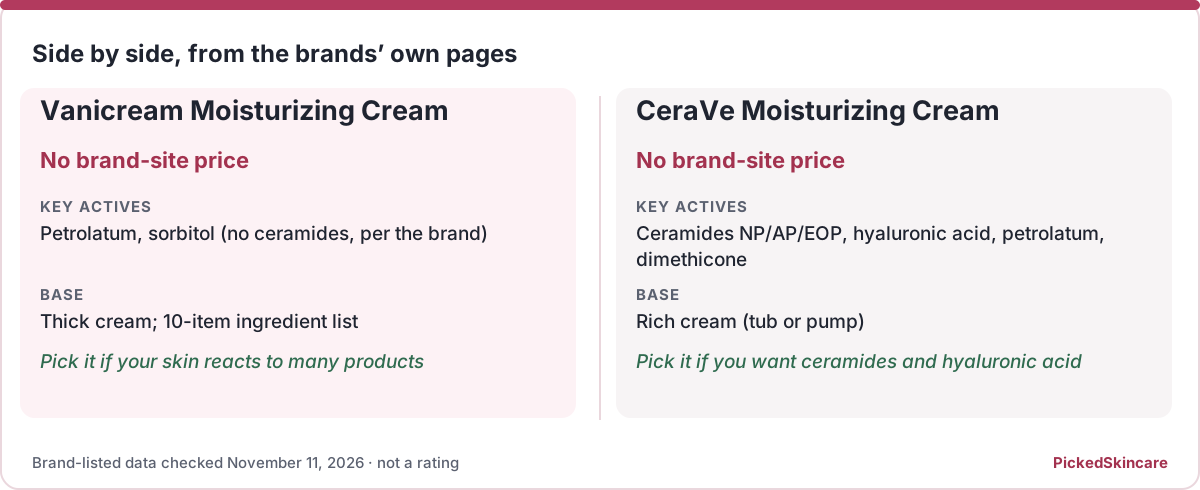
What’s in each bottle?
Copied from each brand’s own product page (or the sunscreen’s Drug Facts) on November 11, 2026. Brands reformulate, so the carton in your hand is the final word.
Vanicream Moisturizing Cream
- Key actives
- Petrolatum, sorbitol (no ceramides, per the brand)
- Base
- Thick cream; 10-item ingredient list
- Brand price
- Not sold on the brand site; check a retailer
- Brand notes
- Brand: free of fragrance and masking fragrance, no botanical extracts or essential oils, non-comedogenic, National Eczema Association Seal of Acceptance.
Full ingredient list
Water, Petrolatum, Sorbitol, Cetearyl Alcohol, Propylene Glycol, Ceteareth-20, Simethicone, Glyceryl Stearate, PEG-30 Stearate, Sorbic Acid.
Vanicream product page · Check price on Amazon (opens in a new tab)
CeraVe Moisturizing Cream
- Key actives
- Ceramides NP/AP/EOP, hyaluronic acid, petrolatum, dimethicone
- Base
- Rich cream (tub or pump)
- Brand price
- Not sold on the brand site; check a retailer
- Brand notes
- Brand: fragrance-free, allergy-tested, non-comedogenic; accepted by the National Eczema Association.
Full ingredient list
Aqua / Water / Eau, Glycerin, Cetearyl Alcohol, Caprylic/Capric Triglyceride, Cetyl Alcohol, Ceteareth-20, Petrolatum, Potassium Phosphate, Ceramide NP, Ceramide AP, Ceramide EOP, Carbomer, Dimethicone, Behentrimonium Methosulfate, Sodium Lauroyl Lactylate, Sodium Hyaluronate, Cholesterol, Phenoxyethanol, Disodium EDTA, Dipotassium Phosphate, Tocopherol, Phytosphingosine, Xanthan Gum, Ethylhexylglycerin.
CeraVe product page · Check price on Amazon (opens in a new tab)
What do dermatology groups say to look for?
The AAD[4] advises a fragrance-free cream or ointment over a lotion for dry skin, and lists petrolatum, glycerin, hyaluronic acid, dimethicone and shea butter among useful ingredients. Both creams fit. Both also appear in the National Eczema Association’s[3] Seal of Acceptance product directory. Remember the FDA’s[5][6] point that “hypoallergenic” has no legal definition; the ingredient list is the real check.
A 2003 review by Lodén[7] noted that moisturizers differ widely in their effect on the skin barrier, so if one doesn’t suit you, another may.
Which one suits your skin type?
- Very reactive / many allergies: Vanicream.
- Dry, tolerant: either; CeraVe adds ceramides.
- Oily face: neither is the light choice; see CeraVe’s lotion.
- Using a retinoid: either works as a buffer at night.
Who should skip it?
- Oily or acne-prone faces wanting a light layer: Both are thick creams, though both say non-comedogenic. Consider instead: a lotion such as CeraVe PM.
- Anyone with a known propylene glycol sensitivity (Vanicream): It’s the 5th ingredient.
How can you spend less?
Neither brand page we read showed a price. Both come in large tubs or pumps, which usually cost much less per ounce; compare per ounce at the retailer.
What should you know before you start?
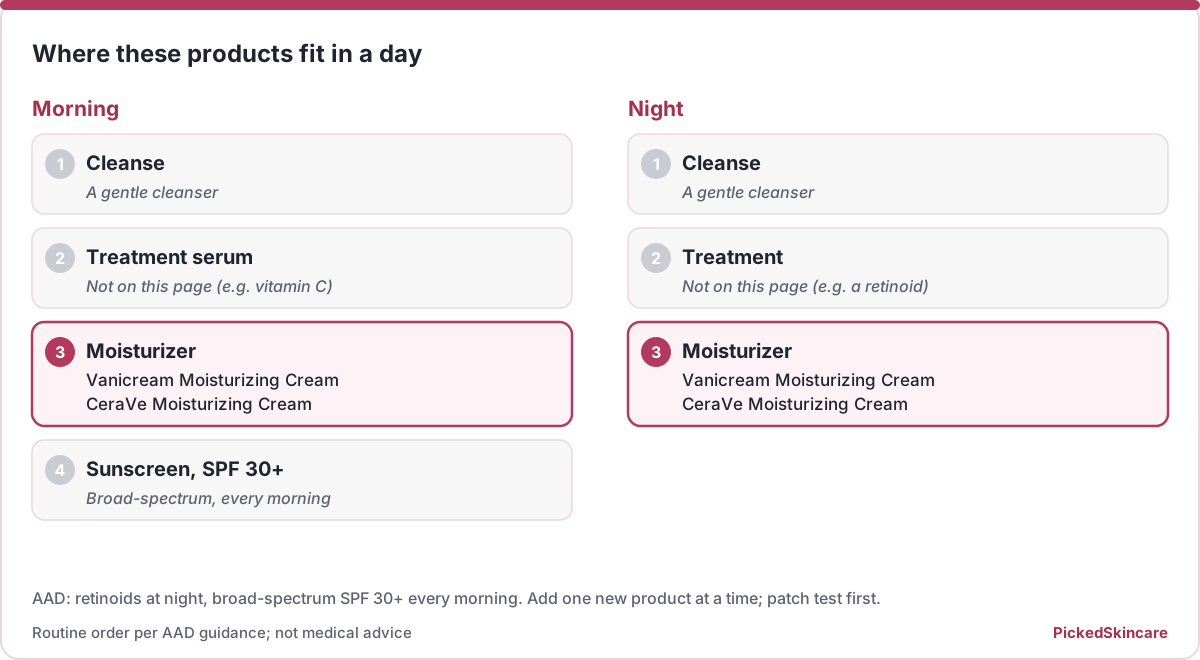
- Patch test first. The American Academy of Dermatology suggests applying a new product to a quarter-sized area twice a day for 7 to 10 days and stopping if you react. AAD: how to test skin care products.
- Add one new product at a time, and give it time: the AAD says many anti-aging products take 6 weeks to 3 months to show results. AAD: get the most from anti-aging products.
What do people ask most?
Does Vanicream have ceramides?
Can I use them on my face?
Are they good for eczema-prone skin?
Why does Vanicream say 11 ingredients but list 10?
Where this comes from
We opened and read every source below for this page. Ingredient lists, strengths, directions and prices come from each brand’s own product page; health and usage guidance comes from the American Academy of Dermatology, the FDA, the National Eczema Association and peer-reviewed studies (via PubMed). Prices checked: November 2026; confirm on the seller’s site before you buy.
- Vanicream (brand page): Vanicream Moisturizing Cream (vanicream.com)
- CeraVe (brand page): CeraVe Moisturizing Cream (cerave.com)
- National Eczema Association: Seal of Acceptance product directory (nationaleczema.org)
- AAD: Dermatologists’ top tips for relieving dry skin (aad.org)
- FDA: “Hypoallergenic” cosmetics (fda.gov)
- FDA: Fragrances in cosmetics (fda.gov)
- Lodén 2003, American Journal of Clinical Dermatology: Topical emollients and moisturizers in dry skin (pubmed.ncbi.nlm.nih.gov)
- Rajkumar et al. 2023, Skin Pharmacology and Physiology: The skin barrier and moisturization (pubmed.ncbi.nlm.nih.gov)
Related
CeraVe Moisturizing Cream vs CeraVe Daily Moisturizing Lotion
CeraVe says the main difference between these two is texture. The ingredient lists show why: the cream has petrolatum near the top and more fatty alcohols; the lotion has no petrolatum and is labeled oil-free. Both carry ceramides NP, AP and EOP, cholesterol and hyaluronic acid.
comparisonCeraVe PM Facial Moisturizing Lotion vs La Roche-Posay Toleriane Double Repair
These two read alike on the shelf: glycerin, niacinamide, ceramide, fragrance-free. Underneath, CeraVe has three ceramides, cholesterol and hyaluronic acid in a light lotion labeled for night; La Roche-Posay has one ceramide and squalane in a lightweight cream for day or night at $24.99 for 100 ml.
comparisonCeraVe AM vs PM Facial Moisturizing Lotion: what’s actually different?
The real difference is sunscreen. AM is a broad-spectrum SPF 30 with zinc oxide 8%, homosalate 10%, octinoxate 5% and octocrylene 2%; PM has no SPF and is labeled night only. Both list niacinamide near the top, three ceramides and hyaluronic acid.
guideMineral vs chemical sunscreen for sensitive skin: which should you use?
Short answer: if your skin reacts easily, start with a mineral sunscreen (zinc oxide and/or titanium dioxide only), which the AAD says dermatologists recommend for sensitive skin. Any sunscreen that is broad spectrum, SPF 30+ and used generously protects you; the best one is the one you’ll wear every day.