Vitamin C forms explained: L-ascorbic acid vs the derivatives
Short answer: L-ascorbic acid is the form with the most research, but it only gets into skin from a very acidic formula and it oxidizes easily. Derivatives such as ascorbyl glucoside are steadier and gentler, with weaker evidence. Sensitive skin should usually start with a derivative.
Checked against brand ingredient lists on and against dermatology sources (American Academy of Dermatology, FDA, peer-reviewed studies). How we research · Editorial policy · 10 sources
Disclosure: PickedSkincare is reader-supported. “Check price” links may become affiliate links, and we may earn a commission if you buy through them, at no extra cost to you. Commission never decides a pick, and we tell you when the cheaper bottle is the better buy. How we make money.
How this page was made: we compared what each brand publishes (actives, strengths, full ingredient lists, directions and prices) and checked the claims against dermatology guidance and published studies, all linked at the bottom. We haven’t tested these products on our own skin, we don’t publish star ratings, and a commission never decides a pick. Our methodology.
Not medical advice. This page compares cosmetic products. If you have a skin condition, use prescription treatment, or are pregnant or breastfeeding, ask a dermatologist or your doctor before starting something new.
Short answer
L-ascorbic acid is the form with the most research, but it only gets into skin from a very acidic formula and it oxidizes easily. Derivatives such as ascorbyl glucoside are steadier and gentler, with weaker evidence. Sensitive skin should usually start with a derivative.
Last updated Ingredient lists checked 2026-11-11Prices checked November 2026
The numbers side by side
| In brief | |
|---|---|
| The rule of thumb | L-ascorbic acid is the form with the most research, but it only gets into skin from a very acidic formula and it oxidizes easily. Derivatives such as ascorbyl glucoside are steadier and gentler, with weaker evidence. |
| Spending less | The cheapest direct vitamin C we found is The Ordinary Vitamin C Suspension 23% at $8.10 for 30 ml. The gentlest cheap derivative is The Ordinary Ascorbyl Glucoside Solution 12% at $14.80. |
“Vitamin C” on a label can mean several different molecules. The form decides how stable the serum is, how much it stings and how much research backs it. We read the key studies and the ingredient lists of five vitamin C products. We haven’t tested them ourselves.
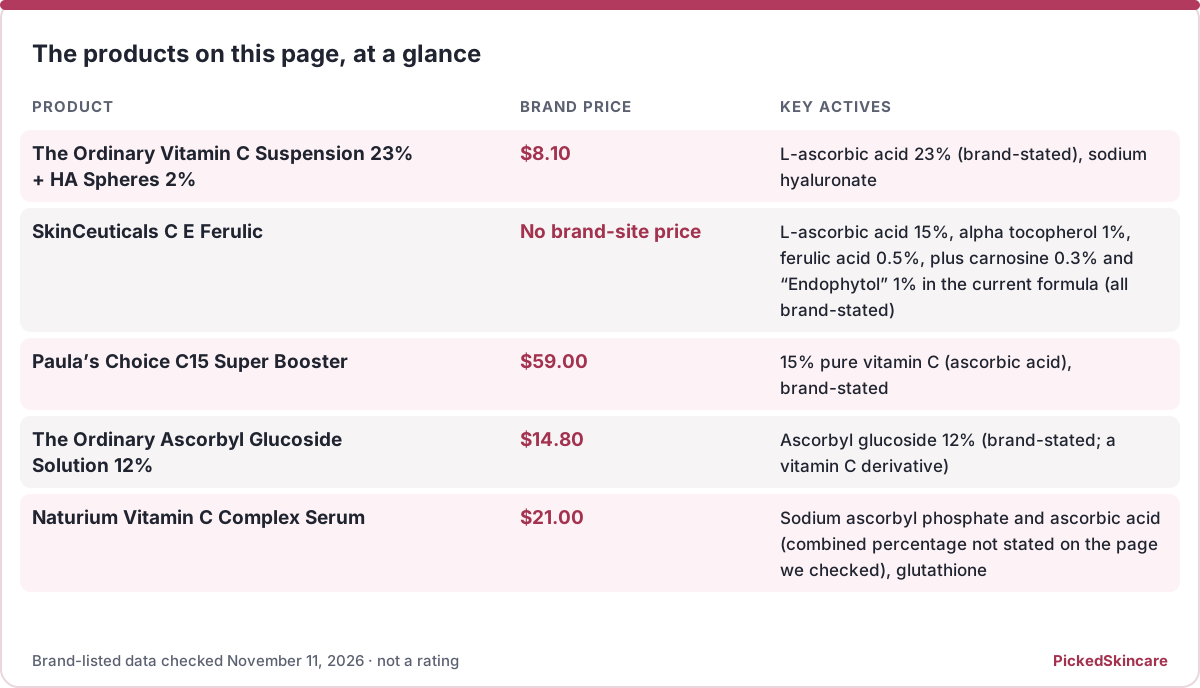
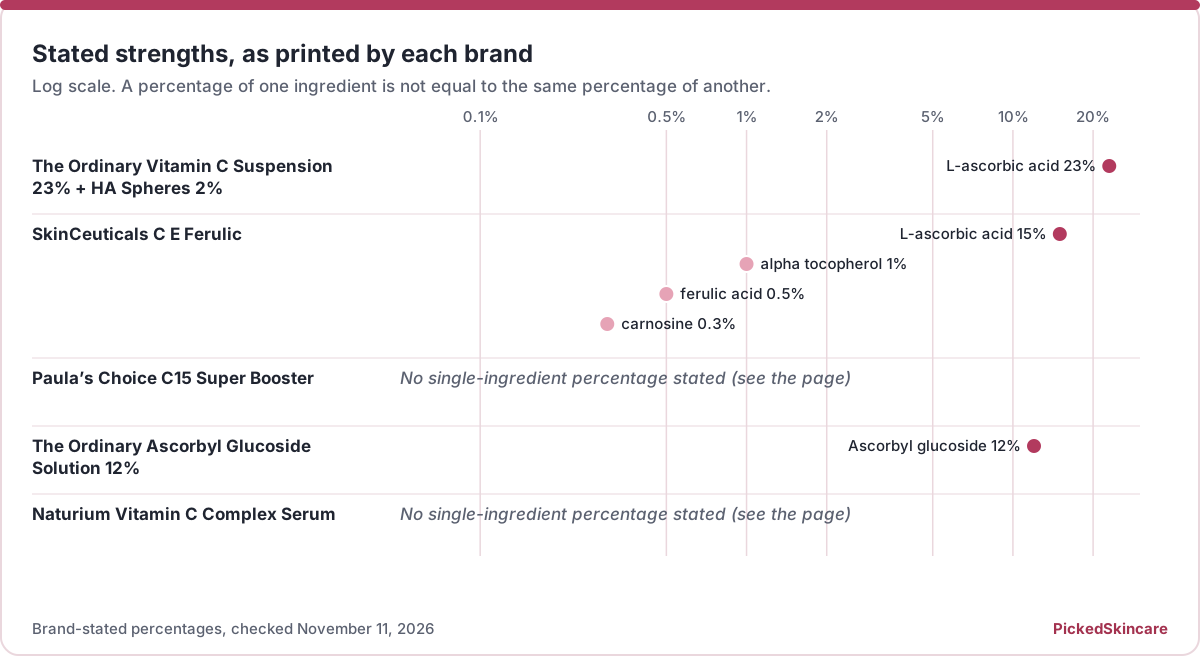
What’s in each bottle?
Copied from each brand’s own product page (or the sunscreen’s Drug Facts) on November 11, 2026. Brands reformulate, so the carton in your hand is the final word.
The Ordinary Vitamin C Suspension 23% + HA Spheres 2%
- Key actives
- L-ascorbic acid 23% (brand-stated), sodium hyaluronate
- Base
- Water-free silicone/ester suspension (slightly gritty)
- Brand price
- $8.10 · 30 ml
- Brand notes
- Brand: tingling can be expected; can be diluted into a cream; patch test advised; not to be used in the same routine as its niacinamide, retinoids, peptides or direct acids.
Full ingredient list
Ascorbic Acid, Squalane, Isodecyl Neopentanoate, Isononyl Isononanoate, Coconut Alkanes, Ethylene/Propylene/Styrene Copolymer, Ethylhexyl Palmitate, Silica Dimethyl Silylate, Sodium Hyaluronate, Glucomannan, Coco-Caprylate/Caprate, Butylene/Ethylene/Styrene Copolymer, Acrylates/Ethylhexyl Acrylate Crosspolymer, Trihydroxystearin, BHT.
The Ordinary product page · Check price on Amazon (opens in a new tab)
SkinCeuticals C E Ferulic
- Key actives
- L-ascorbic acid 15%, alpha tocopherol 1%, ferulic acid 0.5%, plus carnosine 0.3% and “Endophytol” 1% in the current formula (all brand-stated)
- Base
- Water-based serum
- Brand price
- Not sold on the brand site; check a retailer
- Brand notes
- Brand: fragrance-free, paraben-free, alcohol-free; darkens with air and light; use within 3–6 months of opening.
Full ingredient list
Full list not shown in the page text we could read; see the brand page.
SkinCeuticals product page · Check price on Amazon (opens in a new tab)
Paula’s Choice C15 Super Booster
- Key actives
- 15% pure vitamin C (ascorbic acid), brand-stated
- Base
- Water-based booster that can be mixed into serum or non-SPF moisturizer
- Brand price
- $59.00
- Brand notes
- Brand FAQ: can be used in the same routine as niacinamide; use vitamin C in the morning and retinol at night; color can range from clear to pale peach as it ages.
Full ingredient list
Full list not shown in the page text we could read; see the brand page.
Paula’s Choice product page · Check price on Amazon (opens in a new tab)
The Ordinary Ascorbyl Glucoside Solution 12%
- Key actives
- Ascorbyl glucoside 12% (brand-stated; a vitamin C derivative)
- Base
- Water-based solution
- Brand price
- $14.80 · 30 ml
Full ingredient list
Aqua (Water), Ascorbyl Glucoside, Propanediol, Aminomethyl Propanol, Triethanolamine, Isoceteth-20, Xanthan Gum, Dimethyl Isosorbide, Ethoxydiglycol, Trisodium Ethylenediamine Disuccinate, 1,2-Hexanediol, Caprylyl Glycol.
The Ordinary product page · Check price on Amazon (opens in a new tab)
Naturium Vitamin C Complex Serum
- Key actives
- Sodium ascorbyl phosphate and ascorbic acid (combined percentage not stated on the page we checked), glutathione
- Base
- Water-based serum
- Brand price
- $21.00 · 1.0 fl oz
- Brand notes
- Brand advises a patch test and SPF in the morning.
Full ingredient list
Water (Aqua), Glycerin, Propanediol, Sodium Ascorbyl Phosphate, Ascorbic Acid, Glutathione, Ananas Sativus (Pineapple) Fruit Extract, Carica Papaya (Papaya) Fruit Extract, Mangifera Indica (Mango) Fruit Extract, Terminalia Ferdinandiana Fruit Extract, Pleiogynium Timoriense Fruit Extract, Podocarpus Elatus Fruit Extract, Aloe Barbadensis Leaf Juice, Sodium Hyaluronate, Carbomer, Tocopheryl Acetate, Phenoxyethanol, Caprylyl Glycol, Citric Acid, Hydroxyethylcellulose, Sodium Hydroxide, Beta-Glucan, Potassium Sorbate, Hexylene Glycol, Sorbitol, Xanthan Gum, Algin, Benzoic Acid, Sorbic Acid, 1,2-Hexanediol, Sodium Benzoate, Disodium Phosphate, Gold, Polysorbate 60, Sodium Phosphate.
Naturium product page · Check price on Amazon (opens in a new tab)
Which vitamin C forms will you see on labels?
| Name on the label | What it is | Example product |
|---|---|---|
| Ascorbic acid (L-ascorbic acid) | Pure vitamin C; “direct” form | The Ordinary Vitamin C Suspension 23%; SkinCeuticals C E Ferulic (15%); Paula’s Choice C15 (15%) |
| Ascorbyl glucoside | Water-soluble derivative that converts to vitamin C on skin, per The Ordinary | The Ordinary Ascorbyl Glucoside Solution 12% |
| Sodium ascorbyl phosphate | Water-soluble derivative | Naturium Vitamin C Complex (with ascorbic acid) |
What does the research say?
- pH matters: Pinnell[1] et al. (2001) found L-ascorbic acid must be formulated below pH 3.5 to enter skin, with absorption peaking at 20%. Skin levels saturated after three daily applications.
- Some derivatives didn’t deliver: in the same study, magnesium ascorbyl phosphate, ascorbyl-6-palmitate and dehydroascorbic acid did not raise skin vitamin C levels. Ascorbyl glucoside and sodium ascorbyl phosphate weren’t tested there.
- Stabilizers help: Lin[2] et al. (2005) found adding 0.5% ferulic acid to 15% L-ascorbic acid plus 1% vitamin E improved stability and doubled photoprotection in skin from about 4-fold to 8-fold. That is the formula SkinCeuticals sells as C E Ferulic.
- The honest caveat: a 2017 review by Al-Niaimi[3] and Chiang says clinical studies of topical vitamin C formulas remain limited, and the challenge is finding a stable, absorbable formula.
Which form suits your skin?
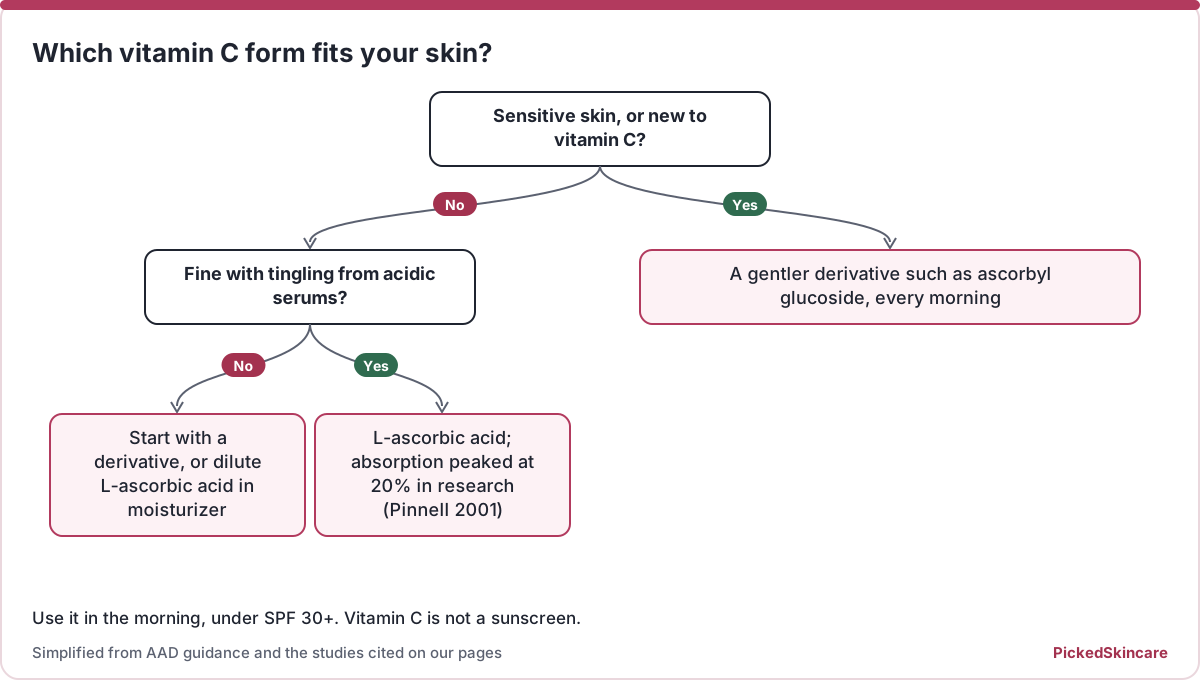
- Sensitive or new to vitamin C: a derivative such as ascorbyl glucoside. The Ordinary itself says direct vitamin C “may not be ideal for sensitive skin”.
- Oily, tolerant skin: L-ascorbic acid at 10% to 20%; above 20% there’s no added absorption per Pinnell[1].
- Dry skin: a water-free or oil-soluble format feels kinder; The Ordinary’s 23% suspension sits in squalane and esters.
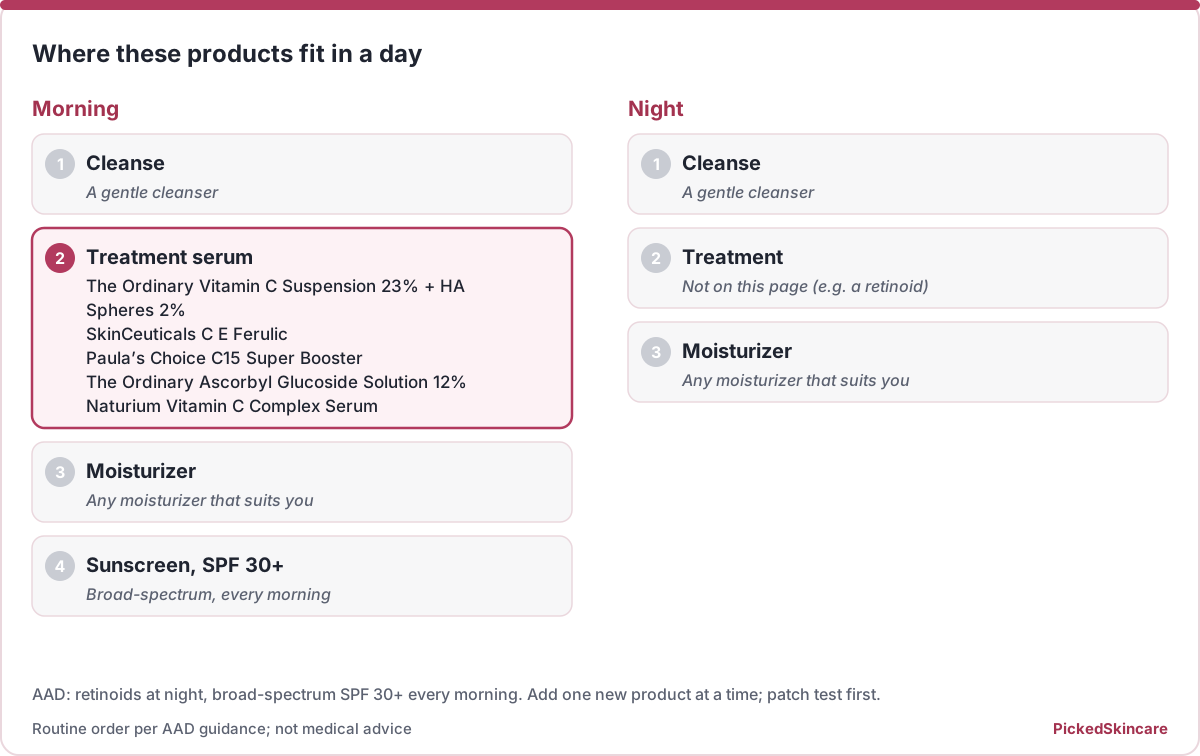
- Always: morning use under sunscreen, per the AAD’s[5] routine advice.
How can you tell a vitamin C serum has gone off?
L-ascorbic acid oxidizes with air, light and water. SkinCeuticals says C E Ferulic darkens over time and should be used within 3 to 6 months of opening; Paula’s Choice says C15 can range from clear to pale peach as it ages. A water-free formula, like The Ordinary’s 23% suspension, avoids water altogether, which the brand says keeps it stable.
Who should skip it?
- Sensitive skin starting with 20%+ L-ascorbic acid: The Ordinary warns tingling is expected with its 23% and that direct vitamin C may not suit sensitive skin. Consider instead: ascorbyl glucoside 12%.
- Paying for more than 20% L-ascorbic acid: Pinnell[1] et al. found absorption peaked at 20%.
- Expecting vitamin C to replace sunscreen: The AAD[5] routine places vitamin C under sunscreen, not instead of it.
How can you spend less?
The cheapest direct vitamin C we found is The Ordinary Vitamin C Suspension 23% at $8.10 for 30 ml. The gentlest cheap derivative is The Ordinary Ascorbyl Glucoside Solution 12% at $14.80.
What should you know before you start?
- Patch test first. The American Academy of Dermatology suggests applying a new product to a quarter-sized area twice a day for 7 to 10 days and stopping if you react. AAD: how to test skin care products.
- Add one new product at a time, and give it time: the AAD says many anti-aging products take 6 weeks to 3 months to show results. AAD: get the most from anti-aging products.
What do people ask most?
Which form of vitamin C is best?
What percentage of vitamin C should I use?
Why did my vitamin C serum turn orange?
Is ascorbyl glucoside as good as L-ascorbic acid?
Where this comes from
We opened and read every source below for this page. Ingredient lists, strengths, directions and prices come from each brand’s own product page; health and usage guidance comes from the American Academy of Dermatology, the FDA, the National Eczema Association and peer-reviewed studies (via PubMed). Prices checked: November 2026; confirm on the seller’s site before you buy.
- Pinnell et al. 2001, Dermatologic Surgery: Topical L-ascorbic acid percutaneous absorption (pubmed.ncbi.nlm.nih.gov)
- Lin et al. 2005, Journal of Investigative Dermatology: Ferulic acid stabilizes vitamins C and E (pubmed.ncbi.nlm.nih.gov)
- Al-Niaimi & Chiang 2017, Journal of Clinical and Aesthetic Dermatology: Topical vitamin C and the skin (pubmed.ncbi.nlm.nih.gov)
- The Ordinary (brand guide): Vitamin C in skincare, direct vs derivative forms (theordinary.com)
- AAD: Dermatologist-recommended skin care for your 20s (aad.org)
- The Ordinary (brand page): The Ordinary Vitamin C Suspension 23% + HA Spheres 2% (theordinary.com)
- The Ordinary (brand page): The Ordinary Ascorbyl Glucoside Solution 12% (theordinary.com)
- SkinCeuticals (brand page): SkinCeuticals C E Ferulic (skinceuticals.com)
- Paula’s Choice (brand page): Paula’s Choice C15 Super Booster (paulaschoice.com)
- Naturium (brand page): Naturium Vitamin C Complex Serum (naturium.com)
Related
The Ordinary Vitamin C Suspension 23% vs SkinCeuticals C E Ferulic
Both are pure L-ascorbic acid. The Ordinary suspends 23% in a water-free base for $8.10 and warns it tingles; SkinCeuticals pairs 15% with vitamin E and ferulic acid, the combination tested in a 2005 peer-reviewed study, at a much higher price.
comparisonThe Ordinary Ascorbyl Glucoside Solution 12% vs Vitamin C Suspension 23%
Same brand, opposite approaches. Ascorbyl Glucoside 12% is a water-based derivative the brand calls lower in irritation potential but less potent; Vitamin C Suspension 23% is pure L-ascorbic acid in a water-free base that the brand says will tingle.
guideNiacinamide vs vitamin C for dark spots: which should you try first?
Short answer: start with daily sunscreen (tinted, if you have a darker skin tone), then add one product. Niacinamide is the gentler first try with clearer clinical data on spots; L-ascorbic acid vitamin C is the stronger antioxidant but can sting.
guideCan you use niacinamide with vitamin C or retinol?
Short answer: niacinamide with retinol is widely accepted; even Paula’s Choice says they pair well. Niacinamide with vitamin C is where brands disagree, so the simple default is vitamin C in the morning and niacinamide or retinol at night.
comparisonLa Roche-Posay Anthelios Ultra Light Fluid SPF 60 vs EltaMD UV Clear SPF 46
Anthelios uses four chemical filters (avobenzone, homosalate, octisalate, octocrylene), is water resistant for 80 minutes and costs $35.99. UV Clear pairs zinc oxide 9% with octinoxate 7.5%, adds 5% niacinamide, is aimed at sensitive, rosacea- and acne-prone skin, isn’t water resistant and costs $46 for 1.7 oz.