Paula’s Choice C15 Super Booster vs SkinCeuticals C E Ferulic
Pick SkinCeuticals C E Ferulic if you want the exact 15% vitamin C + 1% vitamin E + 0.5% ferulic percentages from a 2005 published study. Pick Paula’s Choice C15 if you want a 15% L-ascorbic acid booster at a mid-range price, and you are fine that the brand names vitamin E and ferulic acid without stating those amounts.
Checked against brand ingredient lists on and against dermatology sources (American Academy of Dermatology, FDA, peer-reviewed studies). How we research · Editorial policy · 5 sources
Disclosure: PickedSkincare is reader-supported. Some “Check price” links are Amazon affiliate links. If you buy through them, we earn a commission at no extra cost to you. As an Amazon Associate, PickedSkincare earns from qualifying purchases. Commission never decides a pick, and we tell you when the cheaper bottle is the better buy. How we make money.
How this page was made: we compared what each brand publishes (actives, strengths, full ingredient lists, directions and prices) and checked the claims against dermatology guidance and published studies, all linked at the bottom. We opened both official product pages on November 15, 2026 (SkinCeuticals via a web fetch; curl is blocked). Paula’s Choice’s $59 price comes from the product page’s structured data; the full C15 ingredient list was not shown in the text we could read, and vitamin E and ferulic acid are named without percentages. SkinCeuticals did not clearly attach a standalone bottle price, and its full list was also not shown. We also read the Lin 2005 and Pinnell 2001 abstracts via NCBI. Brand pages checked November 15, 2026; prices checked November 2026. We haven’t tested these products hands-on, we don’t score or rate them, and a commission never decides a pick. Our methodology.
Not medical advice. This page compares cosmetic products. If you have a skin condition, use prescription treatment, or are pregnant or breastfeeding, ask a dermatologist or your doctor before starting something new.
Short answer
Choose Paula’s Choice C15 Super Booster ($59.00) if you want 15% L-ascorbic acid without the prestige price or you like a booster you can wear alone or mix into moisturizer. Choose SkinCeuticals C E Ferulic if you want the exact percentages used in the Lin 2005 study or the prestige price is acceptable.
Last updated Ingredient lists checked 2026-11-15Prices checked November 2026
Check Paula’s Choice C15 Super Booster price (opens in a new tab)Check SkinCeuticals C E Ferulic price (opens in a new tab)
The numbers side by side
| Paula’s Choice C15 Super Booster | SkinCeuticals C E Ferulic | |
|---|---|---|
| Price (brand site) | $59.00 | Check current price |
| Vitamin C | 15% ascorbic acid | L-ascorbic acid 15% |
| Vitamin E | Named; percentage not disclosed | Alpha tocopherol 1% |
| Ferulic acid | Named; percentage not disclosed | 0.5% |
| How the brand says to use it | Alone or mixed into a serum or non-SPF moisturizer | 4–5 drops in the morning before other products |
This is a closer match than a high-percentage suspension versus C E Ferulic. Both products use 15% pure vitamin C (ascorbic acid / L-ascorbic acid). What you are paying for, or giving up, is how completely the antioxidant supporting cast is specified.
Short answer: both are 15% L-ascorbic acid. The real gap is disclosure and price. SkinCeuticals prints 15% + 1% vitamin E + 0.5% ferulic acid, the combination Lin[3] and colleagues studied. Paula’s Choice C15 Super Booster also names vitamin E and ferulic acid as partners, but the official page we read does not give those percentages, and it costs less than the SkinCeuticals prestige price.
How do they differ, line by line?
| Paula’s Choice C15 Super Booster | SkinCeuticals C E Ferulic | |
|---|---|---|
| Price (brand site) | $59.00 | Check current price |
| Vitamin C | 15% ascorbic acid | L-ascorbic acid 15% |
| Vitamin E | Named; percentage not disclosed | Alpha tocopherol 1% |
| Ferulic acid | Named; percentage not disclosed | 0.5% |
| How the brand says to use it | Alone or mixed into a serum or non-SPF moisturizer | 4–5 drops in the morning before other products |
| After opening | Color may run clear to pale peach or amber; store cool and dark | Use within 3–6 months; darkening is normal |
| Full ingredient list on the page we read | Not shown | Not shown |
What does each do well, and where does it fall short?
Paula’s Choice C15 Super Booster: pros
- Same stated 15% vitamin C strength as C E Ferulic
- Mid-range official price
- Brand says it can be used with niacinamide, alone or mixed into a moisturizer
Paula’s Choice C15 Super Booster: cons
- Vitamin E and ferulic percentages are not disclosed
- Full ingredient list was not shown in the page text we could read
- Still an acidic L-ascorbic acid formula
SkinCeuticals C E Ferulic: pros
- States the 15% + 1% + 0.5% combination from Lin et al. (2005)
- Fragrance-free, paraben-free and alcohol-free, per the brand
- Every named antioxidant percentage is disclosed
SkinCeuticals C E Ferulic: cons
- Far more expensive
- Full ingredient list was not shown in the page text we could read
- Finish within 3–6 months of opening
Which one fits your skin?
If you want the studied ratios in print, buy SkinCeuticals. If you want 15% L-ascorbic acid with vitamin E and ferulic acid named on the page, at a mid-range price, C15 is the reasonable pick — with the caveat that you cannot check those two supporting percentages. Neither is the gentlest way to start vitamin C.
Pick Paula’s Choice C15 Super Booster if…
- you want 15% L-ascorbic acid without the prestige price
- you like a booster you can wear alone or mix into moisturizer
- you accept undisclosed E and ferulic percentages
Pick SkinCeuticals C E Ferulic if…
- you want the exact percentages used in the Lin 2005 study
- the prestige price is acceptable
- you want every named antioxidant strength printed on the brand page
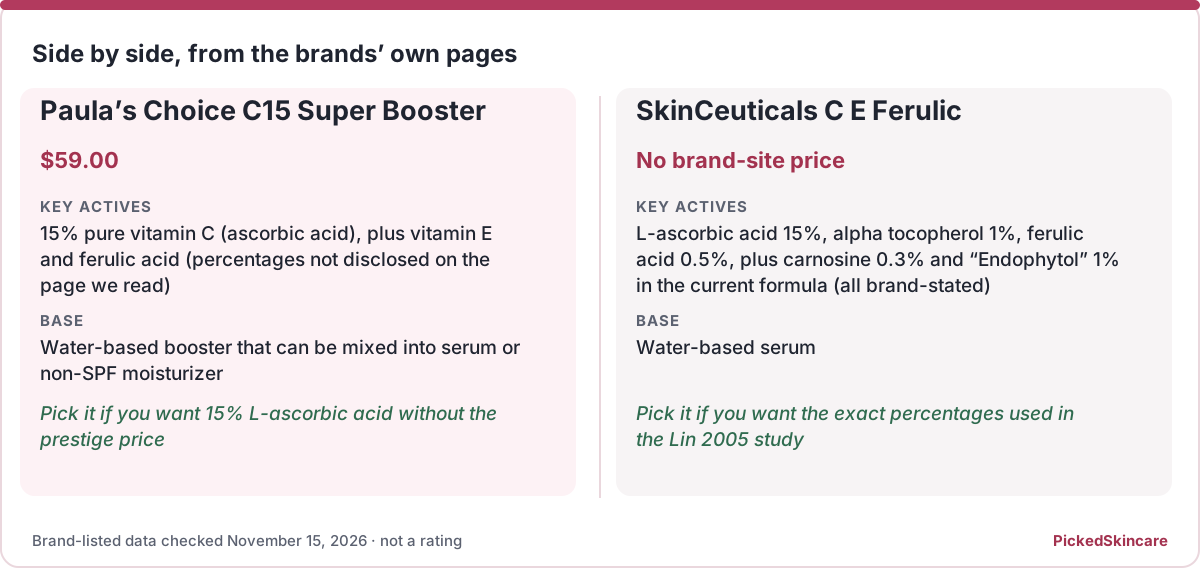
What’s in each bottle?
Copied from each brand’s own product page (or the sunscreen’s Drug Facts) on November 15, 2026. Brands reformulate, so the carton in your hand is the final word.
Paula’s Choice C15 Super Booster
- Key actives
- 15% pure vitamin C (ascorbic acid), plus vitamin E and ferulic acid (percentages not disclosed on the page we read)
- Base
- Water-based booster that can be mixed into serum or non-SPF moisturizer
- Brand price
- $59.00
- Brand notes
- Brand FAQ: can be used alone or mixed into a serum or non-SPF moisturizer, and in the same routine as niacinamide; color can range from clear to pale peach or amber; store in a cool, dark place.
Full ingredient list
Full list not shown in the page text we could read; see the brand page.
Paula’s Choice product page · Check price on Amazon (opens in a new tab)
SkinCeuticals C E Ferulic
- Key actives
- L-ascorbic acid 15%, alpha tocopherol 1%, ferulic acid 0.5%, plus carnosine 0.3% and “Endophytol” 1% in the current formula (all brand-stated)
- Base
- Water-based serum
- Brand price
- Not sold on the brand site; check a retailer
- Brand notes
- Brand: fragrance-free, paraben-free, alcohol-free; darkens with air and light; use within 3–6 months of opening.
Full ingredient list
Full list not shown in the page text we could read; see the brand page.
SkinCeuticals product page · Check price on Amazon (opens in a new tab)
If both are 15% vitamin C, what is the real difference?
The stated vitamin C strength is the same. SkinCeuticals also states 1% alpha tocopherol and 0.5% ferulic acid, plus 0.3% carnosine and 1% Endophytol in the current formula. That 15% + 1% + 0.5% trio is the combination Lin[3] and colleagues (2005) tested: adding 0.5% ferulic acid improved the chemical stability of the vitamins and doubled photoprotection against simulated sunlight in skin, from about 4-fold to about 8-fold, measured by redness and sunburn cells. It was a lab and skin-sample study, not a wrinkle trial of these two bottles, and it is not a sunscreen.
Paula’s Choice describes ferulic acid and vitamin E as partners that help stabilize vitamin C, but the official page we read does not say how much of either is in C15. Pinnell[4] et al. (2001) found L-ascorbic acid absorption peaked at 20% and needed a pH below 3.5; both of these serums sit at 15%, and neither page published a pH.
Which one suits your skin type?
- Tolerant skin, mid-range budget: C15 Super Booster.
- Want the studied ratios in print: SkinCeuticals C E Ferulic.
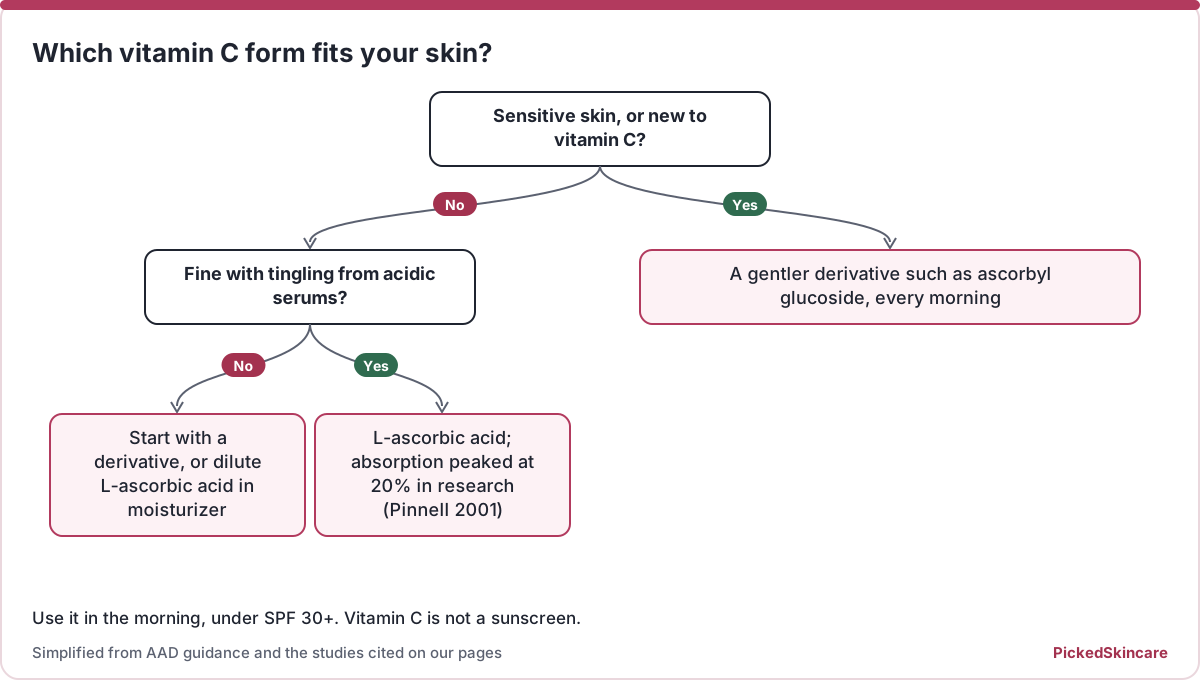
- Sensitive skin: neither first. See a gentler derivative.
Who should skip it?
- Sensitive skin, or skin that looks red or flushed easily: Both are acidic 15% L-ascorbic acid serums and may sting. Consider instead: a vitamin C derivative such as ascorbyl glucoside.
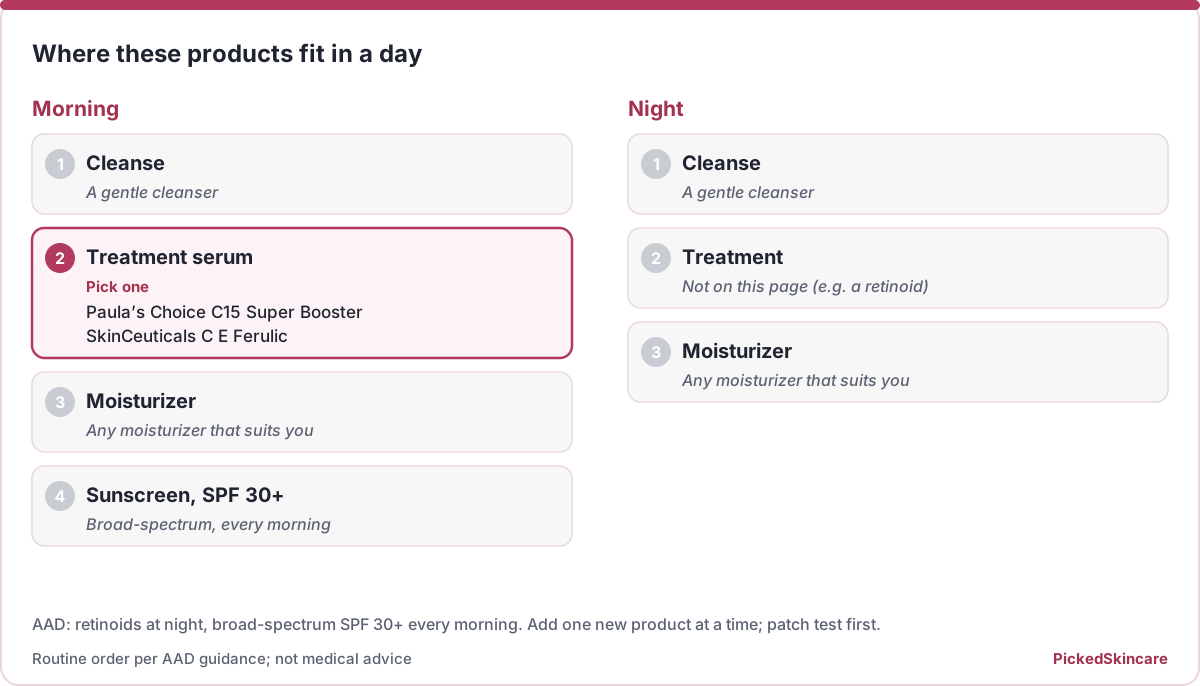
- Anyone using either serum instead of sunscreen: The Lin[3] study measured a boost to skin’s defenses, not sunscreen-level protection. The AAD’s[5] 20s guide puts vitamin C in the morning, then sunscreen.
- Shoppers who need a complete ingredient list before they buy: Neither official page we read showed the full list in the text we could extract.
How can you spend less?
Paula’s Choice C15 Super Booster is about $59 (checked November 15, 2026). SkinCeuticals did not clearly show a bottle price in the text we could read. A cheaper L-ascorbic acid option with vitamin E and ferulic acid named on the label is Timeless 20%, which also does not disclose those two supporting percentages.
What should you know before you start?
- Patch test first. The American Academy of Dermatology suggests applying a new product to a quarter-sized area twice a day for 7 to 10 days and stopping if you react. AAD: how to test skin care products.
- Add one new product at a time, and give it time: the AAD says many anti-aging products take 6 weeks to 3 months to show results. AAD: get the most from anti-aging products.
What do people ask most?
Is C15 a dupe for C E Ferulic?
Can I use C15 with niacinamide?
Why is my C15 darker than when I bought it?
Morning or night?
Where this comes from
We opened and read every source below for this page. Ingredient lists, strengths, directions and prices come from each brand’s own product page; health and usage guidance comes from the American Academy of Dermatology, the FDA, the National Eczema Association and peer-reviewed studies (via PubMed). Prices checked: November 2026; confirm on the seller’s site before you buy.
- Paula’s Choice (brand page): Paula’s Choice C15 Super Booster (paulaschoice.com)
- SkinCeuticals (brand page): SkinCeuticals C E Ferulic (skinceuticals.com)
- Lin et al. 2005, Journal of Investigative Dermatology: Ferulic acid stabilizes vitamins C and E (pubmed.ncbi.nlm.nih.gov)
- Pinnell et al. 2001, Dermatologic Surgery: Topical L-ascorbic acid percutaneous absorption (pubmed.ncbi.nlm.nih.gov)
- AAD: Dermatologist-recommended skin care for your 20s (aad.org)
Related
The Ordinary Vitamin C Suspension 23% vs SkinCeuticals C E Ferulic
Both are pure L-ascorbic acid. The Ordinary suspends 23% in a water-free base and warns it tingles; SkinCeuticals pairs 15% with vitamin E and ferulic acid, the combination tested in a 2005 peer-reviewed study, at a much higher price.
comparisonTimeless 20% Vitamin C + E Ferulic vs SkinCeuticals C E Ferulic
Pick SkinCeuticals C E Ferulic if you want the exact 15% vitamin C + 1% vitamin E + 0.5% ferulic combination used in a 2005 published study and will pay the prestige price. Pick Timeless if you want a stated 20% L-ascorbic acid with vitamin E and ferulic on the label at a much lower price, and you can live without published percentages for E and ferulic.
guideVitamin C forms explained: L-ascorbic acid vs the derivatives
Short answer: L-ascorbic acid is the form with the most research, but it only gets into skin from a very acidic formula and it oxidizes easily. Derivatives such as ascorbyl glucoside are steadier and gentler, with weaker evidence. Sensitive skin should usually start with a derivative.
comparisonThe Ordinary Ascorbyl Glucoside Solution 12% vs Vitamin C Suspension 23%
Same brand, opposite approaches. Ascorbyl Glucoside 12% is a water-based derivative the brand calls lower in irritation potential but less potent; Vitamin C Suspension 23% is pure L-ascorbic acid in a water-free base that the brand says will tingle.
guideCan you use niacinamide with vitamin C or retinol?
Short answer: niacinamide with retinol is widely accepted; even Paula’s Choice says they pair well. Niacinamide with vitamin C is where brands disagree, so the simple default is vitamin C in the morning and niacinamide or retinol at night.
guideVitamin C for sensitive skin: which bottle to start with
If vitamin C serums sting, start with The Ordinary Ascorbyl Glucoside Solution 12%. The label lists that derivative and does not list L-ascorbic acid. Naturium’s Vitamin C Complex is a later try because it still lists ascorbic acid. Paula’s Choice C15 is 15% ascorbic acid, so leave it until a gentler vitamin C has been comfortable.